Becoming Manic: What You Can Do

http://joemacgown.deviantart.com/

Top tips for coping

These are a list of things that people who have difficulties when they become high or manic have found helpful:

  • Try to get some sleep. Going without sleep has been shown to cause manic states and make them last longer.
  • Eat well. Don’t go without food or eat high energy food. Eat slowly.
  • Use relaxation techniques.  Quiet prayer works well right now.
  • Stay in bed even though you feel compelled to do lots of things.
  • Don’t act on your ideas. In a few days time you may see things completely differently.  Emailing friends now is dangerous. (I know).
  • Don’t buy anything expensive. Some people have found it helpful to give their credit cards/check book to friends.  (I tried to buy a 7 foot potted tree in London, UK once, because it was lonely.)
  • Use medication, herbal remedies, or other things that slow you down and/or help you sleep.  Think “speed bumps”.
  • Take relaxing (rather than high energy) exercise e.g. walking, swimming.  This is a must-do.
  • Make a plan for each day and keep to it. Don’t plan to do too much.
  • Try to do things slowly rather than quickly. Talk and walk consciously slower than you feel driven to.
  • Challenge any grandiose ideas you might have about yourself.  You must do this!
  • Reduce any pressures or stresses on you.
  • Cut out stimulants e.g. coffee, sugar, chocolate, fizzy drinks, alcohol. Some anti-depressants (e.g. the SSRIs like Prozac) can have stimulant-like effects – discuss this with your doctor and consider stopping them.

It may be helpful for you to make a plan about what to do before you get really elevated. You know yourself best, so build as many things into the plan that you feel will help you not do things you may later regret. It may be helpful to draw up a plan, and a list of ‘warning signs’, with a trusted friend or mental health professional at a time when you are not ‘high’, but that can be put into place as you or others notice your warning signs.

Some people believe that ‘getting manic’ is a response to not thinking about or facing things that might be quite frightening or depressing. It might be helpful to ‘get connected’ to such things, by talking and thinking about your life and some of the root causes of some unhappiness in your life. You could do this with a trusted friend or mental health professional.


cropped-christiangraffiti1 (3)

Don’t Be Scared: Psalm 143

Psalm 143:

A Prayer Not to Be Killed, or Something Worse

 A psalm of David.

 1 Lord, hear my prayer;
listen to my cry for mercy.
Answer me
because you are loyal and good.
 

The writer stressing the truth that God listens.  A listening God is a God of wonder.  Elijah on Mt. Carmel had focused the people on a hearing God who was the real God.  The psalmist here reveals his trust in the inherent goodness of God.   He listens, He never ever puts His phone on call-forwarding.

2 Don’t judge me, your servant,
       because no one alive is right before you.

We are all in the same boat– we are sinners.  The writer doesn’t need to be convinced of this.  All he can do is appeal to God. He knows his place though–a servant of the Lord.  He understands that he is what he is.  (He accepts what is real, and doesn’t try to pretend otherwise. Some will try to ‘fake it.’)

3 My enemies are chasing me;
       they crushed me to the ground.
    They made me live in darkness
       like those long dead.
 4 I am afraid;
       my courage is gone.

We all have enemies.  They are the satanic evil spirits that are the wholesalers of evil, and its devices, and they mean to harm us.  The writer feels the pursuit, and these sinister antagonists get close enough to strike at him.  He confesses fear.   His life has been far too influenced by their dark ministry.  He is being pressed to the point of being overwhelmed.

  5 I remember what happened long ago;
I consider everything you have done.
I think about all you have made.
6 I lift my hands to you in prayer.
As a dry land needs rain, I thirst for you.  Selah

The psalmist has a spiritual history to ponder.  He thinks of all the past events and draws out his strength.  The Father has led us through all of them. God ‘remembers’ in the truest sense of the word.  Verse 6 declares his proper response to v. 5.  David’s hands reach up; he imagines himself to be a desert–dry and desolate.

 7 Lord, answer me quickly,
       because I am getting weak.
    Don’t turn away from me,
       or I will be like those who are dead.
 

The writer has evaluated his situation, he is weak and he is dying. His spiritual pulse is “weak and thready.”  This seems to be a deteriorating condition.  He is discerning enough however to draw conclusions.  Doctors tell us that hearing is the last faculty to depart a dying man.  Perhaps to a spiritual man discernment is the last to go.  Somehow we know what the truth is until we are completely senile (spiritually, that is).

 8 Tell me in the morning about your love,
       because I trust you.
    Show me what I should do,
       because my prayers go up to you.

The writer affirms his personal connections to the Lord.  Love should be an intimate word, saturated with hope and a future.  This love comes as a result of trust/faith (the word, “because” is key).  The psalmist requests help for his particular situation.  He sees his prayers, like arrows reaching heaven.

 9 Lord, save me from my enemies;
       I hide in you.
 10 Teach me to do what you want,
       because you are my God.
    Let your good Spirit
       lead me on level ground.

Save me…teach me…lead me.  A ‘triune aspect’ of the Spirit’s work.  Each believer can realize this ministry.  He is like a bodyguard, a tutor, and a professional guide to each of us.  Verse 10: “level ground”; nothing is harder on a tired soldier then marching on hilly terrain.  Flat and level is the best, and its not wrong to ask for an easier path.   Sometimes we stumble because we haven’t asked for level ground.

11 Lord, let me live
so people will praise you.
In your goodness
save me from my troubles.
12 In your love defeat my enemies.
Destroy all those who trouble me,
because I am your servant.
    

This should be the cry of the Christian heart–let me be an example that will lead others to worship.  Let me be a reason to them to sing, and give you glory.  Notice that God’s goodness is specifically pointed out to be the starting point for salvation. “Since He is good, I will be saved”.  In verse 12 we are reminded that out of that matrix of love, God can conquer.  “God so loved the world”…John 3:16.  Love is the reason, and not just a vague, general sense of love but a love that rolls up its sleeves and jumps in and pounds my enemies.

 Text taken from New Century Version (NCV) The Holy Bible, New Century Version®. Copyright © 2005 by Thomas Nelson, Inc.

If this post has been a blessing to you, and you would like me to do more of this, won’t you let me know.  Thanks!

1brobry-sig


Healing the Wound of Rejection — by Jonathan Coe


When a child is born into the world, often the first face they see is a doctor or nurse followed by their mother and father. Then in their early years and all the years before they leave home, they will see their parents’ faces probably more than anyone else. Single–parent homes will add a different dynamic to this experience.

Over the years their parents’ faces will communicate different emotions to them. In an emotionally healthy family, lots of love, acceptance, sense of belonging, respect, and appreciation will be communicated. In an unhealthy family, just the opposite, or a confusing mixture of false and true messages, will be communicated and will leave the child with the wound of rejection.

The wound of rejection has to be one of the most difficult wounds to heal. It occurs not only in parent–child relationships, but also in husband–wife, sibling, peer, employer–employee, and  priest/pastor–flock relationships. It cuts deep because it communicates to the person not that they are doing something wrong, but that there is something wrong with them.

The face they see in their mind’s eye tells them that they are defective, second-rate, not good enough, and unlovable. For many this face, and its false messages will plague them the rest of their lives.

It would be foolish for me to try to pretend to solve a complex problem like this in one blog post. However, it is not foolish for someone like me, who has also felt the sting of rejection, to try to provide a helpful beginning.

For starters, one thing that helped me was to realize that the person(s) who rejected me didn’t reject me because I was inherently unlovable; they rejected me because they didn’t have the wherewithal, inner resources, or ability to love me like I needed to be loved. It wasn’t about me; it was about them. Embracing this truth, for many people, can be the beginning of healing.

Another thing that helped me was contemplative prayer. Now when many people hear the words “contemplative prayer,” they feel intimidated and think that such a thing must be reserved only for mystics, monks, and very holy people. That’s not true. Contemplative prayer is for everybody.

When St. John Vianney entered his church and found an old farmer praying, he asked him what he was doing and the peasant told him, “I look at him and he looks at me.” That’s contemplative prayer. St. Teresa of Avila said that “Contemplative prayer, in my opinion, is nothing else than a close sharing between friends.”

We see the face of Jesus and he sees us and there is an intimate exchange. Contemplative prayer is helpful for the person who is wounded by rejection because they replace the face of the person(s) who has/have wounded them and  their false messages with the face of Christ and his true messages about you. So the main question for us as we read this is “Whose face are we looking at?” 

I hope that it’s the face that I see in Zephaniah 3:16 and 17. Please remember that what is said in this passage to Israel under the old covenant is even more true to us today under a better covenant and one greater than Moses (Jesus):

“On that day they will say to Jerusalem, ‘Do not fear, O Zion; do not let your hands hang limp. The Lord your God is with you, he is mighty to save. He will take great delight in you, he will quiet you with his love, he will rejoice over you with singing.'”

God is singing. Why? Because he is rejoicing and delighting over us with an overflowing, super–abundant love. This is the face of Christ that should replace the other faces that we constantly see that have given us the wound of rejection.

Additional to this, it’s also important to have friends and family that become the face of Christ to us or what a psychologist friend of mine called “Jesus with skin on.” With all these things in place we can truly shout from the rooftops, “Let the healing begin!”

ybic, Jonathan


If you like this post from Jonathan Coe, you may also like his new book, Letters from Fawn Creek, that now can be purchased at this link:

https://www.tatepublishing.com/bookstore/book.php?w=9781628542035

Letters from Fawn Creek

cover art/photo: http://www.adventistonline.com

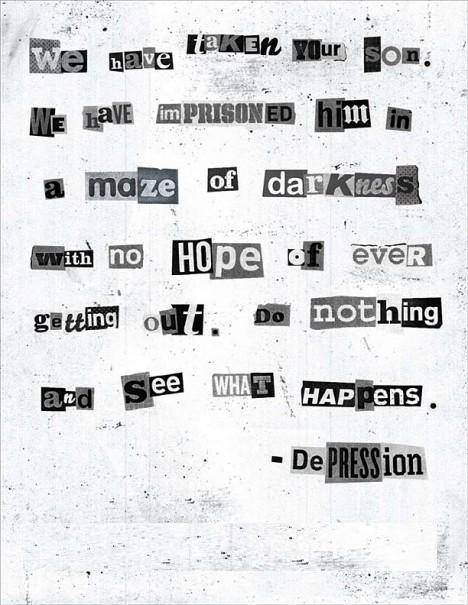
The Ransom Note

depression-note

“We collapse in the dust,
    lying face down in the dirt.
26 Rise up! Help us!
    Ransom us because of your unfailing love.”

Psalm 44:25-26, NLT

“For even the Son of Man came not to be served but to serve others and to give his life as a ransom for many.”

Mark 10:45

“God chose him as your ransom long before the world began, but he has now revealed him to you in these last days.”

1 Peter 1:20

I think that God has more or less ransacked the human language in His effort to get through to us the critical nature of what exactly has been done just for us. When it comes to our salvation and what that means to the universe, the word, “ransom” is used.

The connection for us, as we consider the implications, has mainly a connection with the crime of “kidnapping.” This is when someone is captured by other men, and held in captivity until certain terms are met. When the kidnapper feels his needs are fully met, then the hostage is released.

In the Bible sense, we should work through several verses. There are at least three Hebrew words. In the N.T. Greek just a single word to explain “ransom” is seen. And yet we can say, each word is linked back to the idea of being “helpless.” And helpless is far more than a definition, rather it is a description of a “state of being.”

We come to understand that helplessness is the natural state of human beings. We each have been captured, taken away and are being held, until terms are met for our release. I suppose that some see this helplessness easier than others. (And I’m sure a few will never acknowledge it at all). But nevertheless, it is real and it describes every single person that has ever lived.

Being completely helpless is hardly a situation we would ever choose. Having ransom demands being made to set us free is mostly awkward. And it’s an affront. Perhaps, we feel we are worth more? But the issues here are eternal, and currency concepts are never the consideration.

But there is a present need, to purchase back those who are being held as captives. The absolute clear position is that the Lord Jesus Christ, died in our place. Choosing to die for us, he was essentially tortured before his cruel death. In this decision, he himself paid my ransom. In doing this, I was set free and fully able to return home.

There are many who have been free. But there is a thing called “the Stockholm Syndrome.” This refers to those in captivity who somehow “connect” with their kidnappers through a prolonged captivity. This is to the point where they begin to act less than the victims, and more like the captor. It is confusing. They seem to go out of their way to act “pro-kidnapper”. This can get very disturbing.

We must look to our children, and closest family and our friends. They are toiling for Satan, the captor of our souls (past-tense). Many different tactics are being used– depression, addictions, lust, greed, anger, gluttony, pride, guilt and many other deceitful things. They are being held, until faith (the key) “springs” them out of their prison.

Thank you Jesus, for coming to free us. Thank you for forgiving us. We have been released, and now walk away free. You died, so we might live. We desperately want to see the others we love set free.

*

ybic, Bryan


cropped-christiangraffiti1 (3)

*