Man on Fire

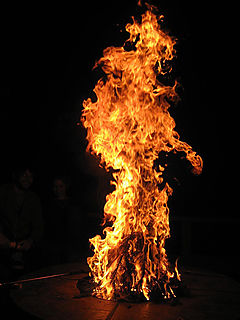
man-on-fireOne morning in January 1984 I set myself on fire. I was in my cabin up on the ridge and I was trying to build a fire. Alaska can be a cold place. I had also started a coffee pot and because it was so cold I opened up the oven door a couple of inches to get some heat.

The oven started getting the place warm, and I gratefully backed up my butt to it. That is when it happened. My sweater ignited from the front burner. At first I didn’t realize that I was on fire, but when the flames started spreading over my head I panicked.

I couldn’t put it out! I dropped to the floor and tried to roll. All that seemed to do is embed that burning sweater into my back, and set the carpet on fire. I ran to the bathroom with the idea of getting under the shower. Somehow I knew that was my only hope.

Needless to say I ended up in the local hospital with second and third degree burns on most of my back. It took months to recover and I still have the scars. It was something that changed my life.

Ironically, I had been thinking of a verse in Hebrews just the night before. I wondered what it meant.

He makes his angels spirits, and his servants flames of fire.”

Hebrews 1:7

 As I healed I prayed for understanding. Why did the Lord allow this to me? I was in my third year at a Bible college and had given my life over for the Gospel. Why did this happen to me?

I’ve never gotten a complete answer from the Lord, but it did confirm my call into the ministry. It also made me aware of the precariousness of our lives. It taught me to appreciate life.

The doctor told me that if I had run outside instead of staying inside I could have died. God preserved me for His own purposes. We have no way of knowing “our time.”

“And we know that in all things God works for the good of those who love him, who have been called according to his purpose.”

Romans 8:28

bry-signat-1

cropped-christiangraffiti1 (2)

An Armored Response

tank-wallpapers-8

When the Holy Spirit talks we listen. What He shares is usually pretty relevant, and typically mandates our action. He is into change, and guides us into Christlikeness.

In my prayer time I saw a man climbing into the turret of a tank. He was sheltered there, protected by the tank’s armor. He seemed to be discovering the capabilities of the tank. He slowly began to grasp the potential of it, and soon began to turn the massive gun. He played around, not so much as a soldier, but as a child would. It was fun to spin the turret around. He could go places on its tracks. He could run over trees.

But slowly he realized that this was much more than a shelter, but it was an offense weapon as well. The tank could be quite formidable, as well as safe and secure. Surrounded by the armor, he at last began to understand exactly what this tank was capable of, and his role as driver/gunner. Using the gun, he could go up against enemy strongholds.

We come into a certain maturity when we begin to obey. God-given tasks become a joy. We start to see not just the defensive perspective, but the offensive as well. God’s ability is given to anyone who asks. His power can’t be diminished. He alone is the force to be reckoned with.

We are often stunted by our vision, we simply don’t grasp the enormity of what has been given to us.

I also pray that you will understand the incredible greatness of God’s power for us who believe him. This is the same mighty power that raised Christ from the dead,”

Ephesians 1:18-19

“For the Kingdom of God is not just a lot of talk; it is living by God’s power.”

1 Corinthians 4:20

1brobry-sig4

cropped-christiangraffiti1 (1)

Tricycle Theology, Psalm 106:1-5

tricycle
Johnny’s new trike

A Psalm Study

Psalm 106:1-5, New Living Translation (NLT)

Praise the Lord!

Give thanks to the Lord, for he is good!
    His faithful love endures forever.
Who can list the glorious miracles of the Lord?
    Who can ever praise him enough?
There is joy for those who deal justly with others
    and always do what is right.

Remember me, Lord, when you show favor to your people;
    come near and rescue me.
Let me share in the prosperity of your chosen ones.
    Let me rejoice in the joy of your people;
    let me praise you with those who are your heritage.

These five verses cap a “Psalm of Rebellion,” tragically found in part two of this psalm (vv. 6-46.)  This work dates to ‘post-exile’ times, and Daniel is believed to have written it. Nehemiah himself quotes from it as he intercedes for the nation upon Israel’s return from captivity.

But these five verses are very different from the rest of the Psalm. They ably serve as a positive introduction to some pretty depressing stuff. I like these first five, they carry a refreshing quality about them. I read them and I’m happy I did.

V. 1, Thanksgiving is to be a normal part of the believer’s life. Imagine little Johnny. He is celebrating his sixth birthday today. His uncle has brought over a gift—a bright red tricycle, with ribbons out of the handlebars! Johnny is estatic, he can’t believe it. Mom steps in and says to him, “What do you say, Johnny?” Johnny thinks. “Thank you, Uncle Ed. This is what I’ve wanted my whole life.”

If the truth be told, Johnny’s response to his uncle’s perfect gift is much like the believer’s response to God. “What do you say, Johnny?” Johnny’s mom would say— and that is what the little guy did. We are to also give thanks. To do is an easy thing, and perhaps does more for us than our Father in heaven.

V.2, “Who can ever praise him enough?” Excessive displays of affection are ‘nothing to roll your eyes at.’ Some wag defined a fanatic as “someone who loves Jesus more than you do.”

V. 3, is an observation by Daniel about the joy available to us if we will only work-out our issues of obedience. This verse might seem out of place, but I assure you its not. It fits in well with vv. 6-46.

V. 4, Remember me, Lord,” contains the desire to be included in the grace that will follow. We should let our heavenly Father know that we want to be part of what He is doing.

V. 5, “Let me” is repeated three times. This phrase is critical to the believer’s walk; it is a statement of submission combined with desire. The writer is asking ‘permission’ from God to become part of the aspects of His kingdom. Matthew 7 gives us the principle that God is looking for. So ask.

8 “For everyone who asks, receives. Everyone who seeks, finds. And to everyone who knocks, the door will be opened.”

Matthew 7:8

bry-signat (1)

cropped-christiangraffiti1.jpg