Version Choices, [Your Bible]

types-of-bible-translations


  • Word-for-word is a literal translation from the original languages.
  • Thought-for-thought is considering context in English to translate.
  • Paraphrase is meant to convey a throughly modern language translation.

What are you looking for in your Bible? Personally I use an ESV, but I also like the NLT. I have used almost every translation listed above, but no matter what you use you should read it. You might have what you believe is the “best” translation known to man, but if you don’t read it you’ll be sorely mistaken.

___________________________

 “All Scripture is breathed out by God and profitable for teaching, for reproof, for correction, and for training in righteousness,”

2 Timothy 3:16, ESV

“Odd, the way the less the Bible is read the more it is translated.”

  –C.S. Lewis

“A readiness to believe every promise implicitly, to obey every command unhesitatingly, to stand perfect and complete in all the will of God, is the only true spirit of Bible study.”

 — Andrew Murray

“The Word of God well understood and religiously obeyed is the shortest route to spiritual perfection. And we must not select a few favorite passages to the exclusion of others. Nothing less than a whole Bible can make a whole Christian.”

–A.W. Tozer

“Where one man reads the Bible, a hundred read you and me.”

  –D.L. Moody

1brobry-sig4

cropped-christiangraffiti1 (1)

Is Mania A Spiritual Experience? [Bipolar]

by Chris Cole

I was eighteen years old when I first experienced acute manic psychosis. I had just arrived at the University of Georgia for my freshman fall semester when I suddenly had what seemed like a profound spiritual awakening. I felt as if I was waking up from a bad dream, as if my mind and body were merely figments of my imagination. I felt an incredible transcendence and oneness with the universe, an experience I could only fathom to be spiritual. Back then, I didn’t know anything about bipolar disorder.

My first thought upon being struck with this overwhelmingly blissful state was, “This is what God feels like; I must be Jesus!” It was from there that I began my deluded descent into madness. I ran upstairs in my dormitory, assuming that my friends would be my first disciples, and tried to perform miracles to prove my divinity. When they attempted to calm me down, I punched one of them in the face, calling him the devil, and ran back downstairs. Campus police promptly met me in the dorm lobby and arrested me on the spot.

On my way to jail, I was no longer feeling so ecstatic. In fact, it was the most excruciating fear I had ever experienced. I began believing that the police officers were the Pharisees taking me to my crucifixion. They placed me in my own jail cell, and I began stripping off my clothes, demanding for the officers to come look at my naked body. Throughout the whole experience, I felt almost completely dissociated, as if I was watching a movie of myself with little to no control of the actor.

After a few days of trying to convince my parents that I was returning humanity to the Garden of Eden, they realized my condition might not be from taking psychedelic drugs as they had thought. I was escorted to my local psychiatric hospital, and once medicated, came down from my messianic mission to create heaven on earth. The only problem was, I had never been more certain of God in my life, and the clinicians just kept telling me that it was normal for grandiose delusions to take on religious and spiritual themes. I was not convinced.

My thoughts immediately went to the biblical stories I grew up with: how God tested Abraham’s faith when he was told to sacrifice his son, and how God communicated to Moses through a burning bush. Were these not examples of delusions and hallucinations? Even Jesus was convinced to be the Son of God. Were the holy men of the Bible bipolar? I had a lot of questions, and my questions seemed to be forcing me to choose one side or the other—either spirituality or psychiatry.

It took me about a decade to finally integrate both truths and find some peace around my manic episodes. I studied spirituality and psychology, and I came to the conclusion that bipolar disorder and spiritual experiences didn’t need to exist in opposition. I’ve come to some basic definition of spirituality as the transcendence of ego. In this sense, mania was indeed a spiritual experience, albeit an unmanageable one. This didn’t mean my bipolar diagnosis was bogus, and I’m not saying all psychotic episodes are spiritual. But I can now rest easy knowing that my experiences were both spiritual and bipolar.

If I’m honest with myself, a major sign of my mania is increased spirituality, but at the same time, a major sign of my depression is a lack of spiritual significance. Finding balance in recovery means that I am able to seek both spiritual and clinical solutions to my bipolar symptoms without fear that I am falling out of grace with God. When I was first diagnosed, I had the idea that either bipolar existed or God existed. There was no space for both.

My spirituality has necessarily evolved over the years. Because of my history with manic psychosis, I have to guard myself against dogmatic or superstitious beliefs. I try my best to live a life of love, and I rest assured knowing that the more kindness I spread to the world, the more aligned I am with my spiritual path. Telling my story of recovery has become part of this spiritual process. My faith means a great deal to my health, and without it, my recovery wouldn’t be as strong as it is today. I hope that by sharing my story, others going through the same difficulties might not take so long to make sense of their own experiences.

____________________________

Chris Cole has authored a book recounting his experiences, and he’s now a life coach for folks in recovery.

Source: http://www.ibpf.org/blog/mania-spiritual-experience

cropped-cropped-christiangraffiti1.jpg

What is it for you to be a Christian? –J.R. Miller

What is it for you to be a Christian?

We ought to seek to gather in this world — treasure that we can carry with us through death’s gates, and into the eternal world. We should strive to build into our lives — qualities that shall endure. Men slave and work to get a little money, or to obtain honor, or power, or to win an earthly crown — but when they pass into the great vast forever, they take nothing of all this with them!

Yet there are things — virtues, fruits of character, graces — which men do carry with them out of this world. What a man IS — he carries with him into the eternal world. Money and rank and pleasures and earthly gains — he leaves behind him; but his character, he takes with him into eternity!

This suggests at once, the importance of character and character-building.

Character is not what a man professes to be — but what he really IS, as God sees him.

A man may not be as good as his reputation. A good reputation may hide an evil heart and life. Reputation is not character. Reputation is what a man’s neighbors and friends think of him; character is what the man IS.

Christ’s character is the model, the ideal, for every Christian life. We are to be altogether like Him; therefore all of life’s aiming and striving should be towards Christ’s blessed beauty. His image we find in the Gospels. We can look at it every day. We can study it in its details, as we follow our Lord in His life among men, in all the variations of experience through which He passed.

A little Christian girl was asked the question,What is it for you to be a Christian?

She answered, “It is to do as Jesus would do, and behave as He would behave — if He were a little girl and lived at our house.”

No better answer could have been given. And there is scarcely any experience of life — for which we cannot find something in Christ’s life to instruct us. We can find the traits and qualities of His life, as they shine out in His contact . . .
with temptation,
with enmity,
with wrong,
with pain,
with sorrow.

The next thing, when we have the vision of Christ before us, is to get it implanted into our own life. We cannot merely dream ourselves into godly manhood or womanhood; we must forge for ourselves, with sweat and anguish, the beautiful visions of Christ-likeness which we find on the Gospel pages! It will cost us self-discipline, oftentimes anguish, as we must deny ourselves, and cut off the things we love. SELF must be crucified.

It is not easy to become a godly man, a Christlike man.

–J.R. Miller, (1840-1912)


cropped-christiangraffiti1-3-1

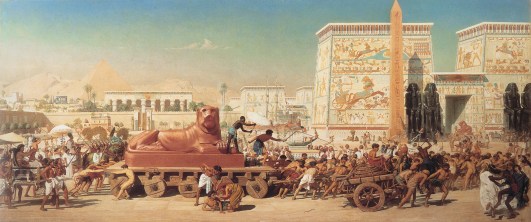
So You Wanna Go Back to Egypt?


1867_edward_poynter_-_israel_in_egypt

God has always wanted to lead His people. I think that He is almost catatonic with joy when we allow Him to do this. Throughout the ages, and all through Israel’s history, we see Him reaching out to people,  who are stubborn and selfish in their choices. But He reaches out to them anyway.

Israel had been sovereignly led out of Egypt. Miracle after miracle had made this happen. A dramatic exodus from slavery would make the front page that day. People from every generation would know that God was setting His people free.

God didn’t tell them the way, but rather showed them the path Himself. He led them with “a cloud by day and a pillar of fire by night” (Exodus 13:20-22). The people, however, repeatedly refused to trust their Deliverer-Shepherd. They hardened their hearts and rebelled against Him.

“Our fathers were unwilling to be obedient to him, but repudiated him and in their hearts turned back to Egypt, 40 saying to Aaron, ‘Make for us gods who will go before us; for this Moses who led us out of the land of Egypt—we do not know what happened to him.’”

Acts 7:39-40, NASB

They made the choice themselves, they would turn around. They would go back in slavery to Egypt. (Actually in their hearts, they had already done so!) They were rejecting and renouncing God, and turning their backs on Him.

But we are given what we want. Even if it takes us into bondage again.

When we begin to follow, God starts to lead. He takes an active role to guide and direct us, and to bring us into victory. When we try to go back to Egypt, we will experience His discipline.

“So Christ has truly set us free. Now make sure that you stay free, and don’t get tied up again in slavery…” 

Galatians 5:1, NLT

“Because of their unbelief they were not able to enter His rest” (Hebrews 3:19). Then the author draws a clear distinction: “They didn’t share the faith of those who listened to God. For only we who believe can enter His rest” (Hebrews 4:2-3).

There is a wonderful and real rest. But I am tempted to turn back. Will I decide to let God lead me?

1brobry-sig4 (2)

k

k

cropped-christiangraffiti1-3-1