Left-Handed People

Left-handed people are powerful

15 “But when the people of Israel cried out to the Lord for help, the Lord again raised up a rescuer to save them. His name was Ehud son of Gera, a left-handed man of the tribe of Benjamin. The Israelites sent Ehud to deliver their tribute money to King Eglon of Moab. 16 So Ehud made a double-edged dagger that was about a foot long, and he strapped it to his right thigh, keeping it hidden under his clothing. 17 He brought the tribute money to Eglon, who was very fat.

18 After delivering the payment, Ehud started home with those who had helped carry the tribute. 19 But when Ehud reached the stone idols near Gilgal, he turned back. He came to Eglon and said, “I have a secret message for you.”

So the king commanded his servants, “Be quiet!” and he sent them all out of the room.

20 Ehud walked over to Eglon, who was sitting alone in a cool upstairs room. And Ehud said, “I have a message from God for you!” As King Eglon rose from his seat, 21 Ehud reached with his left hand, pulled out the dagger strapped to his right thigh, and plunged it into the king’s belly. 22 The dagger went so deep that the handle disappeared beneath the king’s fat. So Ehud did not pull out the dagger, and the king’s bowels emptied. 23 Then Ehud closed and locked the doors of the room and escaped down the latrine.”

Judges 3:15-23, NLT

Moab had subjected Israel to a considerable tribute. Every Israelite was affected by this arrangement. Just imagine owing a debt that you couldn’t pay, and having to pay it anyway. The Bible (Judges 3:12–4:1) includes the story of Ehud, an Israelite judge who uses his ‘left-handedness’ in successfully assassinating an oppressive king. Moab’s dominance over Israel would last for 12 years prior to Ehud’s brave deed.

We have metal detectors in our airports. If you are carrying a weapon, the detector senses it and alerts the TSA people. You simply can’t carry a gun or a knife and pass through the security. You will be caught.

A Israelite by the name of Ehud manages to get into the King of Moab’s palace with a dagger. The king’s guards searched him as if he were a right-handed man. But Ehud is left-handed, and he manages to keep the dagger hidden. After the search he is allowed to enter the palace.

It is just a moment, and Ehud states that he is carrying a secret message for King Eglon. The king clears the room.  Ehud and the king are now alone. It is then when Ehud draws his dagger strapped to his right leg. He then (rather grotesquely) stabs Eglon and escapes the palace.

Only 10% of the world’s population is left-handed. It is kind of rare, I suppose. Studies have shown that there is a greater incidence of left-handed mathematicians, musicians, architects, and artists. Historically, most regarded left-handedness as a weakness and a deficiency. There is a suggestion that being a lefty is unlucky or evil. There are some who even avoid contact with left handed people. (The Latin for “left” is “sinister.”).

Various Thoughts on This Passage:

1) God will always respond to the cry of His people for deliverance.

2) Our innate gifts are given to us to build God’s people.

3) Our so-called “weaknesses” will often be used to advance God’s kingdom.

4) Sometimes we will have to take a stand and do what no one else will do.

This account in Judges 3 should encourage and strengthen your faith. What others consider is weakness, is often what God uses to deliver His people. I suppose that this is the reason the Holy Spirit preserved this story of Ehud the Judge.

8

bry-signat (1)

cropped-christiangraffiti1.jpg

*

Hardly Indispensable: A Leader’s View

hands1

13″ The next day, Moses took his seat to hear the people’s disputes against each other. They waited before him from morning till evening.

14 When Moses’ father-in-law saw all that Moses was doing for the people, he asked, “What are you really accomplishing here? Why are you trying to do all this alone while everyone stands around you from morning till evening?”

Exodus 18

Often your father-in-law will observe things clearly and honestly. I believe most can perceive situations that our own fathers will overlook. I think this is because our own fathers are often functioning out of their hearts.  They are emotionally attached. But a father-in-law has a different view.

Jethro has come, most likely to escort the grandkids, and his daughter. He is probably quite curious about Moses new direction. Jethro has only known that his son-in-law as a shepherd. But now, things are changing quickly. And Jethro is praising God for what He did over the Egyptians.

Jethro is enthusiastic. But he is also alert and aware. As Moses schedules his day, Jethro sees an inordinate amount of time given to judging, not leading. He watches and than asks some questions. This is the sign of good correction. Moses faces these questions really well. He is a great model for teachability.

Leadership is almost always a shared work.

Many aspects of it should be collaborative and plural. The singular view of leading people– out of my own resources alone, will not end well. Moses was teachable and Jethro needed to share this word of correction. If Moses had not took the wise advice of Jethro, they would’ve died in the desert.

When Moses released these things to others who were qualified, he commences on a new understanding of ministry. He actually becomes a better man because of the advice of Jethro. He must become “expendable.”

24 “Moses listened to his father-in-law’s advice and followed his suggestions. 25 He chose capable men from all over Israel and appointed them as leaders over the people. He put them in charge of groups of one thousand, one hundred, fifty, and ten.26 These men were always available to solve the people’s common disputes. They brought the major cases to Moses, but they took care of the smaller matters themselves.”

None are ever indispensable and no one can do everything. We may try, but that usually is ego. We will do better if we will relinquish control. I think that the Father designs it this way.

Dwight L. Moody once said that he would rather put a thousand men to work than do the work of a thousand men.  I believe that is a Kingdom concept that we should activate.

bry-signat (1)

cropped-christiangraffiti1.jpg

*

Exam Time: Psalm 138

“God, examine me and know my heart;
       test me and know my anxious thoughts.
 24 See if there is any bad thing in me.
       Lead me on the road to everlasting life.”

Psalm 138:23-24,  NCV


“Examine me |  Test me | See me | Lead me.”  When we think about an examination, we are never happy or relaxed about it.  In our thinking an examination could mean the exposure of weakness.  And that is exactly what we want to avoid.  Funny though, the psalmist puts himself under the microscope.  He invites full disclosure, he anticipates God’s x-ray machine.  He wants it.

But his life isn’t perfect or complete.  There are fears, and anxieties laying deep inside his heart.  Many times this would divide us, and split us from Him.  Anxiety will often become a strong wall, that would grow into an issue of some significance.  The psalmist moves into God’s presence.  So much in him had to be extracted.  Understanding that the Father is incredibly aware of us is only the first step.

Examine me |  Test me | See me | Lead me.  Four words that we must get to know.  The Christian life “pivots” on these four words. The four brought together, get dynamically linked into our hearts.  These four concepts will become quite critical as we come closer to Him.  There is a synergy, when the elements of discipleship are mixed together.  For example, if we extract “the examine me” part of this equation, we will not be able to conclude the situations we face very effectively.

I once made a couple loaves of bread where I mistakenly substituted sugar instead of flour.  I was frustrated because the lump of dough, was not responding.  So what did I do?  I added more “flour” which was really powered sugar, from the unmarked canister.  Later, what I buried in the backyard was a big lump of something that would never, ever work.   Not even if I wished it very hard.

Discipleship must always be intimacy at its a basic level. 

That takes God examining my life, full disclosure of everything.  We need to be intimate, by being astonishingly open to Him.  The things we share will be confidential.  And it will also be essential. “May it be the real me who encounters the real You.”

bry-signat (1)

cropped-christiangraffiti1.jpg


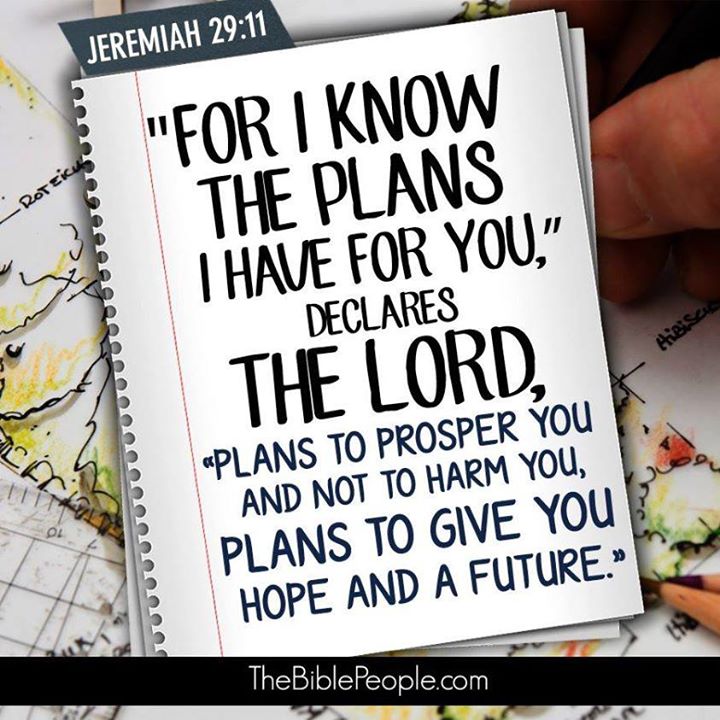
Of Promises and Plans

Jeremiahverse

To understand this truth is to be set free.

We live in sort of toxic atmosphere that ‘leeches’ out of us God’s sure promises. But we do have significant resources that will keep us secure. What has been given is fortified promises and plans.

“And because of his glory and excellence, he has given us great and precious promises. These are the promises that enable you to share his divine nature and escape the world’s corruption caused by human desires.

2 Peter 1:4

Every believer has been given these strong promises. It doesn’t matter if you have a physical or mental illness. God is for you in the midst of your pain and disability. You may be miraclously healed, or you may ‘carry the load’ on a daily basis; God is for you regardless.

“What shall we say about such wonderful things as these? If God is for us, who can ever be against us?”

Romans 8:31

When a believer is in a storm, sometimes God will calm it, and other times He will calm the child. Either way we are remarkably protected in His hands. God is for us. We are given ‘promises and plans.’ We may traverse through much difficulty— that seems to be the normal state of things. It seems some will travel from crisis-to-crisis, yet God holds them secure. We will trust Him in the storm.

Think of all you have already been through— search your memories. You will undoubtly recall some hard times, yet you have survived the awful storms.

“I will trust Him. Whatever, wherever I am, I can never be thrown away. If I am in sickness, my sickness may serve Him; in perplexity, my perplexity may serve Him; if I am in sorrow, my sorrow may serve Him. My sickness, or perplexity, or sorrow may be necessary causes of some great end, which is quite beyond us. He does nothing in vain.”    

John Henry Newman

bry-signat (1)

cropped-christiangraffiti1.jpg