The Glory of Gripping Things

Acts 17:33 Artwork | Bible Art

I never had an opportunity to attend a seminary, and only have a three year diploma from a Bible Institute. But I’ve had to rely on the Holy Spirit in ways that a seminary trained pastor will never really understand. I’ve come to see the wisdom in the way God has led me.

“It is the glory of God to conceal things, but the glory of kings is to search things out.”

Proverbs 25:2

Concealing things and searching for things are contrasting actions. God hides things purposefully–they are sort of like a spiritual version of “Where’s Waldo.” Certain things are hidden, but always in plain sight.

Searching for things should definitely be our own response. The word used in Hebrew means to investigate, but with a planned purpose. It’s more than curiosity, rather it’s a passionate curiosity. And the Holy Spirit is always pleased with that.

In the New Testament book of Acts (17:11) we can see this attitude of the Bereans. They were the only ones in Scripture to be called “noble minded” for their serious study and thought. When they heard Paul’s teaching they sat down, opened their Bibles and began to investigate for themselves.

But it will always take humility. Always.

Intellect is important but it’s not enough. The list seen below is something to work through, and the issue is one that has been a challenge for me through 40+ years of following Jesus.

Here’s a study that I’m confident will bless you.

Justification & Sanctification– Gripping the Two
  •  Justification is free (John 4:1)
  • Sanctification is costly (Lk. 14:25-33)
  • Justification is instantaneous (Jn. 3:8)
  • Sanctification is a lifelong process (Jn. 8:31)
  • Justification is by faith (Eph. 2:8)
  • Sanctification is by faithfulness (1 Cor. 4:2)
  • Justification is not of works (Eph. 2:9)
  • Sanctification is of works (Eph. 2:10)
  • Justification involves Christ’s love for me (Jn. 3:16)
  • Sanctification involves my love for Christ (1 Jn. 4:19)
  • Justification concerns Christ’s righteousness (2 Cor. 5:21)
  • Sanctification concerns my righteousness (Lk. 14:25-33)
  • Justification involves my position in Christ (Col. 2:11-14)
  • Sanctification involves my practice (Col. 3:1-11)
  • Justification considers what God has done (1 Cor. 15:3-4)
  • Sanctification considers what I am doing (Lk. 14:25-33)
  • Justification is God’s commitment to me (1 Jn. 5:9-13)
  • Sanctification is my commitment to God (Jn. 14:15)
  • Justification requires obedience to one command: to believe the Gospel (Ac. 6:7)
  • Sanctification requires obedience to all of Christ’s commands (Matt. 28:19-20)
  • Justification focuses on the cross which Jesus took up once and for all (1 Cor. 1:18)
  • Sanctification focuses on the cross which I am to take up daily (Lk. 9:53)
  • Justification is finished at the moment of faith (Jn. 5:24)
  • Sanctification is not finished until I go to be with the Lord (1 Cor. 9:24-27)

Discerning between the two should only be a blessing. In some sense working through the differences between justification and sanctification should energize you, and bring truth to your walk. Now you might disagree, but let it be after you’ve worked through this list.

“I have more understanding than all my teachers, for your testimonies are my meditation.”

Psalm 119:99

The author of the above ‘list’ is unknown. May they be blessed by this if they should read this post.
 
 
cropped-christiangraffiti1 (3)
 

The Caged Bird is Now Free

caged-bird

“Whoever dwells in the shelter of the Most High
    will rest in the shadow of the Almighty.
I will say of the Lord, “He is my refuge and my fortress,
    my God, in whom I trust.” 

Psalm 91:1-2, NIV

Psalm 91 focuses on being intimate with our heavenly Father.

Throughout the entire chapter we see personal pronouns used. In contrast to other psalms that are directed to the nation, this one is written to an individual. This personal focus makes this a favorite psalm for many.

Shelter and shadow, refuge and trusting.

These four are the opening ‘word pictures,’ and they are used with wisdom and an alert discernment. The psalmist writes what he knows, and it is apparent that he understand the needs of the human spirit, and our need for protection.

Each of these four words creates a common link between believers. Each of us need a working understanding of all four protections.

These four are necessary elements for Psalm 91 to really work. I should ‘dwell’ in God’s sheltered care. All too often, I wander out past the security of the Lord (or maybe I’m lured out?) But there is safety in having God so close to us.

His proximity is for my protection.
“Surely he will save you
    from the fowler’s snare
    and from the deadly pestilence.
He will cover you with his feathers,
    and under his wings you will find refuge;
    his faithfulness will be your shield and rampart.”

Psalm 91:3-4

silhouette-bird-on-branch-grangerV.v. 3-4, maintains its personal or familiar tone. ‘Save you’ (salvation) is far more that a theological term.  For the psalmist however, it’s not about ‘doctrine’; rather the psalm is an embrace. He is rescued from the trap, and the sickness that seems so contagious never touches him. Moving from metaphor to metaphor, he engages our imaginations to ‘see’ God’s salvation. The writer knows his stuff.

The Lord is pictured as a protective bird that covers his chicks with His wings.

We have a sure confidence as we gather together in that warm and safe spot under His wing. Whatever is after us has to go through God first. His presence is formidable. In His company is found true safety.

“What, then, shall we say in response to these things? If God is for us, who can be against us? Who will bring any charge against those whom God has chosen? It is God who justifies.”

Romans 8:31, 33

All of heaven is rallying for your well-being. You are sure of this based on your faith in God’s own word. He has ‘busted us’ out of a dark cage, and now defends you against all your enemies. And that is a very good thing.


A Sound Mind

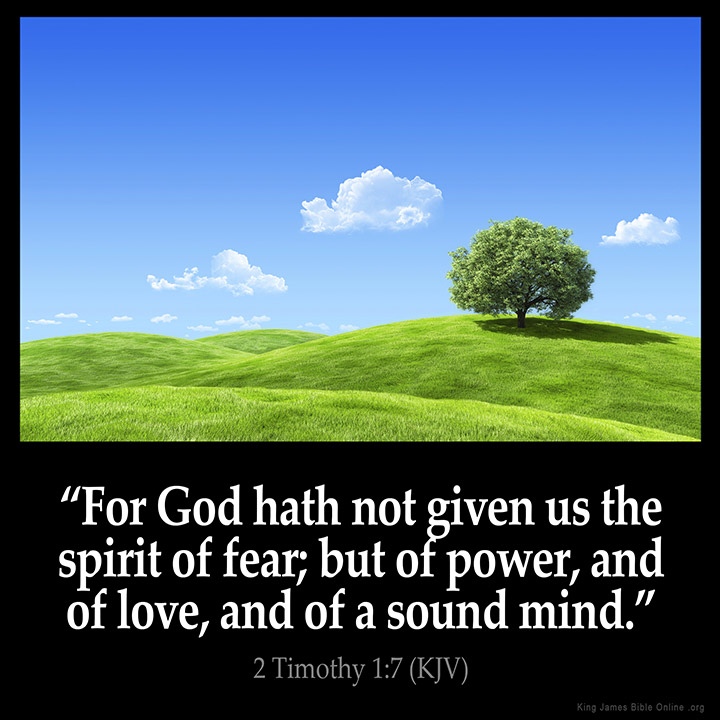
2-Timothy_1-7

“A sound mind.” For some of us that doesn’t seem remotely possible. We’ve come to believe this is only true for others, maybe, but not me. As mentally ill people we seem to think that we shouldn’t be this way. Given enough time our illness becomes fused to our spirit and soul. We buy the lie and choose to live defeated. Only the Lord Jesus can break this chain.

Healthy thinking is a wonderful gift. That’s important to note. I can’t earn it; nor can I fabricate it. It must be simply acknowledged and received as a bonus. We must come humbly and broken. I suppose that is where we become the happiest and healthiest.

In 1 Timothy 1:7 we’re told that we have a salvation that includes:

  • incredible power,
  • love,
  • and a sound (healthy) mind.

These three are a gift from God. You don’t buy a gift, nor do you earn it. Rather it comes from Someone who loves you (!) and only wants to restore you. We may have issues, but the Spirit is sound and lucid. He speaks so we understand.

Afflicted people will find what they need from the Holy Spirit of God. Mental illness isn’t a death sentence. Rather it’s a grand opportunity for God to teach us about His power in the middle of our pain.

The healthy mind is one that is clear and life-giving. It is without any sick or crippling deficiencies. It’s a mind that is vigorous and robust. Those of us who struggle with a mental illness this is fantastically good news. And it maybe that you’re certainly impaired but even then you’re given a strength to use in service in the body. Everyone has a gift and calling.

There is nothing worse than fighting through muddled thinking when you’re having mental issues. Names, dates and memories disappear in the fog. It can be frightening. I know what it’s like to be afraid of one’s own mind. It seems like it’s trying its best to kill me. (Some of you can ‘read-between-the-lines’ and understand exactly what I am saying.)

My own experience is that the Holy Spirit is working, with my meds, to hold me in a good place. Just as a diabetic must take insulin, so I need to take my antidepressants. The brain is an organ that can get sick also. We live in a fallen and broken world. We are human and therefore vulnerable just like anyone else. (Somehow, we imagine better.)

Grace does heal many, but there are some who will find ‘weakness’ becoming their real strength.

The very presence of the Holy Spirit is what enables. Broken believers are coming to see that their illnesses are helping them to be weak enough for God to use. It’s not how strong you are, but it’s how weak. “It is not that we think we are qualified to do anything on our own. Our qualification comes from God,” 2 Cor. 3:5, NLT.

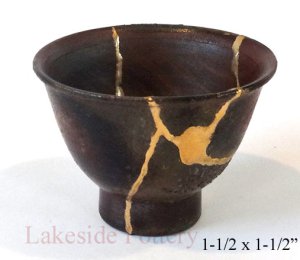
bizen-kintsukuroi-tea-cup-1 (1)

“When the Japanese mend broken objects, they aggrandize the damage by filling the cracks with gold [‘kintsukuroi’]. They believe that when something’s suffered damage and has a history it becomes more beautiful.”

–Barbara Bloom


The Desiderata

Desiderata (Latin: “desired things”, plural of desideratum) is a 1927 prose poem by American writer Max Ehrmann (1872-1945).

It exhorts the reader to “be at peace with God, whatever you conceive Him to be”, and to “keep peace with your soul”. “With all its sham, drudgery, and broken dreams,” wrote Ehrmann, “it is still a beautiful world.”Wikipedia

Unquestionably, some of this prose-poem may be a bit pretentious, it revolves around concepts, at times which are not entirely sound, especially for the Christian believer.

We note these things and look for what we need. My old pastor liked to observe, “Swallow the meat, and spit out the bones.” That seems fitting, especially now. But no matter what we say, this particular work has very much wisdom for each of us. It is worthwhile I think.

This world that we’re immersed in needs hope and peace. Especially now.

  The Desiderata

Go placidly amid the noise and haste,
and remember what peace there may be in silence.
As far as possible without surrender
be on good terms with all persons.
Speak your truth quietly and clearly;
and listen to others,
even the dull and the ignorant;
they too have their story.
Avoid loud and aggressive persons,
they are vexatious to the spirit.
If you compare yourself with others,
you may become vain or bitter;
for always there will be greater and lesser persons than yourself.
Enjoy your achievements as well as your plans.
Keep interested in your own career, however humble;
it is a real possession in the changing fortunes of time.
Exercise caution in your business affairs;
for the world is full of trickery.
But let this not blind you to what virtue there is;
many persons strive for high ideals;
and everywhere life is full of heroism.
Be yourself.
Especially, do not feign affection.
Neither be cynical about love;
for in the face of all aridity and disenchantment
it is as perennial as the grass.
Take kindly the counsel of the years,
gracefully surrendering the things of youth.
Nurture strength of spirit to shield you in sudden misfortune.
But do not distress yourself with dark imaginings.
Many fears are born of fatigue and loneliness.
Beyond a wholesome discipline,
be gentle with yourself.
You are a child of the universe,
no less than the trees and the stars;
you have a right to be here.
And whether or not it is clear to you,
no doubt the universe is unfolding as it should.
Therefore be at peace with God,
whatever you conceive Him to be,
and whatever your labors and aspirations,
in the noisy confusion of life keep peace with your soul.
With all its sham, drudgery, and broken dreams,
it is still a beautiful world.
Be cheerful.
Strive to be happy.

Max Ehrmann, 1927