The Desiderata

Desiderata (Latin: “desired things”, plural of desideratum) is a 1927 prose poem by American writer Max Ehrmann (1872-1945).

It exhorts the reader to “be at peace with God, whatever you conceive Him to be”, and to “keep peace with your soul”. “With all its sham, drudgery, and broken dreams,” wrote Ehrmann, “it is still a beautiful world.”—Wikipedia

Unquestionably, some of this prose-poem may be a bit pretentious, it revolves around concepts, at times which are not entirely sound, especially for the Christian believer.

We note these things and look for what we need. My old pastor liked to observe, “Swallow the meat, and spit out the bones.” That seems fitting, especially now. But no matter what we say, this particular work has very much wisdom for each of us. It is worthwhile I think.

This world that we’re immersed in needs hope and peace. Especially now.

  The Desiderata

Go placidly amid the noise and haste,
and remember what peace there may be in silence.
As far as possible without surrender
be on good terms with all persons.
Speak your truth quietly and clearly;
and listen to others,
even the dull and the ignorant;
they too have their story.
Avoid loud and aggressive persons,
they are vexatious to the spirit.
If you compare yourself with others,
you may become vain or bitter;
for always there will be greater and lesser persons than yourself.
Enjoy your achievements as well as your plans.
Keep interested in your own career, however humble;
it is a real possession in the changing fortunes of time.
Exercise caution in your business affairs;
for the world is full of trickery.
But let this not blind you to what virtue there is;
many persons strive for high ideals;
and everywhere life is full of heroism.
Be yourself.
Especially, do not feign affection.
Neither be cynical about love;
for in the face of all aridity and disenchantment
it is as perennial as the grass.
Take kindly the counsel of the years,
gracefully surrendering the things of youth.
Nurture strength of spirit to shield you in sudden misfortune.
But do not distress yourself with dark imaginings.
Many fears are born of fatigue and loneliness.
Beyond a wholesome discipline,
be gentle with yourself.
You are a child of the universe,
no less than the trees and the stars;
you have a right to be here.
And whether or not it is clear to you,
no doubt the universe is unfolding as it should.
Therefore be at peace with God,
whatever you conceive Him to be,
and whatever your labors and aspirations,
in the noisy confusion of life keep peace with your soul.
With all its sham, drudgery, and broken dreams,
it is still a beautiful world.
Be cheerful.
Strive to be happy.

Max Ehrmann, 1927


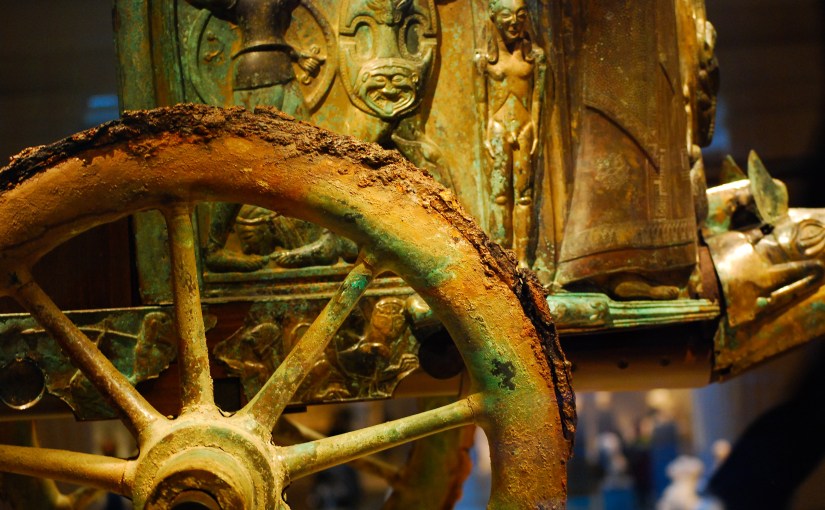
When Teachability Rides a Chariot

I think this post will wander around a bit, we’ll see if the Father will speak to us somehow.

I really think our lives are made up of the decisions we’re making. At least, it sometimes sees that way.

Some decisions are like ‘forks’ in the road.  They’re made and then they shunt us in another direction. Most are minor–(will it be McDonalds or Pizza Hut?) But the biggies really alter us–very quickly we see that the road is going to take us in a radically different path.

Sometimes, if we’re honest, we will admit to backtracking; retracing our route back to the point we turned.  A lot of time it’s too late, and the moment has past. But we will sometimes learn that sometimes even our detours are part of the journey. (Amazing, isn’t? But He controls it all, and that’s comforting.)

I think I’m starting to learn how to receive correction from others. 

I’ve been mulling over the decision of the Ethiopian eunuch in Acts 8:30-31, he wanted to understand the truth:

“So when Philip ran toward the chariot, he heard the man reading from Isaiah the prophet [on his Kindle]. Philip asked, “Do you understand what you are reading?”
 31 He answered, “How can I understand unless someone explains it to me?” Then he invited Philip to climb in and sit with him.”

We see here such a very ‘thoughtful humbleness’– a teachableness of the heart that this eunuch seems to have learned.  He is confident enough in himself to acknowledge that he just doesn’t know. He invites Philip to a Bible study in the chariot.

We are responsible for our receptivity to truth. 

It’s our personal decision to either seek or not seek, to learn, or not to learn.  No one else can do this for us.  We come to a decision point and we go the way things seem to direct us, or we don’t. Again, we must choose.

Sometimes to not make a decision, is a decision.

The book of Proverbs is saturated with ideas on being guided by our humility when it comes in contact with truth.  Furthermore, there are many warnings about receiving correction and reproof gracefully.  For me, I’m learning slowly to receive hard counsel.

When my wife and I made the decision to work in the migrant camps in Mexico there was one elder who kept saying “no!” At first it was a real issue for us. We sort of resented it. But we began to see the blessing of his resistance. It caused us to really analyze our decision, and “count the cost.” We were stepping into a very hard place, and we needed that voice. We were being called to break in “new ground.” It was to be a challenge.

It seems that scriptural truth is almost always negative when it’s first encountered. It often irritates more than it comforts.

It often will not sit well, and I will try to shake it off.  But truth can be remarkably persistent.  ‘Forgive your brother’, the Holy Spirit says.  And you say right away, ‘Not a chance!’  But, give it time, and the Word will soften rock.  If you respond properly, humbly, you be able to make the right decision.

One more thing, Jesus told us in Matthew 18:3,

“I promise you this. If you don’t change and become like a child, you will never get into the kingdom of heaven.”

We’ll need to be a complete alteration in our hearts if we are to accommodate His command.  Becoming a child is more difficult as an adult– then becoming an adult is for a child.  Becoming small again takes a great amount of brokenness and it’s never really mastered.

God fully intends to work with you in this. 

God wants you to learn teachableness. He brings others to direct you. The Holy Spirit ignites the Word that’ll light your path. He doesn’t seem to ever give up.  He is wonderfully persistent–He never really does give up.

“The intelligent man is always open to new ideas. In fact, he looks for them.”

Proverbs 18:15, LB

Running the Good Race, [Endurance]

reebok-running-shoes-track-small-17515

23 “The Lord directs the steps of the godly.
    He delights in every detail of their lives.
24 Though they stumble, they will never fall,
    for the Lord holds them by the hand.”

Psalm 37:23-24, NLT

We are each on a journey, and when we start to get serious about our following, we feel His pleasure. In the movie, “Chariots of Fire,” a line is spoken by Eric Liddell: “I believe God made me for a purpose, but he also made me fast. And when I run I feel His pleasure.” The film resonated deep inside the bones of many who saw it.

Part of it I suppose was this runner had something called passion–  it is something we hardly hear about these days. (Perhaps we need some of that “fervor.”) There is also a point to made that we can really make God happy. And many of us don’t completely understand this. Or don’t believe it! What they end up living is a substandard life, and that is tragic.

“And let us run with endurance the race God has set before us.”

Hebrews 12:1

The pleasure we bring God is our profound purpose in life.

When we start moving out into that heart-intensity, we will discover that it is what we crave. All the pleasures of sin will never satisfy us. You might as well sort that out as soon as you can. You will only find satisfaction in running the spiritual race. Oh to grab hold of life with two hands and make it your own!

V. 24, paints a picture of a stumbling runner. Perhaps your feet slipped, or you tripped over a root or rock. Nobody goes out to race with the idea of falling on their hinder parts. The key idea though isn’t my falling, but by His proximity. He is holding your hand! To suggest otherwise is foolish and bad theology. He finds us— follows us—and holds us steady.

“I have fought the good fight, I have finished the race, and I have remained faithful.”

2 Timothy 4:7

As a mentally ill believer, my race is different than many.

I run with constant pain and clinical depression. I remember in boot camp a recruit had to carry around a thirty pound rock in his ruck sack for 48 hours. He ran with it, ate with it, showered with it.  He even had to sleep with it. Perhaps that rock made that recruit a future Command Sargeant Major?!

I still must run, and I’m not disqualified by my ‘rock.’. I still am a disciple and still must run my own particular race.  I think deep-down you know this; you see, everyone you meet today is running a challenging race, a profoundly hard race– so be kinder than you have to be. Grit your teeth and be kind.

1brobry-sig4

cropped-christiangraffiti1 (1)

Seriously. Forever and Ever.

“Christianity asserts that every individual human being is going to live for ever, and this must be either true or false. Now there are a good many things which would not be worth bothering about if I were going to live only seventy years, but which I had better bother about very seriously if I am going to live for ever.”

–CS Lewis

“But let all who take refuge in you rejoice; let them shout for joy forever. May you shelter them, and may those who love your name boast about you.”

Psalm 5:11, CSB