Repeated Sin

I must tell you this right from the start! You must believe it before we can go any further.

(I want to apologize for my brother pastors who may have told you otherwise.)

1 John 3:6-9 

Over and over, we sin the same sin until it has become habitual. It is exactly the opposite of godliness (that’s why we call it ungodliness.) It’s truly the other side of the proverbial coin. It haunts everyone who sincerely wants to follow Jesus.

Let’s understand these things. I’ve listed seven consequences of repeated sin.

  1. It creates hypocrisy and self-hatred.
  2. It nullifies witness, and the work of missions.
  3. It cancels out real praise, worship, and Bible reading.
  4. It destroys real fellowship between other believers.
  5. Any personal ministry is degraded and turned upside down.
  6. It blinds others, and deceives them to who we really are inside.
  7. It always engenders guilt and unworthiness, especially toward God.

I once lived in a house that had a severe mold problem. The previous owner, in an attempt to make things liveable, painted over the offending walls. He meant well, of that I am sure, but the problem of the mold was never dealt with properly. No matter how much you slathered on the paint, the mold was still alive and well. It simply worked its way to the surface. Sin is like this.

Paul’s letter to the Romans, chapter 7, gets to the root of our “mold.” If we read it carefully (as we should) we’ll start to grasp what it means to walk biblically.

Paul floats different concepts our way. Law, sin, nature. Each word must be processed.

“Law” is something that is always true. (Think of the Law of gravity.) “Sin” or falling short. The Greek word is pretty descriptive–it means “an arrow that misses the target.” “Nature,” or the intrinsic character of something.

We use these words so seldom that they seem archaic and outdated; but not so. Understanding these three opens up the entire realm of spiritual holiness. When we realize that the Word explains our situation so clearly we become convinced that holiness is possible. We begin to hope again.

Tolerating repeated sin is a terrible form of “spiritual suicide.” It always breaks fellowship with the living God. But as a believer, God doesn’t break fellowship with us, rather He comes closer and patches up our self-inflicted wounds. But even then we will not understand Him.

The Father’s heart is for us to be heart-holy. This is His perfect plan for us. 

1 Peter 1:14-16

You must become convinced. You dare not continue to sin and live in terrible guilt and risk “spiritual suicide.” You must decide that the Spirit of holiness is in residence in your heart, and live willingly as true saints. 

But there is an all powerful remedy to our sickness-plague of repeated sin. Almost always we stare at this ugliness, it seems we’re fixated on it. Often there are two approaches we take regarding repeated sin. 1) We ignore and flail out a life of “holiness.” We minimize this. 2) We become hyper-aware of our sin and guilt. We maximize sin to the point where we lose all joy and peace.

“Looking at the wound of sin will never save anyone. What you must do is look at the remedy.”

D.L. Moody

I need to stop teaching now. Rereading this has made me slightly frustrated about what I’ve written. If any of this has helped, I’m glad. I’d like to close this with a Billy Sunday quote. He explains the seriousness of repeated sin. 

“I’m against sin. I’ll kick it as long as I’ve got a foot, and I’ll fight it as long as I’ve got a fist. I’ll butt it as long as I’ve got a head. I’ll bite it as long as I’ve got a tooth. And when I’m old and fistless and footless and toothless, I’ll gum it till I go home to Glory and it goes home to perdition!” 

 Billy Sunday

Are You Stuck in a Particular Sin?

Galatians 5:1

There are certain people who are just stuck in this seemingly endless cycle of sin. Oh, I feel conviction. Oh, I confess and repent and I receive forgiveness. And then the next day it happens all over again, and they are in this seemingly endless cycle. There are two truths that we have to embrace here. They are not mutually exclusive; they are perfectly compatible.

It is a good thing for you to see your sin.

You need to feel the conviction of the Spirit on the one hand, but God doesn’t want you to stay in that mindset. He says “When I awaken your heart to the reality of how you’ve fallen short, come quickly to the throne of grace and look at the many ways in which I have dealt with that sin. I have put it behind my back. I’ve buried it in the depths of the sea. I’ve blotted it out. I’ve trampled it underfoot. I turned my face away from it. I won’t gaze upon it.”

And it’s the power of that truth that will enable us to break out of this cycle in which so many people find themselves. It’s a cycle in which they just live in constant fear and trepidation. Oh, maybe I’ve done it one too many times, and God’s just so fed up with me that I’m going to be cast aside forever.

Live now in the freedom and the joy of knowing that you are forgiven fully and finally.

Sam Storms

I’ve actually heard people say, I envisioned myself coming to the Lord once again and him saying, ‘Oh no, not you again. The umpteenth time and are you just expecting me to forgive you over and over and over again?’ And they live in fear that God’s just going to run dry and not have mercy, that he’s going to run out of grace.

And God has said, “Look, it’s good that you recognize the ways you have failed. I don’t want you to live oblivious to the fact that you have disobeyed in an unrepentant and high-handed way. But know this: I have dealt with that sin. The punishment that deserves has been exhausted in Jesus.

Live now in the freedom and the joy of knowing that you are forgiven fully and finally, and let that be the power to break the cycle of the constant repetitive falling back into these old ways and these old patterns of the past.”

Live in the fullness of your freedom in Jesus.”

Sam Storms (PhD, University of Texas at Dallas) has spent more than four decades in ministry as a pastor, professor, and author. He is currently the senior pastor at Bridgeway Church in Oklahoma City, Oklahoma, and was previously a visiting associate professor of theology at Wheaton College from 2000 to 2004. He is the founder of Enjoying God Ministries and blogs regularly at SamStorms.org.

Sam Storms is the author of A Dozen Things God Did with Your Sin (And Three Things He’ll Never Do).

brokenbelievers.com

Our Heavy Weight

“The bridge of grace will bear your weight, brother. Thousands of big sinners have gone across that bridge, yea, tens of thousands have gone over it. Some have been the chief of sinners and some have come at the very last of their days but the arch has never yielded beneath their weight. I will go with them trusting to the same support. It will bear me over as it has for them.”

CH Spurgeon

Quite often many of us deal with guilt and condemnation. We live in sinful bodies, and it seems that we actually cherish things that God has told us are wrong, and not part of an authentic Christian walk.

We’ve got an enemy that condemns and accuses. Our sin can be compared to “hooks” that Satan can latch on and pull us toward dark things. I personally don’t believe that a Christian can be demon-possessed. The Holy Spirit resides in the believer–He protects us with His presence.

The believer can be oppressed but never possessed.

Life can be very challenging when we choose sin over holiness. Often we really don’t have a fear of God. A healthy believer knows that he or she will stand and give an account of the way we live. Rewards will be given, and judgment will be passed on all that we’ve done.

When God saves a person He really does save a person.

We need not feel condemnation or guilt, Jesus was punished for our sin. His poured out blood is sufficient for everyone. He died so we won’t. He was risen to give us power over all of these nasty dark things. He becomes the bridge that holds our weight.

Be encouraged saint, as His holiness is given to each of us. We must choose it.

Sorry, Not Sorry

Have you ever heard someone say those words? “Sorry, not sorry.” It’s kind of annoying. It’s said following a statement or action the speaker knows is unkind or won’t be appreciated by someone else, but they just don’t care. It’s worse than not saying sorry at all.

We humans have a terrible time admitting when we are in the wrong. There’s always some justification for our actions, often that we were wronged first, or we had no choice, or some such nonsense. Misunderstandings escalate into disagreements, which quickly become heated arguments, and nobody really wins in the end. Sometimes good friends end up enemies, all because no one will say those two simple, yet truly difficult, words: “I’m sorry.”

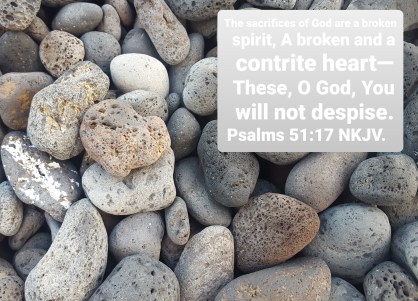
We sometimes have the same problem with God. We know we have not acted as we should, but we can’t let go of pride and say we are sorry. Scripture reveals the truth: a contrite heart is all God wants from us. He desires for us to admit when we’ve missed the mark.

The stories of King David and King Saul illustrate this principle. Both were in the wrong. David committed adultery, and then had the husband of the woman he slept with sent to the front lines of a battle, knowing he would be killed. But when the prophet Nathan brought David’s transgressions to his attention, David’s response was a remorseful attitude. He immediately fell to his knees and confessed his sin. And God forgave David.

Saul, on the other hand, committed a transgression that seems much less serious. He counted his army. Doesn’t sound like much of a sin, does it? But the heart of Saul’s transgression was a lack of trust in God. He didn’t believe he would win a battle even though God had promised him victory. Not only did Saul not trust God, he refused to confess his lack of trust. Instead he made excuses, tried to justify his actions. As a result, God took away Saul’s kingdom and gave it to David. And God did not forgive Saul.

David is remembered as a man after God’s own heart in spite of his many sins because a relationship with God was most important to him. Saul is not remembered so kindly.

What have we lost because we refuse to say we are sorry? A kind word, an admission of our own contribution to a dispute, can go a long way toward healing relationships. Is there someone you need to say “I’m sorry” to today? What’s holding you back? Is it a stubborn nature, like what often holds me back? What do you have to lose? What do I have to lose? More importantly, think what we have to gain.

What about your relationship with God? Is there some transgression you need to confess to restore the intimacy you once enjoyed with your Savior? What do you have to lose? You have the best God intends for you to gain.