Blind From Birth

John 9:1-7

As he was walking along, he saw a man blind from birth.

“Master,” his disciples asked him, “why was this man born blind? Was it a result of his own sins or those of his parents?”

“Neither,” Jesus answered. “But to demonstrate the power of God. All of us must quickly carry out the tasks assigned us by the one who sent me, for there is little time left before the night falls and all work comes to an end. But while I am still here in the world, I give it my light.”

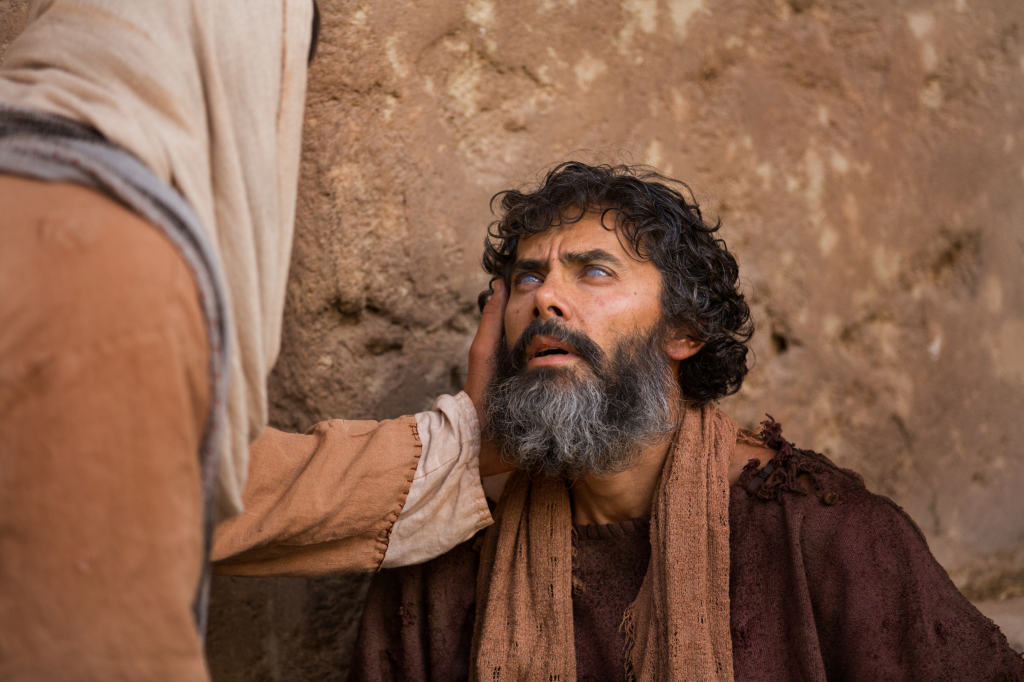
Then he spat on the ground and made mud from the spittle and smoothed the mud over the blind man’s eyes, and told him, “Go and wash in the Pool of Siloam” (the word Siloam means “Sent”). So the man went where nd washed and came back seeing!

Up to now I’ve tried to approach these posts from the first person viewpoint. Ihoped to understand those who met face-to-face with Jesus. I wanted to grasp what they were seeing through their own eyes. But I intend with this post to revert back to a more traditional approach to this passage.

First, we’re introduced to a man who is blind from birth.

I can’t even imagine what that would be like (just as he probably could imagine having sight). I’ve been told that he probably didn’t have a “dream” life–that requires having seen images (a dog, a tree, a mean person) and this wasn’t available to him. He never saw the color red, or seen a mountain. (He didn’t have the circuitry.)

I suppose we can only imagine what blindness like this would be.

Somehow I’ve come to an idea that this represents fallen men–we’re spiritually blind to the workings and truths of Jesus’ Kingdom. It seems a pretty good explanation of each of us–“blind from birth.”

Secondly, notice the response of the disciples who first met this unfortunate man. They don’t see his needs, rather they want to know the theology behind this. Perhaps that’s how we respond much of the time–we don’t see the needs, we only want to know the reasons. We’re not wise or discerning enough to see what’s going on–in short we’re not equipped to love or show mercy. (We haven’t got the circuitry.)

Perhaps this is how we operate as immature Christians.

We don’t engage the need, but rather we like having great theology over understanding compassion. If we really don’t love needy people, we miss so much. We don’t ever grow up. It’s easy to philosophize–it’s hard to get down and serve and really love others.

It’s funny but Jesus declares Himself to be the light of the world while speaking to the man who is born blind.

Third, we discover the gentle mercy that Jesus has when He meets needy people. Now the Lord does accommodate His followers, but not at the expense of engaging the need of the moment. Jesus is full of compassion–most especially when He meets broken people–and as His followers, we must grasp this.

Good theology is not the primary calling of Jesus’ followers.

As I mature in Christ I’m learning (slowly) that people are His real focus. He has come, not to theologize or philosophize, but to meet needs! Sure the reasons why become clearer, but that really isn’t Jesus’ primary goal. People are, not having impeccable theology.

Classes in systematic theology are good, but soup kitchens are better.

The miracle happens, and Jesus’ love and desire to restore this man is ‘front and center.’ The Lord’s methodology is interesting. Spit and mud, wiped on the blind man’s eyes. In Genesis we discover that God made man out of dirt and dust of the ground. Perhaps what He’s doing here mirrors that work.

And it’s also important to understand that Jesus never performs the exact same healing in the exact same way. For some reason He ‘tailors’ His work to the individuals deepest need. I suppose He doesn’t want us to grab a hold of a formula, as that’s what we want to have.

The story is primarily about a blind man’s healing.

It’s not theology, and it certainly isn’t about what is proper and acceptable. We really must understand this, and we really need to understand the tremendous mercy and power of God to both heal and restore.

Image: MCCC. Text from the “Living Bible,” published by Tyndale House


Mastered by Jesus

“A Christian is a person who has died with Christ, whose stiff neck has been broken, whose brazen forehead has been shattered, whose stony heart has been crushed, whose pride has been slain, and whose life is now mastered by Jesus Christ.”

–John Piper

No longer do I call you servants, for a servant does not know what his master is doing; but I have called you friends, for all things that I heard from My Father I have made known to you.”

John 15:15

I believe that the purpose of life is not to find our freedom. It’s really meant to find our Master.

Yes, the idea of being a slave to anyone is repugnant. We chafe at this, and yet man was never meant to be seperated from the Lordship of Jesus. We’re instructed repeatedly with the New Testament idea that “our life is not our own”  Over and over God proclaims Himself as the King.

That troubles us somewhat.

Not so much when life is fairly good, granted, but in those hard moments when a decision must be made between enjoying the titillating “lusts of the flesh,” or accepting the fruits of the Spirit. This is one of those “lordship moments.” They come, and go, and they show us exactly who we are.

If you’re really going to be authentic–a legitimate and real disciple, then you must determine who is going to be “boss.” This isn’t one of those casual decisions. You must securely fix it in your heart.

Your decision must become a settled issue.

The thief on the cross knew salvation, he was promised an eternity with God simply by faith. But I submit to you that he had put himself under the Lordship of Jesus, simply by recognizing the sign, “the King of the Jews.” I believe he saw and understood its imlications. Jesus was King!

This is a very hard word for some, but many of our personal issues hinge on this.

I know this first-hand. It can be a monumental struggle. You must admit to not only having Jesus as your Savior, but you also must put your life under His total Lordship.  You need to pick up your cross daily in order to follow.  You need to learn how to kneel.

I’ve chosen a crown to open up this post–it’s done on purpose.  I simply want you to to understand the supreme call He has on your life.

“The question in salvation is not whether Jesus is Lord, but whether we are submissive to His lordship.”

    John MacArthur

You must learn here and now how to kneel before the Sovereign King.


Sinners Get Priority

17 Jesus heard this and said to them, “It is not the healthy people who need a doctor, but the sick. I did not come to invite good people but to invite sinners.”

Mark 2:17, NCV

“The true Christian’s nostril is to be continually attentive to the inner cesspool.”  

–C.S. Lewis

How ironic!  Today, religious people are seen as a sort of an elite, an upper crust. The seem like they have it together, or at least they think so. Somewhat superior to those of us who live hard, and know all about sin.  The hearts of the lower level don’t make any pretension to any kind of spirituality.

They understand that they are the ‘dregs.’  They have adapted to living in an ugly and twisted world that gives nothing.  There is a sense that they know they are on ‘the highway to hell.’ They aren’t surprised by this.

The gross sinner, and the spiritually debilitated, have been brought into a very special place.  Jesus intends to escort us into glory, even in spite of our and unsightly infection.  He is wonderful, and yet we see that He really does specialize in losers.  He ‘homes in’ on them and then connects with those who have no ‘religious’ sense to speak of.

This seems quite counter-intuitive, especially if you’re trying to start a religious movement.  It is quite necessary to have a strong base, to seek out good people, and with finances– obviously.  And ‘the sick’ have blown it all on sex, drugs and rock & roll.  They will never finance the ministry of Jesus.  The disciples all have grasped this, especially Judas.  They are full of practicality.  They approach discipleship as a business. (And truly, these are the dangerous ones.)

The sick, the defective, and the infirm have now been elevated by Jesus’ new focus.  They have ‘zero spiritual’ value, with absolutely nothing to contribute — they are more of a liability then anything.  People like us who are very ill really can’t contribute to what is really happening.  More often then not, they require intensive care from the healthy and whole, sapping the strength of the work. Truly God is not against us because of our sin. He is with us against our sin.

I have a blue handicapped placard. This really helps and gives me preferential parking. And in much the same way spiritually, if you are a loser– you have dibs.   Jesus shines on you specifically (even if the Church won’t.)

There is a kind of a loving triage that He uses as He draws people into His domain and influence.  Hearts and lives that are black receive His eager attention.  Of course, there will be voices that object to this perceived inequity.

But Jesus has no favorites, only intimates.  Remember this, the sinner who has been “forgiven much, loves much.”

*


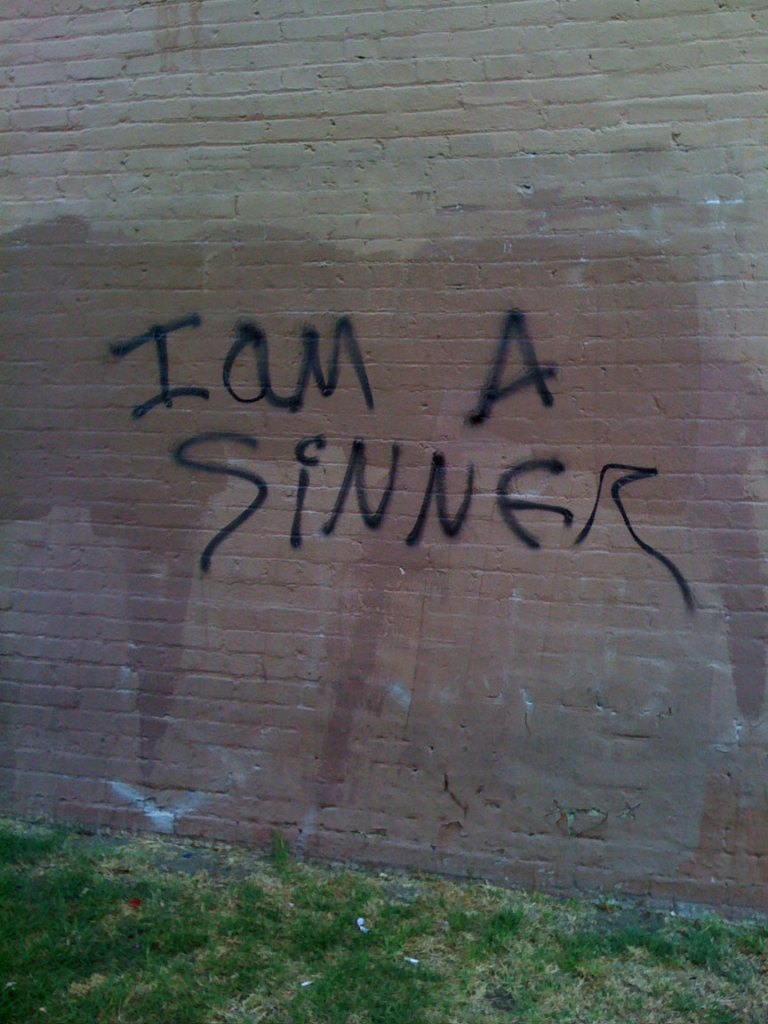
cropped-christiangraffiti1-2

Crooked Kisses

kiss-596093_960_720

“The Son of Man has come eating and drinking, and you say, ‘Look at him! A glutton and a drunkard, a friend of tax collectors and sinners!’”

Luke 7:34

God, in some profound way accommodates Himself to your ‘sickness.’ He will never turn away from you.

We discover that Jesus has a beautiful quality–He becomes quite tender and gentle around any spiritual disease. He gravitates to the broken and sinful. His love for sinners is a fact we must consider over and over. It’s absolutely critical that we recognize this.

And if we can only understand this, it’ll change us forever.

In his book Mortal Lessons (Touchstone Books, 1987) physician Richard Selzer describes a scene in a hospital room after he had performed surgery on a young woman’s face:

“I stand by the bed where the young woman lies. . . her face, postoperative . . . her mouth twisted in palsy . . . clownish. A tiny twig of the facial nerve, one of the muscles of her mouth, has been severed. She will be that way from now on. I had followed with religious fervor the curve of her flesh, I promise you that. Nevertheless, to remove the tumor in her cheek, I had cut this little nerve.”

Her young husband is in the room. He stands on the opposite side of the bed, and together they seem to be in a world all their own in the evening lamplight . . . isolated from me . . private.”

“Who are they? I ask myself . . .

“He and this wry mouth I have made, who gaze at and touch each other so generously. The young woman speaks. “Will my mouth always be like this?” she asks. “Yes,” I say, “it will. It is because the nerve was cut.” She nods and is silent. But the young man smiles. “I like it,” he says, “it’s kind of cute.”

All at once, I know who he is.”

“I understand, and have to lower my gaze.”

“One is not bold in an encounter with the divine. Unmindful, he bends to kiss her crooked mouth, and I am so close I can see how he twists his own lips to accommodate to hers. . . to show her that their kiss still works.”

This is your Savior. He has always been there for you. He is seeking a kiss of spiritual intimacy.

But if you think somehow you are getting to be a great kisser, or you think maybe you’re looking desirable, I feel sorry for you. For it’s He who wraps himself around our hurts, our brokenness, and our ugly and our ever-present sin. He loves the unlovable. He kisses those who shouldn’t be kissed.

I guess I’m starting to know who I am.

I need Jesus so much to love me like I really am: brokenness, memories, wounds, sins, addictions, lies, death, fear….all of it. (Take all it, Lord Jesus.) If I don’t present this broken, messed-up person to Jesus, my faith is dishonest, and my understanding of it will become a way of continuing the ruse and pretense of being “good.”

God truly loves the unlovely. I am learning this. Slowly. Far too slowly.

He is passionate about those who have been disfigured by sin. And for those playing “make-believe” and are trying to find some sort of ‘spiritual Botox’ are not being truthful. Only by clinging to Him can find real healing and true acceptance.

For some reason, and I don’t really understand quite why, but He delights in kissing lips that are crooked.

I’m glad because that is really who I am.

     Henry Ward Beecher