Blind From Birth

John 9:1-7

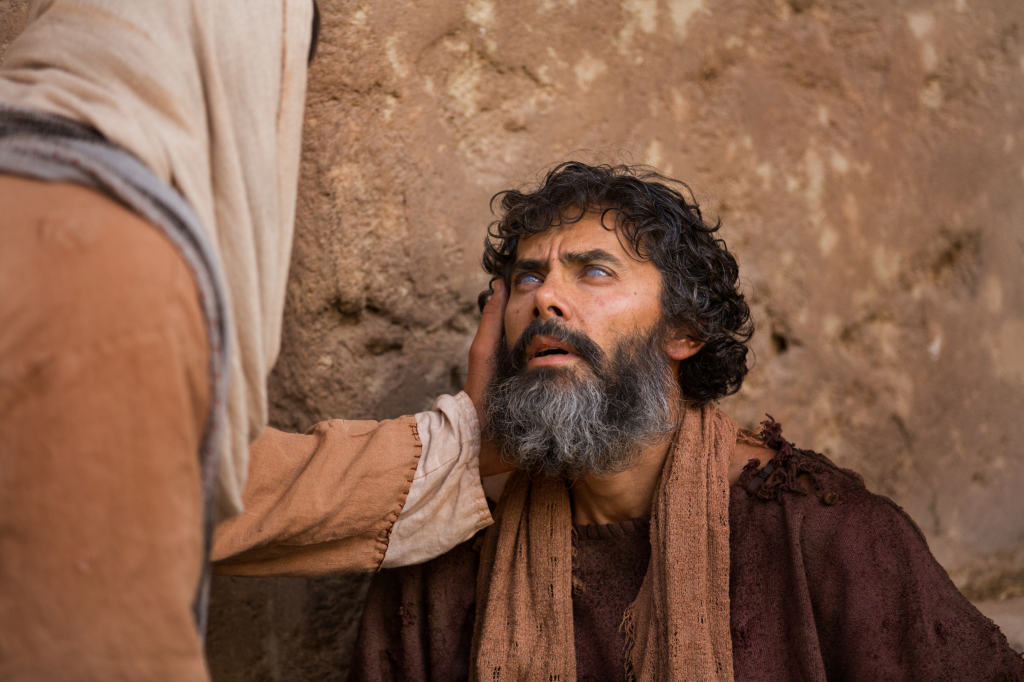
As he was walking along, he saw a man blind from birth.

“Master,” his disciples asked him, “why was this man born blind? Was it a result of his own sins or those of his parents?”

“Neither,” Jesus answered. “But to demonstrate the power of God. All of us must quickly carry out the tasks assigned us by the one who sent me, for there is little time left before the night falls and all work comes to an end. But while I am still here in the world, I give it my light.”

Then he spat on the ground and made mud from the spittle and smoothed the mud over the blind man’s eyes, and told him, “Go and wash in the Pool of Siloam” (the word Siloam means “Sent”). So the man went where nd washed and came back seeing!

Up to now I’ve tried to approach these posts from the first person viewpoint. Ihoped to understand those who met face-to-face with Jesus. I wanted to grasp what they were seeing through their own eyes. But I intend with this post to revert back to a more traditional approach to this passage.

First, we’re introduced to a man who is blind from birth.

I can’t even imagine what that would be like (just as he probably could imagine having sight). I’ve been told that he probably didn’t have a “dream” life–that requires having seen images (a dog, a tree, a mean person) and this wasn’t available to him. He never saw the color red, or seen a mountain. (He didn’t have the circuitry.)

I suppose we can only imagine what blindness like this would be.

Somehow I’ve come to an idea that this represents fallen men–we’re spiritually blind to the workings and truths of Jesus’ Kingdom. It seems a pretty good explanation of each of us–“blind from birth.”

Secondly, notice the response of the disciples who first met this unfortunate man. They don’t see his needs, rather they want to know the theology behind this. Perhaps that’s how we respond much of the time–we don’t see the needs, we only want to know the reasons. We’re not wise or discerning enough to see what’s going on–in short we’re not equipped to love or show mercy. (We haven’t got the circuitry.)

Perhaps this is how we operate as immature Christians.

We don’t engage the need, but rather we like having great theology over understanding compassion. If we really don’t love needy people, we miss so much. We don’t ever grow up. It’s easy to philosophize–it’s hard to get down and serve and really love others.

It’s funny but Jesus declares Himself to be the light of the world while speaking to the man who is born blind.

Third, we discover the gentle mercy that Jesus has when He meets needy people. Now the Lord does accommodate His followers, but not at the expense of engaging the need of the moment. Jesus is full of compassion–most especially when He meets broken people–and as His followers, we must grasp this.

Good theology is not the primary calling of Jesus’ followers.

As I mature in Christ I’m learning (slowly) that people are His real focus. He has come, not to theologize or philosophize, but to meet needs! Sure the reasons why become clearer, but that really isn’t Jesus’ primary goal. People are, not having impeccable theology.

Classes in systematic theology are good, but soup kitchens are better.

The miracle happens, and Jesus’ love and desire to restore this man is ‘front and center.’ The Lord’s methodology is interesting. Spit and mud, wiped on the blind man’s eyes. In Genesis we discover that God made man out of dirt and dust of the ground. Perhaps what He’s doing here mirrors that work.

And it’s also important to understand that Jesus never performs the exact same healing in the exact same way. For some reason He ‘tailors’ His work to the individuals deepest need. I suppose He doesn’t want us to grab a hold of a formula, as that’s what we want to have.

The story is primarily about a blind man’s healing.

It’s not theology, and it certainly isn’t about what is proper and acceptable. We really must understand this, and we really need to understand the tremendous mercy and power of God to both heal and restore.

Image: MCCC. Text from the “Living Bible,” published by Tyndale House


Covered in Shame

Psalm 44:15

Some of us truly understand shame. It’s like we have been dipped in it, we have wallowed in it, and awful things are sticking to us. We live out our lives in disgrace and in the sense of nasty embarrassment which we can’t truly resolve. And it effects all that we do, even in those rare moments we are not aware of it.

Sometimes I wish I was teflon.

I would love to have a ‘non-stick’ heart. There is often a constant sense of being totally insufficient as a person. It seems I can develop a deep awareness of being defective and unworthy. Many of us feel this way all the time. It is painfully welded to us, and we keep trying to figure how to break that dark bond that’s on our hearts and minds.

Sometimes mental illness thrives on that blackness.

Depression feeds on that stuff, it seems to cycle through us. Our pasts become its nourishment, and at certain times it flourishes. Sometimes it explodes in our minds.

A psychiatrist once told me that 90% of resident psych patients could go home, if only they knew they were truly forgiven.

Shame is a monster that is constantly tracking us. At times we can put some distance between us. But occasionally it leaps up on our backs and drags us down. We are humiliated with our guilt. That is precisely when we should scream out for help.

There are pastors and psychiatrists, therapists and friends who are most helpful. Practicing prayer and soaking ourselves in worship can drive the monster away. And maybe meds can often provide help. All of these have helped me.

Human beings were never created to bear guilt.

But we really don’t know what to do. Shame is vigorously parasitical and consuming. If it runs amok through your life it can and will destroy you. And it’s caustic, it erodes your relationships with others. It blocks grace.

God has made an incredible effort to remove your guilt. Your sin, though it is crimson red in its intensity and very obvious, becomes as white as snow. Your shame and guilt can be erased.

The blood of Jesus, and the cross, can free the guilty and give us real life.

Please trust Him in this. He wants to do this for you.

Isaiah 1:18

Your Dark Past

“For the kind of sorrow God wants us to experience leads us away from sin and results in salvation. There’s no regret for that kind of sorrow. But worldly sorrow, which lacks repentance, results in spiritual death.”

2 Corinthians 7:10, NLT

“You will have mercy on us again; 
 You will conquer our sins.
 You will throw away all our sins
 into the deepest part of the sea.”  

Micah 7:19, NCV

 
I’ve done many evil things in my life that I am ashamed of. Regret and sorrow over my sins frequently trouble me. But I always come back to see my sins covered by His blood.
 
I’d probably go insane if all I could do is see my sin without a Savior.

“Properly remembering our past sins with shame will deter us from repeating them and help us receive God’s saving grace.  When we recall our failures through the lens of Christ’s mercy, God produces in us ongoing repentance and deepening humility.” 

–Robert D. Jones

I have walked in self-hatred for many years.  I know all about loathing, fear, and paranoia over my many sins.  These things have handicapped me spiritually, and hating yourself is a terrible way to live.  My struggles with guilt and regret have deepened my sense of despair and depression. 

I’ve come to a point where I find that I am ashamed of my shame.

I have included the lyrics to Bob Bennett’s song “Lord of the Past” in this post.  He is a gifted songwriter and an exceptional guitar player.  (I can’t find it on Youtube.com.)  If you’re like me, you will find that you resonate with those who have been assaulted in the past.

We now speak a common language, and we understand each other. 

We are those whom Jesus has completely forgiven.

LORD OF THE PAST
Bob Bennett
© 1989 Matters Of The Heart Music (ASCAP)  

Every harsh word spoken
Every promise ever broken to me
Total recall of data in the memory
Every tear that has washed my face
Every moment of disgrace that I have known
Every time I’ve ever felt alone

Lord of the here and now
Lord of the come what may
I want to believe somehow
That you can heal these wounds of yesterday
(You can redeem these things so far away)
So now I’m asking you
To do what you want to do
Be the Lord of the Past
(Be the Lord of my Past)
Oh how I want you to
Be the Lord of the Past

All the chances I let slip by
All the dreams that I let die in vain
Afraid of failure and afraid of pain
Every tear that has washed my face
Every moment of disgrace that I have known
Every time I’ve ever felt alone

Well I picked up all these pieces
And I built a strong deception
And I locked myself inside of it
For my own protection
And I sit alone inside myself
And curse my company
For this thing that has kept me alive for so long
Is now killing me.
And as sure as the sin rose this morning,
The man in the moon hides his face tonight.
And I lay myself down on my bed
And I pray this prayer inside my head

Lord of the here and now
Lord of the come what may
I want to believe somehow
That you can heal these wounds of yesterday
So now I’m asking you
To do what you want to do
Be the Lord of my Past
You can do anything
Be the Lord of the Past
I know that you can find a way
To heal every yesterday of my life
Be the Lord of the Past.


Rembrandt’s Prodigal Son

Rembrandt-The_return_of_the_prodigal_son
Rembrandt, “The Return of the Prodigal Son,” c. 1661

17 “But when he came to himself, he said, ‘How many of my father’s hired servants have more than enough bread, but I perish here with hunger! 18 I will arise and go to my father, and I will say to him, “Father, I have sinned against heaven and before you. 19 I am no longer worthy to be called your son. Treat me as one of your hired servants.”’ 20 And he arose and came to his father. But while he was still a long way off, his father saw him and felt compassion, and ran and embraced him and kissed him. 21 And the son said to him, ‘Father, I have sinned against heaven and before you. I am no longer worthy to be called your son.’ 22 But the father said to his servants, ‘Bring quickly the best robe, and put it on him, and put a ring on his hand, and shoes on his feet. 23 And bring the fattened calf and kill it, and let us eat and celebrate. 24 For this my son was dead, and is alive again; he was lost, and is found.’ And they began to celebrate.

Luke 15:17-24, ESV

Two hundred and eighty-nine words– these describe the life of every man, woman, and child who has ever lived. These 289 words reveal to us a God who loves far too much, way too easy. Perhaps we sort of expect that he will ‘appropriately’ punish his son– at least put him on probation at least. It only makes sense. But we find that is legalism talking.

“Every saint has a past, and every sinner has a future.” 

Many of us have lived as prodigals, and we have spent our inheritance like ‘drunken sailors.’ We really have nothing at all to show for it. The prodigal, completely destitute, takes the only work he can find. (Imagine a good Jewish boy feeding hogs.)

He is so far gone that he starts inspecting the filthy slop buckets for something to eat.

Many of us will understand his despair. Often there comes to us a crystalline moment of simple awareness. The prodigal, sin-crusted and impoverished, still has a lingering memory of the Father’s house.

The servants there had far more than him right now. Sometimes I wonder if in our captivity, we instinctively want to go home, if only in our minds, to be a servant there.

The Father has dreamed of this precise moment.

The parable says, “He saw him–felt compassion–ran out to him–embraced him–and kissed him.” The Father is a whirlwind of agape love. I’ve read the Parable of the Prodigal Son a hundred times or more. It never loses its punch. I simply want to bring some observations: 

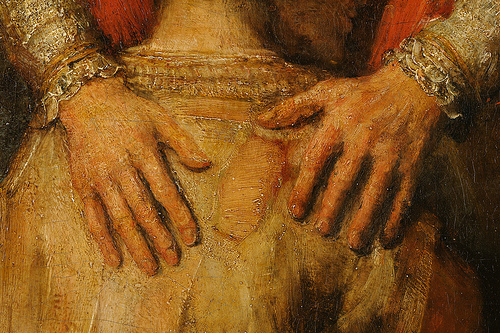
  • We see that his father receives him with a tender gesture. His hands seem to suggest mothering and fathering at once; the left appears larger and more masculine, set on the son’s shoulder, while the right is softer and more receptive in gesture.
  • The son’s head is downy, almost like a newborn’s. We must enter the kingdom like little children. 
  • The Prodigal Son seems to be protected by his father. He snuggles near the Father’s breast. It’s love that holds him there.
  • Consider his sandals. It has taken a long time for him to come home. 
  • Standing at the right is the prodigal son’s older brother, who crosses his hands in stoic judgment; we read in the parable that he objects to the father’s compassion for his brother.
  • We see his mother in the background in the painting, and a seated steward or counselor. One stands in profound joy, the other in sits in stunned perplexity.

But Rembrandt had painted the Prodigal once before, when he was considerably younger. And it is a very good painting. The prodigal is happy and gay; there is absolutely no indication of the consequences of sin.

The Prodigal Son in the Brothel, 1635

He’s a charming young man at the height of his popularity, and we see him at a happy party. He is spending the inheritance of his father.

But Rembrandt chooses at the very end of his life to re-paint it to reflect reality.

This is one of the last paintings he will do, and it is the Prodigal Son–destitute and repenting. I can only imagine; the years have taken a toll and he doesn’t really feel his first painting is enough. He wants to paint what is true.

He now is painting our spiritual condition.

We are given a work that some critics call as the greatest painting ever completed. The painting is now in St. Petersburg, Russia. It is seldom seen by visitors. It is a clear echo of the grace of God for fallen men and women. Like the father in the painting, He’s ready to forgive every sin saturated son and daughter.

The Father’s Prodigal

bry-signat (1)