Make the Decision to Be Weak


Our society has pretty much embraced the American cultural icon of the cowboy.  We revere those who ride alone and hard. We are rugged individualists and hardened men making our own way.  Our society reflects this in subdued ways.  No matter what happens, we are fiercely free and independent.  We are ‘desperadoes’–we do whatever we think is best.

John Wayne, the ‘Alamo,’ and the biker with his Harley-Davidson on Route 66 have been our inspiration.  Each are distinctly heroic and carry our hopes and dreams.

We must understand that the Bible is not an American book.

It belongs to every tribe, race, and nation. 

A cowboy did not die for our sins (which are countless).  The way of discipleship does not take us through Luckenbach, Texas. We’re not desperados. We are Jesus’ disciples.

His Words to us are bold and entirely challenging in an amazingly fresh and different direction.  We are told to wash feet, to repeatedly turn the other cheek, to surrender all our rights, and then take the lowest place there is in every situation.

Our lives truly begin when we come under the Lordship of Jesus Christ.

Humility is to become the way we think and how we act, we have become slaves to righteousness.  Our vaunted independence has been toppled. This selfish crown has slipped. My willfulness still wants to stand instead of kneeling. We discover this has been the truth all along.  We have never ever been in control. 

He has been the King since before time, and will always be, for an eternity.

“Many Christians have what we might call a “cultural holiness”. They adapt to the character and behavior pattern of Christians around them. As the Christian culture around them is more or less holy, so these Christians are more or less holy. But God has not called us to be like those around us.

He has called us to be like Himself. Holiness is nothing less than conformity to the character of God”.

Jerry Bridges

Our churches often struggle over our personal issues of pride and stubbornness. 

I pose the following questions.  Are we honestly in a condition of being weak?  Can you serve with a basin and towel?  Is your heart that of a child? Do we see the world through the ‘lens’ of a soft and broken spirit?

I write these things surveying my own life. 

Self will and my hard heart fit ‘hand-and-glove’ with being that desperado.  I ride alone, making my own way, and I don’t make any disciples. I jettison my cross— my cross of discipleship.  I serve no one, unless it suits me.  Am I His disciple, or am I a man of my own?  Is He my Lord, or have I decided to claim that right for myself?

I only hope I have spoken the truth today. Forgive me if I offended.

“Lord, I am willing to receive what You give, to lack what You withhold, to relinquish what You take, to suffer what You inflict, to be what You require.”  Amen.


When There’s Blood in the Water

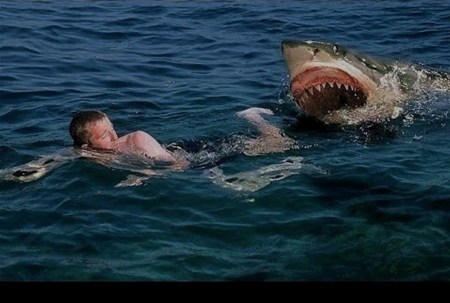
It’s a fact. Biologists tell us that sharks can smell blood from 2-3 miles away. They follow their noses to the place where they sense it. They have an ‘attack mechanism’ that drives them to their victim . Blood acts as a trigger inside their brains. Occasionally dozens of sharks attack in a feeding frenzy.

Over 40 years in the Church has taught me that sharks aren’t the only ones that turn on the wounded.

The Church is supposed to be a safe and a healing place.

This is what the Holy Spirit wants. That isn’t always the case. Someone fails, another falters. Sin is uncovered and the sharks move in. There is blood in the water. Now things don’t always work this way, but it does happen.

There are some who might be restored, and yet others are trampled down instead.   There’re many who would rather pounce than pray. Unfortunately when the “sharks” attack it almost always ends up being a as a vicious personal attack. It only creates more blood in the water.

There are many who are bleeding.

They are those with a mental illness, or confined to a wheelchair, or with Downs Syndrome, they are the first that come to mind. They’re often the the very sick, the developmentally disabled, the drunk, the addict, the adulterer, the disabled, the homosexual, the poor, and the ex-con who are just several kinds of people that regularly get hurt in our churches.

Matthew 5:7, ESV

Mercy is what God extends to people who don’t deserve any. Failure to understand God’s deep penchant for the broken puts us in a bad place. We don’t always understand. Keep in mind that the Prodigal’s older brother refused to party with the forgiven son.

How terribly sad, and religiously confusing. I have to wonder, who really has been attacked by the enemy? The Kingdom of God is specifically designed for losers; it exists for the sick, the stumbler and the sinner.

In theory, we agree with Matthew 5:7.

We find tremendous inspiration when this verse is read. But the noble feelings don’t always translate into dedicated action. I’ve come to see that I must consciously press this into action. I must actively show mercy for the healing of others– and if anything, just to protect my own heart.

The Great Physician has come for the sick, not so much who consider themselves healthy.

He loves each of us, but Jesus cares in different ways. He tailors His grace to fit our sin. He’s concerned for the very worst of us. Yes, repentance is necessary and crying out to Jesus for healing is always needed.

Jesus has always been associated with the lowly.

If there is blood in the water, let’s turn it up a notch, and let’s show special mercy for those who are struggling. Let us be kinder than we have to be. If we err— let us always err on the side of mercy and kindness. 

For further studyPsalm 72:13; Psalm 82:4; Matt. 9:12; Romans 15:1; 1 Thess. 5:14;

&

When God Doesn’t Heal You

Mike Mason

God heals. Of that I have no doubt. We have many promises and see so much actual healing in Scripture. Jesus’ ministry would connect with hundreds of people who would be physically touched. The Lord would pass the baton on to His Church. We’re called to “lay hands on the sick,” (James 5:14-15).

But not everyone who is sick will receive physical healing. Even those who were active in ministry knew sickness.

In the second episode of season 3 of “The Chosen,” Little James, who we’ve seen walks with a limp, comes to Jesus after He commissions the Apostles. He tells him he finds it hard to believe that he will be healing people, given that Jesus hasn’t healed him.

“Do you want to be healed?” asks Jesus.

“Yes, of course,” James says, “if that’s possible. Why haven’t you?” he asks Jesus—again, a question some of us would’ve asked.

“Because I trust you,” Jesus says. “Little James. Precious Little James. I need you to listen to me very carefully, because what I am going to say defines your whole life to this point and will define the rest of your life. Do you understand?”

Jesus tells James that he will heal many people, and they will have a good story to tell.

“To know how to proclaim that you still praise God in spite of this—to know how to focus on all that matters, so much more than the body—to show people that you can be patient with your suffering here on Earth, because you know you’ll spend eternity with no suffering—not everyone can understand that. How many people do you think the Father and I trust this with? Not many.”

“But the others,” James says, “they are so much more … stronger, better at this.”

“James, I love you,” Jesus says, “but I don’t want to hear that ever again.”

“I know how easy it is to say the Psalm of David, that I am beautifully and wonderfully made, but it doesn’t make this any easier,” says James, begins to weep. “It doesn’t make me feel like any less of a burden.”

“When you pass from this earth,” Jesus says to James, “and you meet your Father in Heaven, where Isaiah promises you will leap like a deer, your reward will be great. So hold on a little longer. And when you discover yourself finding true strength because of your weakness, when you do great things in my Name in spite of this, the impact will last for generations. Do you understand?”

James cries, and says, “Yes. Thank you, Master.”

I believe that there are two truths that every Christian can count on. These are solid, and completely trustworthy. They are forever fixed and will never change.

“Fear not, for I am with you; be not dismayed, for I am your God; I will strengthen you, I will help you, I will uphold you with my righteous right hand.” Isaiah 41:10

“He will wipe away every tear from their eyes, and death shall be no more, neither shall there be mourning, nor crying, nor pain anymore, for the former things have passed away.” Revelation 21:4

     John Henry Newman  

One More Night With the Frogs

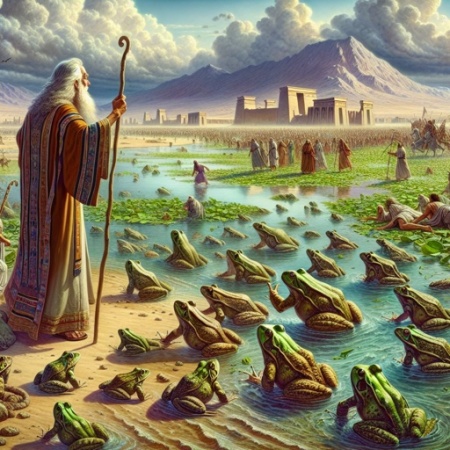
“You set the time!” Moses replied. “Tell me when you want me to pray for you, your officials, and your people. Then you and your houses will be rid of the frogs. They will remain only in the Nile River.”

“All right,” Moses replied, “it will be as you have said. Then you will know that there is no one like the Lord our God.

Exodus 8:9-10

Often there comes a point in a person’s life that not to make a decision, becomes the decision.

This was the dynamic working in Pharaoh’s mind. God had warned him earlier that he must release the Jews from slavery. But he oscillates, and vacillates after each warning. His stubborn indecisiveness  is remarkable. Pharaoh resists, and becomes more and more obstinate.

There is a deep danger of delay.

God sends 10 plagues– quite dramatic and miraculous. But “the supernatural” really can’t touch certain hearts. There were certain Pharisees in Jesus’ time that they would not believe, no matter what Jesus did. (We call this, “hardness of heart.”)

In this particular ‘show-down’ a plague of frogs is threatened. It’s kind of funny, but Pharaoh doesn’t dispute the possibility of this “green invasion.” He just absorbs the inevitable. Pharaoh simply replies, “I will take one more night with the frogs.”

Within Egyptian mythology the frog was regarded as “holy.” It wasn’t to be harmed or killed. It was regarded as a blessing to the people. But that was hardly the case among the enemies of God’s chosen.

Often there comes a point in a person’s life that not to make a decision, becomes the decision.

Sadly to say, there are so many like that man today. “Lord, I’m going to follow You, but let me have just one more fling, one more trip to Vegas, or the bar, or the Princess cruise, or a new car– just “one more night with the frogs!” And the “one more night” stretches out into a terrible, endless night, in the blackness of darkness forever.

2 Corinthians 6:2

Will you choose to spend another night with the frogs, that is, in your sins? Or will you come to Jesus Christ for salvation today? There are consequences that follow each decision. What will you decide today? Will it be sin or the Savior? Will it be Heaven or Hell? Will it be forgiveness or the frogs? What will you do with the message you have read here today?

Often there comes a point in a person’s life that not to make a decision, becomes the decision.

bry-signat (1)