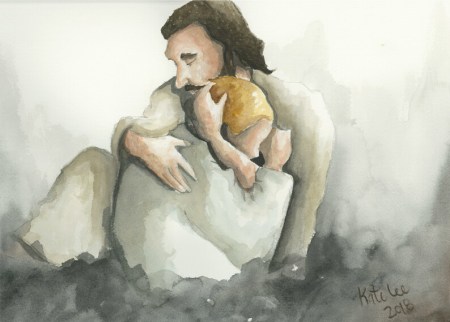
“Snuggle in God’s arms. When you are hurting, when you feel lonely, left out. let Him cradle you, comfort you, reassure you of His all-sufficient power and love.”
This should give direction and dialogue on the issues faced by every church member. It is a great opportunity we have been given— to minister to every person in the Body of Christ. —Bryan
by Ken Camp, Associated Baptist Press —
Living with depression — or any other form of mental illness — is like viewing life “through a glass darkly,” according to Jessy Grondin, a student in Vanderbilt University’s Divinity School. “It distorts how you see things.”
Like one in four Americans, (25%), wrestles significantly with a mental illness.
Depression is one of the most common types of mental illness, along with bipolar disorder, another mood-altering malady. Other forms of mental illness include schizophrenia and disorders related to anxiety, eating, substance abuse and attention deficit/hyperactivity.
Like many Americans with mental illness, Grondin and her family looked to the church for help. And she found the response generally less-than-helpful. “When I was in the ninth grade and hospitalized for depression, only a couple of people even visited me, and that was kind of awkward. I guess they didn’t know what to say,” said Grondin, who grew up in a Southern Baptist church in Alabama.
Generally, most Christians she knew dealt with her mood disorder by ignoring it, she said. “It was just nonexistent, like it never happened,” she said. “They never acknowledged it.” When she was an adolescent, many church members just thought of her as a troublemaker, not a person dealing with an illness, she recalled.
Mental Illness that affects believers must be accepted by the Church.
A few who acknowledged her diagnosed mood disorder responded with comments Grondin still finds hurtful. “When dealing with people in the church … some see mental illness as a weakness — a sign you don’t have enough faith,” she said. “They said: ‘It’s a problem of the heart. You need to straighten things out with God.’ They make depression out to be a sin, because you don’t have the joy in your life a Christian is supposed to have.”
A Baylor University study revealed that among Christians who approached their local church for help in response to a personal or family member’s diagnosed mental illness, more than 30 percent were told by a minister that they or their loved one did not really have a mental illness. And 57 percent of the Christians who were told by a minister that they were not mentally ill quit taking their medication.
It’s not a sin to be sick.
That troubles neuroscientist Matthew Stanford. “It’s not a sin to be sick,” he insists. Stanford, professor of psychology and neuroscience and director of the doctoral program in psychology at Baylor, acknowledges religion’s longstanding tense relationship with behavioral science. And he believes that conflict destroys lives. “Men and women with diagnosed mental illness are told they need to pray more and turn from their sin. Mental illness is equated with demon possession, weak faith and generational sin,”
Stanford writes in his recently released book, Grace for the Afflicted. “The underlying cause of this stain on the church is a lack of knowledge, both of basic brain function and of scriptural truth.” As an evangelical Christian who attends Antioch Community Church in Waco, Texas, Stanford understands underlying reasons why many Christians view psychology and psychiatry with suspicion. “When it comes to the behavioral sciences, many of the early fathers were no friends of religion. That’s certainly true of Freud and Jung,” he noted in an interview.
Often sin is not the main issue.
Many conservative Christians also believe the behavioral sciences tend to justify sin, he added, pointing particularly to homosexual behavior. In 1973, the American Psychiatric Association famously removed homosexuality from its revised edition of its Diagnostic and Statistical Manual of Mental Disorders. As a theologically conservative Christian, Stanford stressed that scripture, not the Diagnostic and Statistical Manual, constitutes the highest authority.
But that doesn’t mean the Bible is an encyclopedia of knowledge in all areas, and all people benefit from scientific insights into brain chemistry and the interplay of biological and environmental factors that shape personality. Furthermore, while he does not presume to diagnose with certainty cases of mental illness millennia after the fact, Stanford believes biblical figures — Job, King Saul of Israel and King Nebuchadnezzar of Babylon, among others — demonstrated symptoms of some types of mental illness. “Mental disorders do not discriminate according to faith,” he said.
Regardless of their feelings about some psychological or psychiatric approaches, Christians need to recognize mental illnesses are genuine disorders that originate in faulty biological processes, Stanford insisted. “It’s appropriate for Christians to be careful about approaches to treatment, but they need to understand these are real people dealing with real suffering,” he said. Richard Brake, director of counseling and psychological services for Texas Baptist Child & Family Services, agrees. “The personal connection is important. Church leaders need to be open to the idea that there are some real mental-health issues in their congregation,” Brake said.
Pastors much carefully reach out to the mentally ill.
Ministers often have training in pastoral counseling to help people successfully work through normal grief after a loss, but may lack the expertise to recognize persistent mental-health problems stemming from deeper life issues or biochemical imbalances, he noted. Internet resources are available through national mental-health organizations and associations of Christian mental-health providers. But the best way to learn about available mental health treatment — and to determine whether ministers would be comfortable referring people to them — is through personal contact, Brake and Stanford agreed. “Get to know counselors in the community,” Brake suggested. “Find out how they work, what their belief systems are and how they integrate them into their practices.”
Mental-health providers include school counselors and case managers with state agencies, as well as psychiatrists and psychologists in private practice or associated with secular or faith-related treatment facilities, he noted. Stanford and Brake emphasized the vital importance of making referrals to qualified mental-health professionals, but they also stressed the role of churches in creating a supportive and spiritually nurturing environment for people with mental-health disorders. Mental illness does not illustrate lack of faith, but it does have spiritual effects, they agreed. “Research indicates people with an active faith life who are involved in congregational life get through these problems more smoothly,” Brake said.
You can’t fix the issues, but you can love them.
Churches cannot “fix” people with mental illness, but they can offer support to help them cope. “The church has a tremendous role to play. Research shows the benefits of a religious social support system,” Stanford said. They stressed the importance of creating a climate of unconditional love and acceptance for mentally ill people in church — a need Grondin echoed. “There needs to be an unconditional sense of community and relationships,” she said. She emphasized the importance of establishing relationships that may not be reciprocally satisfying all the time.
People with mental-health issues may not be as responsive or appreciative as some Christians would like them to be, she noted. “Others need to take the initiative and keep the relationship established. People don’t realize how hard it can be (for a person with a mood disorder) to summon the courage just to get out of bed,” Grondin said. Christians who seek to reach out to people with mental illness need to recognize “they are not able to see things clearly, and it’s not their fault,” Grondin added.
Mostly, Christians need to offer acceptance to people with mental illness — even if they don’t fully understand, she insisted. “Just be present. Offer support and love,” Grondin concluded. “You won’t always know what to say. Just speak words of support into a life of serious struggles. That means more than anything.”
(EDITOR’S NOTE — Camp is managing editor of the Texas Baptist Standard.)
A great book:
“Grace for the Afflicted: A Clinical and Biblical Perspective on Mental Illness” [Paperback] can be found at www.Amazon.com, by Matthew S. Stanford Ph.D
*******
For more information: National Alliance on Mental Illness (800) 950-6264 Anxiety Disorders Association of America (240) 485-1001 Depression & Bipolar Support Alliance (800) 826-3632 American Association of Christian Counselors (800) 526-8673 Stephen Ministries (314) 428-2600
“But he turned and said to Peter, “Get behind me, Satan! You are a hindrance to me. For you are not setting your mind on the things of God, but on the things of man.”
Matt. 16:23
The principles of the Kingdom will often confuse an outsider. In this chapter of Matthew, we hear Peter extolling the divinity of Jesus (vv. 15-17). Peter exceeds the norm with his analysis of what he believes is real and true.
Peter’s insight is as perceptive as it is supernatural. “You are the Christ,” Peter proclaims, “the Son of the Living God,” Jesus responds to this and He praises Peter for his sensitivity.
But, just a short time after he makes his astonishing pronouncement, he is taken apart by Jesus, being solidly rebuked face-to-face. In one clear and singular moment, he expresses a wonderful faith, and then suddenly his personal awareness precipitously crashes. He is now an evil person with Satan’s agenda. (See verse 23.)
I’m not sure why Peter does what he does.
It seems that in the light of this chapter (which actually seems like a bright glare), Peter is devastated. In three years of discipleship, it seems that all he merits is a brutal ‘dressing-down.’ All because he thinks he can correct Jesus, “the Son of the Living God.”
The rebuke is bitter. Peter is being compared to Satan!
I suspect that Peter was ashamed. He most likely wished he had a rewind button. His Savior, Jesus– has given him a new label. And it hurts. Many times, we would become resentful, maybe a bit bitter. It could cause some to walk away, developing an anger that solidifies into a permanent offense. Thank God, Peter doesn’t do anything that stupid.
The correction in the rebuke gives him life and hope.
But who’s to say we would be as correctable? Peter was rebuked in the presence of the other disciples. The publicity was embarrassing. Too many people were watching and listening. Peter will survive this, but he has to learn something valuable.
Our daily commitment to Jesus hinges on our willingness to be undone.
Jesus pretty much rakes us over the coals. He insists on total obedience to His faithfulness. And like Peter, we will learn. It may take some time though.
Every true disciple will be scorched– but incredibly loved.
My own studies have immersed me in the awful book of Job. This man lost everything–there is much we can learn from him. But it may be a definite challenge to plow through these “dark” issues. But we need to do this, sooner or later.
First of all, Job is a mysterious book. There’s no reference to the Temple or the Temple services. No connection with other biblical writings or persons. Most students believe that the book of Job is the first one written in the Old Testament.
It’s not Jewish, but it’s not pagan either.
In a real sense, it speaks about suffering and pain. Job lost everything. And yet this book tries to explain what broken believers face every day. We all struggle. We all will experience some sort of suffering and loss.
Job connects us with those with illnesses–mental or physical.
We are people who must try to navigate through dark things. Most will never really understand this, but we are those who must face adversity and conflict. Like Job we start to ask why. We may even end up accusing God of attacking us.
We have to sort things out and believe me, it’s never easy. As we try we’ll often ask “why me?” We often accuse God. But I’m thoroughly convinced that the Almighty isn’t fazed by our questions and we should never think we’re wrong when we so challenge his goodness. He’s big enough to handle these.
In Job we’ll learn to hear God speak to us through “the whirlwind.”
I want to encourage you (the reader) to find place in your heart for this book. Job isn’t easy to read–but I’ve gained a lot by reading it in a modern translation, but anything works. Just pick it up and read. Chapters 1-3 are good.
We’ll realize all of our questions will probably not be answered, but that’s okay. The problem of our suffering will most likely remain. There are no pat answers. I’m sorry.
“Anyone who has suffered knows that there is no such thing as ‘getting a grip on oneself’ or ‘pulling oneself up by the bootstraps.’ The only bootstrap in the Christian life is the Cross, sometimes laying hold of the cross can be comforting, but other times it is like picking up a snake.””








 Broken Believers