From Vessel to Vessel

amphora_on_stand

“Moab has been at ease from his youth, and he has settled on his lees, and has not been emptied from vessel to vessel, neither has he gone into captivity: therefore his taste remained in him, and his scent is not changed.”

Jeremiah 48:11, ESV

The expression, “emptied from vessel to vessel” is a figure that speaks of wine making. It relates to a method used to produce a well-refined wine, which is poured into a vessel and allowed to stand for a certain length of time. Then it is poured into another vessel.

Each time this is done, there is a settling of the dregs and sediment which remain in the container, as the wine-maker carefully pours the liquid into another vessel. This process is repeated until the wine is perfectly refined and yields a freshness of fragrance and color that is pleasing to the maker.

This result will not occur if the wine had been allowed to stay in only one vessel. Instead, it would have “settled upon its lees” and become scented with the essence of the dregs. Because the intention of the Lord is to bring us to spiritual maturity, we also are carefully poured from vessel to vessel.

We’re being poured from one dealing to another.

As we yield to His purpose, the Holy Spirit will see to it that we are brought, step upon step (vessel by vessel), into spiritual growth and maturity. With our wills yielded, and our spirits mellowed, we shall then become “wine, well refined.”

Once we understand what we are by nature, we realize that no natural power could carry out so massive of  an undertaking. If ever this is to be accomplished, the power must come from a source other than ourselves. Thus, the Lord simply asks us to become willing, yielded, broken material upon which to work, and He will furnish the means and power for our transformation.

The Lord does not say the vessels are all alike.

That would spoil the teaching given in this figure. Rather, the vessels are quite different, scarcely two being alike. Let’s consider a few in order to enlarge our understanding.

The first is a vessel made of tinted glass.

As the wine is emptied within, it assumes a color that results from the hue of the glass. This is the vessel of misunderstanding. People then judge the wine as being “off-color.” An endless course of reasons ensues as to the cause of its being thus.

The “wine” is aware of these remarks, and as a result has a difficult time remaining still and submitted, so the sediment might settle and cling to the sides and bottom of the vessel. All this keeps the wine in a disturbed state, until finally it discovers that it is really what it should be at this time of its development, since only the glass (dealing) is tinted. Thus there is a delay and a longer time is needed to produce clear wine.

The Maker waits for it to become settled and then carefully pours it into another vessel. All that is left behind are a few dregs of self-importance and some shreds of the self-life.

There is the vessel of being in the public eye.

As the wine is poured out, it beholds the new vessel, a large but shallow receptacle, gray and ugly. At first there is a shrinking, for the vessel seems so unusual, and so absolutely unlike any into which it had been before emptied. As the wine is poured, it is so wide that it fills the entire open vessel. This is the vessel of “public gaze.” It is where the Lord pours us when we are to experience ‘weakness.’

The wine cannot gather itself up to appear in any other shape. It must spread out flat and be open to public judgment and criticism. The snide remarks hinder the wine from becoming quiet, yielded, and silent. But as it realizes that this is a necessary step in its perfection, it becomes settled and is again poured out. Clinging to the sides of the ugly, gray vessel are the dregs of pride and self-preservation, but added to the wine is a richer hue.

There is the vessel of isolation.

The next vessel is made of clay. It is tall with a long narrow neck, and is not transparent. Thus, it reflects no light. As the wine is poured, it has difficulty getting adjusted, owing to the darkness and a fear as to the certainty that it belongs there. But at last it yields and fills the vessel in ‘quietness.’

Here it stands for a long period of time, in shadow and darkness. At times, the wine faintly hears the music and delightful cries of those without who are in the light, but the clay allows no participation, nor affinity of satisfaction. The wine can only remember the light it had found in former days, and simply trust that it will shine again.

There’a another trial of a dark and bitter trial.

This is the vessel of long, dark trial; the kind in which the Lord leaves us alone in order to prove us, even in shadow and darkness. But it works wonders in the wine. As it is again poured forth, it gleams with the light of faith, tried and tested. Left behind are the dregs of impatience, questioning, and unbelief.

There is the vessel of misunderstanding.

Again the wine is poured into a new vessel, which is unusual in size and unique in design. It has many bulges and ridges. Therefore, the wine has a difficult time finding its way into the many bulges, odd nooks, and corners. Those who watch, immediately conclude that the wine is in the wrong vessel, and that it was never called to go into such a receptacle. Thus, it appears to others that the wine’s leading and witness is wrong. This is the vessel of misunderstanding.

The Lord’s ways are not our ways; thus, His ways are often incomprehensible. The Lord seldom explains to others the leadings which He lays upon those who are His own. It is certainly death to our flesh to be led into situations that produce criticism from others, and then not be able to satisfy their reasoning’s. Thus, the wine finds no pleasure in this vessel, but it had been poured and must now fill the vessel.

“The same Jesus who turned water into wine can transform your home, your life, your family, and your future. He is still in the miracle-working business, and His business is the business of transformation.”

     Adrian Rogers

Pushing Through

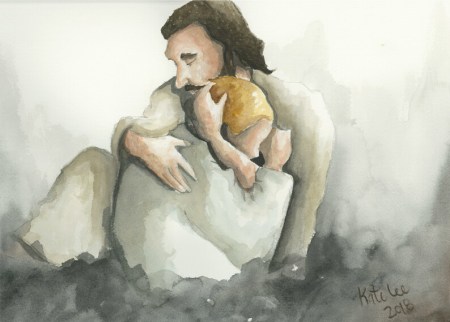
“Snuggle in God’s arms. When you are hurting, when you feel lonely, left out. let Him cradle you, comfort you, reassure you of His all-sufficient power and love.”

     Kay Arthur

There is a lifeline if you are:

  • A weary leader, caregiver, or simply a burned-out believer.
  • Navigating the heavy fog of grief, anxiety, or emotional numbness.
  • Quietly asking yourself, “Why do I still feel so empty?”
  • Aching to feel close to Jesus again.

You don’t have to fix yourself to be found. You’re not too broken—you are already being held.

To Be Unseen

“Sit ye here while I go and pray yonder.”   

Matthew 26:36, KJV

by J.R. Miller

You and I have often felt that experience, that disappointment. There has arisen, mayhap [‘perhaps’] a great opportunity for Christian service. Some are sent to the front; some are sent to the middle. But WE are made to lie down in the rear.

Perhaps sickness has come; perhaps poverty has come; perhaps obloquy [‘censure, blame’] has come; in any case we are hindered and we feel sore. We do not see why we should be excluded from a part in the Christian life. It seems like an unjust thing that, seeing we have been allowed to enter the garden, no path should be assigned to us there.

It is a hard thing to be kept in the background at a time of crisis. In the Garden of Gethsemane eight of the eleven disciples were left to do nothing. Jesus went to the front to pray; Peter, James and John went to the middle to watch; the rest sat down in the rear to wait.

Methinks that party in the rear must have murmured. They were IN the garden, but that was all; they had no share in the cultivation of its flowers. It was a time of crisis, a time of storm and stress; and yet they were not suffered to work.

Be still, my soul, it is not as thou deemest! Thou art NOT excluded from a part of the Christian life. Thinkest thou that the garden of the Lord has only a place for those who walk and for those who stand! Nay, it has a spot consecrated to those who are compelled to SIT…….

When that experience comes to thee, remember, thou art not shunted. Remember it is CHRIST that say ‘Sit ye here.’ THY spot in the garden has ALSO been consecrated. It has a special name. It is not ‘the spot of wrestling,’ not ‘the place of watching’, but ‘the place of waiting.’

There are lives that come into this world neither to do great work, nor to bear great burdens, but simply to be; …….they are the flowers of the garden which have had no active mission. They have wreathed no chaplet; they have graced no table; they have gladdened the sight of JESUS. By their mere perfume, by their mere beauty, they have brought Him joy; by the very preservation of their loveliness in the valley they have lifted the Master’s heart. Thou needst not murmur shouldst thou be one of these flowers!”

flourish2

o

J. R. Miller (1840 – 1912) James Russell Miller was born on March 20, 1840 at Frankfort Springs, Pennsylvania and died on July 2, 1912. Besides authoring over 80 books, booklets, and pamphlets, Dr. J.R. Miller was the Editorial Superintendent of the Presbyterian Board of Publication, and a very active pastor in a succession of churches. He had a strong popularity among that generation of believers.

______________________

This was sent to me from a dear friend; she had taken it from a very old devotional, published in 1925.  However, the truths are not dated.  They speak to us, long after the writer has gone to heaven. 

These principles come to us, especially with our disabilities– mental, emotional and physical. Perhaps they meet us in a hard place, but they can lead us into hope and purpose. 


cropped-christiangraffiti1 (2)


Deformed Hands

The Man with a Deformed Hand, Mark 3:1-5

Jesus went into the synagogue again and noticed a man with a deformed hand. 2 Since it was the Sabbath, Jesus’ enemies watched him closely. If he healed the man’s hand, they planned to accuse him of working on the Sabbath.
3 Jesus said to the man with the deformed hand, “Come and stand in front of everyone.” 4 Then he turned to his critics and asked, “Does the law permit good deeds on the Sabbath, or is it a day for doing evil? Is this a day to save life or to destroy it?” But they wouldn’t answer him.
5 He looked around at them angrily and was deeply saddened by their hard hearts. Then he said to the man, “Hold out your hand.”So the man held out his hand, and it was restored!
Mark 3:1-5

It was the Sabbath. I was led to the synagogue by a Pharisee who promised me money. I had no idea what was going to happen. This is my story,

I was born with a deformity in my hand. It was misshapened and more like a club than a hand. I had perfect use of the other and I learned to adapt. It seemed perfectly natural to me now. I suppose I just got used to it, but it would be nice to have a normal hand. The children in the streets would always made fun of me. I suppose I became the neighborhood outcast.

Life was never normal for me. I lived on handouts and spent my days sitting on the sidewalk out of the hot Judean sun. I suppose that there must been sin in my life for God to judge me so, that is what they told me anyway.

When the Pharisee approached me with the promise of money I jumped at the chance. “All you have to do is stand there and show off your hand.” That was easy enough. I could do that. Little did I know that I was just a pawn in the Pharisee’s plan to trap Jesus.

I entered the synagogue which was a new experience for me. I had never been inside but the Pharisee who was leading me said it was OK, that I was expected. I stood in the back trying not to be noticed. I held out my deformed just like they asked me to.

At one point Jesus noticed me. “Come up here,” he said, “Come up front.” I had no idea of what was going to happen, no way of anticipating what Jesus was going to do. Jesus challenged the Pharisees. “Is it part of the Law to do good on the Sabbath day. Should we not do what is right?” I was scared, I had no idea what I was mixed up in. The room was very quiet.

Jesus was angry and I was afraid. He looked around to see if anyone would answer him. No one did although the answer seemed plain enough, even for me. Yet I still had no idea what was going to happen next.

Jesus looked at me. I sensed his love and his peace in his gaze. “Hold out your hand,” he asked me. There were no theatrics. No hoopla, just a simple command. So I did exactly that, and in an instant I was completely healed.

What more could I say. My deformity was turned into a healthy hand. Bones and tendons and muscle instantly reorganized themselves and something normal appeared where their was once twistedness. I flexed new fingers and wondered exactly what had happened to me.

It took me years to realize that there was a deeper deformity in the Pharisees understanding that Jesus wanted to heal. It was an issue of grace and goodness over error and legalism. Yes, I was healed on the Sabbath, but that was what was supposed to happen. People were meant to be made whole on God’s special day of rest.

It is a tremendous thing to have two healthy and whole hands. I marvel at the goodness of God every time I think about it. The Lord has been gracious to me and I rejoice at that grace. He has made me a wonder.

Lord, at times I feel deformed. But please don’t forget me. I will always stumble if you’re not holding my hand, Remind that being religious is a poor substitute for your nearness. Amen.