A Failure to Understand [An Excerpt]

cropped-depressionmeds1.jpg

Excerpt from “A Firm Place to Stand”

BY MARJA BERGEN

I’m disappointed when friends and family who know me well say things that reveal a gross misunderstanding of depression and how it affects those of us who suffer from it. One person close to me thought depression was something we bring on when we feel sorry for ourselves. Perhaps she thought we liked the attention.

Sufferers of depression would do anything to feel happy and vibrant again. When I’m depressed, many friends keep me at arm’s length. I don’t blame them. It’s not pleasant to be around me when I can’t find anything to talk about except my pain. Depression does that to you: It turns your thinking inward; all you can wrap your mind around is the misery you feel. You end up feeling very alone.

Another person complained to me about an acquaintance with depression who couldn’t manage to do anything more than lie on the sofa. “Couldn’t he just try and make himself do something?” she asked. Nothing I said could convince her that this was an illness that, like other illnesses, couldn’t be helped by simple willpower. Those who have never experienced depression find it difficult to understand how profoundly a brain disorder can affect the entire body.

A long time ago, when I was bordering on psychosis, my doctor put me in a seniors’ care facility for a few days to give me relief from the stress I faced at home. I called a close family member to let her know where I was. She advised me, “You’ve got to pull yourself together and be strong. You have to try harder.” That was insensitive. I was at the facility because I was doing my best to recover – I wasn’t living with eighty and ninety-year-olds for fun. She should have known I always try my best. When I’m trapped in this state, extricating myself is extremely hard. I need time and medication to recover. If I sound angry and hurt, yes, I was.

A person I worked with recommended strongly that I get counseling. “You don’t need those pills you’re taking. All you need is to talk to someone at my church.” She knew nothing about mental disorders like mine. She had no idea what I was dealing with. Again, I seethed, remembering how psychotic I was when I was first admitted to hospital. I could become sick like that again if I didn’t take the medication my mental stability depended on. Would this person tell a diabetic to stop taking insulin?

Christian psychiatrist and author, Dwight L. Carlson, writes, “There are legions of God-fearing Christians who – to the best of their ability – are walking according to the Scriptures and yet are suffering from emotional symptoms. Many of them have been judged for their condition and given half-truths and clichés by well-meaning but ill-informed fellow believers. ‘Pray for God’s forgiveness,’ some are told. ‘A person who is right with the Lord can’t have a nervous breakdown.’”

Fortunately, I have not been treated in this way. The church congregations I’ve belonged to were understanding, yet the stigma continues. It hurts me deeply that Christians who should be compassionate are often judgmental. Church communities need to learn the medical basis for mental disorders and how that differs from the spiritual. They are in the best position to help those in crisis. But when they don’t understand, they are in danger of doing a lot of damage. For Christians, there is nothing worse than to be told our emotional problems are our own fault, the result of unconfessed sin. We suffer so much already. Having to shoulder blame multiplies our mental anguish.


flourishx

1 Dwight L. Carlson, Why do Christians Shoot Their Wounded? Helping (Not Hurting) Those With Emotional Difficulties,(InterVarsity Press, 1994)

Marja Bergen has lived with bipolar disorder for over forty years. Her mission is to dispel the lingering stigma attached to mental health conditions and to encourage people to lovingly welcome the sufferers into congregations by understanding them better and supporting them in practical ways.

She is the author of Riding the Roller Coaster (Northstone, 1999) and A Firm Place to Stand: Finding Meaning in a Life with Bipolar Disorder (Word Alive). Marja is the founder of the growing faith-based support group ministry, Living Room.  Visit her website and her blog.

 

cropped-christiangraffiti1 (3)

When Anxiety Becomes An Issue

anxiety

 Can all your worries add a single moment to your life?”

Matthew 6:27, NLT

“And who of you by worrying and being anxious can add one unit of measure (cubit) to his stature or to the span of his life?”

Matthew 6:27, AMP

Anxiety can be described as “misplaced concern.”  Many are over-wrought and disturbed by the way life is developing for them.  They can’t make it work, and find themselves in a place they regard as perilous.  They are stressed and then try to imagine themselves to a place of success.  But a year from now, they will not have improved and find themselves in pretty much in the same place.

The evil of anxiety is that we become overly concerned with the future— today. 

Under a great deal of worry, we develop a deep tendency for fear.  Soon doubt filters in and we work ourselves up into a significant problem.  Seeking success we find ourselves in the chains of anxiety and worry.

Jesus declared that we should never ever be anxious.  He suggests that anxiety will never pay-off.  Our fear over our future can bring us nothing but spiritual poverty, and emotional crisis  We find a bag and we try to collect some security and certainty, but little do we know that our bag has holes.  It holds nothing, and leaks everything.

No matter what we think, we change a single thing.  Concentrating on wealth and success will in the long run, is futile and empty.  We can’t make an iota of a difference.

6 “Don’t worry about anything; instead, pray about everything. Tell God what you need, and thank him for all he has done. Then you will experience God’s peace, which exceeds anything we can understand. His peace will guard your hearts and minds as you live in Christ Jesus.”

Philippians 4:6-7, NLT

Security for us is not what we can scrape up, but it is found in coming under the control of Jesus Christ.  We have an awareness that life is cruel, capricious and demanding.  We sift through our life, our eyes eager to find something, anything that will help us.  And, we find nothing. But faith in God will push the anxious thoughts out.

“An unpeaceful mind cannot operate normally. Hence the Apostle teaches us to “have no anxiety about anything” (Phil. 4:6). Deliver all anxious thoughts to God as soon as they arise. Let the peace of God maintain your heart and mind (v. 7).”

Watchman Nee

Anxiety seems to be a disturbing companion to those of us with a mental illness.  (We definitely don’t like his company.)  Anxiety shapes us and victimizes us, and we often find ourselves in a confusing place. But understanding the presence of anxiety is just a half-step towards freedom. We must shake ourselves of the fear and doubt that accompanies this sin.

We must trust our Father, and completely lean on his grace. We must learn to pray again.

Important to Know:

General Anxiety Disorder (GAD) is a seperate category of mental illness, and although similar to the anxiety experienced by many, requires the help of medical professionals.  We should not confuse the two. GAD is an illness and not just basic anxiety. Panic attacks can often accompany GAD. Get help if you think this might be an issue for you. 

Visit http://www.medicinenet.com/panic_disorder/article.htm for more information.


1brobry-sig4


cropped-christiangraffiti1 (1)

#

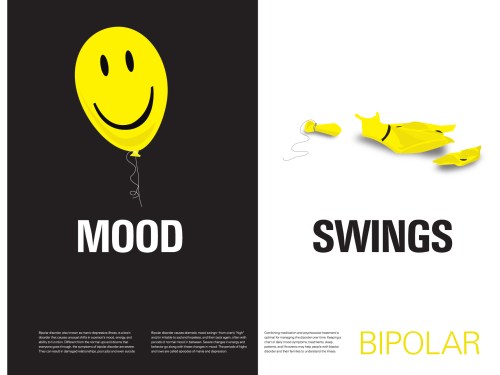
Bipolar Disorder– Basic Stuff


If you have bipolar disorder, you may recognize many below. Not everyone has exactly the same symptoms. Talk with your healthcare provider about your symptoms at each visit.

  • Feeling sad or blue, or “down in the dumps”
  • Loss of interest in things you used to enjoy, including sex
  • Feeling worthless, hopeless, or guilty
  • Sleeping too little or too much
  • Changes in weight or appetite
  • Feeling tired or having little or no energy
  • Feeling restless
  • Problems concentrating or making decisions
  • Thoughts of death or suicide


Symptoms of mania may include:

  • Increased energy level
  • Less need for sleep
  • Racing thoughts or mind jumps around
  • Easily distracted
  • More talkative than usual or feeling pressure to keep talking
  • More self-confident than usual
  • Focused on getting things done, but often completing little
  • Risky or unusual activities to the extreme, even if it’s likely bad things will happen

Here are some behaviors that may be seen in people with bipolar disorder. Please note some of these behaviors may also indicate a different problem, so proper diagnosis is important.

  • Agitation
  • Alcohol or drug abuse
  • Irritability
  • Excessive gambling
  • Violence
  • Poor judgment with decisions
  • Careless spending, buying sprees
  • Talking about hurting oneself
  • Risky sex or change in sexual activity
  • Impulsive financial investments
  • More arguments
  • Change in energy level, appetite, or sleep pattern
  • Relationship problems at home or work
  • Mounting debt
  • Drinking or drugging for ‘escape’ or maintenance purposes
  • Legal/criminal issues
Visit http://www.webmd.com/depression/guide/bipolar-disorder-manic-depression for more detailed information about bipolar disorder and its symptoms.

bry-signat-1

cropped-christiangraffiti1 (2)


The Hidden Life of Bulimia

Bulimia nervosa is characterized by recurrent and frequent episodes of eating unusually large amounts of food (e.g., binge-eating), and feeling a lack of control over the eating. This binge-eating is followed by a type of behavior that compensates for the binge, such as purging (e.g., vomiting, excessive use of laxatives or diuretics), fasting and/or excessive exercise.

Unlike anorexia, people with bulimia can fall within the normal range for their age and weight. But like people with anorexia, they often fear gaining weight, want desperately to lose weight, and are intensely unhappy with their body size and shape. Usually, bulimic behavior is done secretly, because it is often accompanied by feelings of disgust or shame. The binging and purging cycle usually repeats several times a week. Similar to anorexia, people with bulimia often have coexisting psychological illnesses, such as depression, anxiety and/or substance abuse problems. Many physical conditions result from the purging aspect of the illness, including electrolyte imbalances, gastrointestinal problems, and oral and tooth-related problems.

Other symptoms include:

  • chronically inflamed and sore throat
  • swollen glands in the neck and below the jaw
  • worn tooth enamel and increasingly sensitive and decaying teeth as a result of exposure to stomach acids
  • gastroesophageal reflux disorder
  • intestinal distress and irritation from laxative abuse
  • kidney problems from diuretic abuse
  • severe dehydration from purging of fluids

As with anorexia, TREATMENT FOR BULIMIA often involves a combination of options and depends on the needs of the individual.

To reduce or eliminate binge and purge behavior, a patient may undergo nutritional counseling and psychotherapy, especially cognitive behavioral therapy (CBT), or be prescribed medication.

Some antidepressants, such as fluoxetine (Prozac), which is the only medication approved by the U.S. Food and Drug Administration for treating bulimia, may help patients who also have depression and/or anxiety. It also appears to help reduce binge-eating and purging behavior, reduces the chance of relapse, and improves eating attitudes.

CBT [or, talk therapy] that has been tailored to treat bulimia also has shown to be effective in changing binging and purging behavior, and eating attitudes. Therapy may be individually oriented or group-based.

Source: http://www.nimh.nih.gov/health/