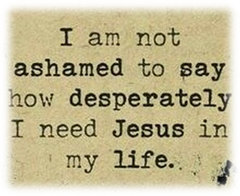
Admitting I Need Jesus

When I was in the sixth grade, a friend invited me to her church. My parents didn’t go to church, but said I could go with Clarissa if I wanted to. Before long, I was spending at least three days a week with my church friends. I learned who Jesus was and that if I believed in Him I would be saved.

I believed, though I didn’t fully understand my need for a Savior.

It would be many years and much wayward living later before I would realize the importance of the Apostle Paul’s words to the church in Rome. “For I am not ashamed of the gospel, for it is the power of God for salvation to everyone who believes, to the Jew first and also to the Greek. For in it the righteousness of God is revealed from faith to faith; as it is written, ‘But the righteous man shall live by faith.’” (Romans 1:16–17 NASB).

It’s easy to think “of course I’m not ashamed of the gospel.” Why would anyone be ashamed of the good news that Jesus died for our sins so that we might be reconciled to Him?

But at its core, faith in the gospel requires the believer to say “I can’t do this myself.”

Well, let me tell you a little secret that believers and nonbelievers often forget. We humans, with all our self-importance, like to think we’re the kings and queens of the universe. We strut around like peacocks, patting ourselves on the back for our so-called brilliance. And you know what? We even pass that audacity onto our poor children, encouraging them to be little independent dynamos. But hey, who needs divine intervention when we’ve got our fabulous human ego, right? wink

I remember a time when my son was in high school and because of a snow day his class schedule was changed. As a result, he took the wrong books. He called to ask me to bring the right books to the school office on my way to work, which I happily agreed to do. When I got to the office to drop them off, the school secretary chided me for bailing him out. “These kids need to learn to be responsible or suffer the consequences,” she said.

I’ve thought of that encounter often, being thankful that Jesus didn’t say the same to the Father when the plan of salvation was put into place. What if Jesus had said, “You know Dad, these humans need to be more responsible or suffer the consequences.” We’d all be doomed.

And so, although it requires me to admit I can’t do it alone, I choose to live by faith in the One who gives me His righteousness.

For the broken believer (which is all of us, if we’re honest), it is all the more important to be okay with something less than full independence. We were created to be dependent on God and on one another. We were created to live in community and relationship with others.

Note: A version of this article was originally published in the January 2020 issue of The Christian Journal, a publication I highly recommend, and not just because they publish some of my writing.

The Plow and Jesus

57 As they were walking along the road, a man said to him, “I will follow you wherever you go.”

58 Jesus replied, “Foxes have dens and birds have nests, but the Son of Man has no place to lay his head.”

59 He said to another man, “Follow me.”

But he replied, “Lord, first let me go and bury my father.”

60 Jesus said to him, “Let the dead bury their own dead, but you go and proclaim the kingdom of God.”

61 Still another said, “I will follow you, Lord; but first let me go back and say goodbye to my family.”

62 Jesus replied, 

“No one who puts a hand to the plow and looks back is fit for service in the kingdom of God.”

Luke 9:57-62, NIV

There’s to be no whitewashing the way of discipleship–there’s no glamour, no special recognition–no acclaim in it to speak of it openly. I guess this is the “real” way of being His follower. The path Jesus has for me demands I give Him my whole heart. Heart enough to turn it all to Him. Heart enough to give Him total commitment.

Jesus seems to make it hard to follow Him. But is it really?

We can see this in His responses to each prospective disciple. His statements to each possible follower seem harsh, difficult, and a bit “unreasonable,” but He doesn’t receive these men unless they do what He says.

Discipleship demands that we give up what we hold dearest.

What happened to these three “would-be” followers? Did they return home dejected and frustrated? To follow in Jesus’ footprints means we give up our personal agendas, and turn our backs on what is closest and dearest. We must renounce everything, and give Him preeminence over all.

These are hard verses with profound implications.

But this passage is given to us for a reason. We dare not minimize what it means to be a disciple. We must grasp the plow with both hands, and we can’t look back. All that we do is a fair response to His mercy, and His kindness. There is incredible joy in all of this.

“Christianity without discipleship is always Christianity without Christ. Unless he obeys, a man cannot believe.”

    Dietrich Bonhoeffer

brokenbelievers.com

One More Night With the Frogs

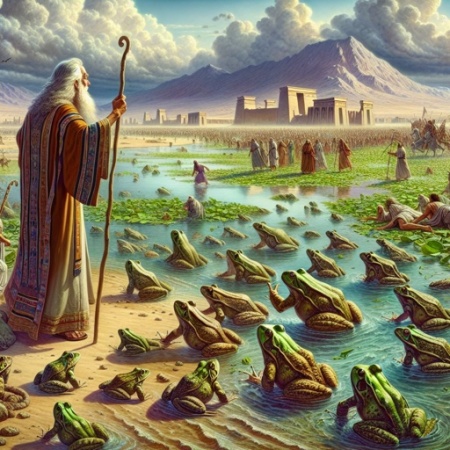
“You set the time!” Moses replied. “Tell me when you want me to pray for you, your officials, and your people. Then you and your houses will be rid of the frogs. They will remain only in the Nile River.”

“All right,” Moses replied, “it will be as you have said. Then you will know that there is no one like the Lord our God.

Exodus 8:9-10

Often there comes a point in a person’s life that not to make a decision, becomes the decision.

This was the dynamic working in Pharaoh’s mind. God had warned him earlier that he must release the Jews from slavery. But he oscillates, and vacillates after each warning. His stubborn indecisiveness  is remarkable. Pharaoh resists, and becomes more and more obstinate.

There is a deep danger of delay.

God sends 10 plagues– quite dramatic and miraculous. But “the supernatural” really can’t touch certain hearts. There were certain Pharisees in Jesus’ time that they would not believe, no matter what Jesus did. (We call this, “hardness of heart.”)

In this particular ‘show-down’ a plague of frogs is threatened. It’s kind of funny, but Pharaoh doesn’t dispute the possibility of this “green invasion.” He just absorbs the inevitable. Pharaoh simply replies, “I will take one more night with the frogs.”

Within Egyptian mythology the frog was regarded as “holy.” It wasn’t to be harmed or killed. It was regarded as a blessing to the people. But that was hardly the case among the enemies of God’s chosen.

Often there comes a point in a person’s life that not to make a decision, becomes the decision.

Sadly to say, there are so many like that man today. “Lord, I’m going to follow You, but let me have just one more fling, one more trip to Vegas, or the bar, or the Princess cruise, or a new car– just “one more night with the frogs!” And the “one more night” stretches out into a terrible, endless night, in the blackness of darkness forever.

2 Corinthians 6:2

Will you choose to spend another night with the frogs, that is, in your sins? Or will you come to Jesus Christ for salvation today? There are consequences that follow each decision. What will you decide today? Will it be sin or the Savior? Will it be Heaven or Hell? Will it be forgiveness or the frogs? What will you do with the message you have read here today?

Often there comes a point in a person’s life that not to make a decision, becomes the decision.

bry-signat (1)

Our Salvation Is Quite Sure

My favorite of all the apostles is John, “the disciple whom Jesus loved.” I love his Gospel, the three epistles that he wrote, and of course,  Revelation.

There are a couple of things I love about John’s writings:

  1. He reminds his readers that he was an eyewitness to Jesus’ life, death, and resurrection.
  2. He clearly sets out the evidence for Jesus’ divinity.
  3. He focuses, particularly in the epistles, on the love of God.
  4. He reveals the power and purpose of the Holy Spirit in the lives of believers.
  5. He provides believers with an assurance of salvation.

It is this last point that I want to write about today.

Early in the history of the Christian faith, deceivers had come into the church who taught that one had to achieve sinless perfection to be saved. John wrote his first epistle to combat this heresy. The same type of heresy has crept into many legalistic denominations even today. By outwardly following the rules, such people claim to be without sin. But as John writes:

If we claim to be without sin, we deceive ourselves and the truth is not in us. If we confess our sins, he is faithful and just and will forgive us our sins and purify us from all unrighteousness. If we claim we have not sinned, we make him out to be a liar and his word is not in us.

1 John 1:8-10 (NIV).

John here provides assurance that the fact that the believer sometimes sins does not negate their salvation, because Jesus is faithful and forgives our sin. One of the definitions of assurance on Dictionary.com is “full confidence; freedom from doubt; certainty.” Throughout this epistle, John provides further assurance that those who trust in Jesus can be assured of their salvation even though they are not sinless and perfect.

The word “know” appears 42 times in this short epistle.

John wants to make sure believers know that God loves them and that they can rely on His promise of salvation. In each of the chapters of the epistle, John includes his assurance:

I am writing to you, dear children,
   because your sins have been forgiven on account of his name.
I am writing to you, fathers,
   because you know him who is from the beginning.
I am writing to you, young men,
   because you have overcome the evil one.

1 John 2:12-13 (NIV).

“Dear friends, if our hearts do not condemn us, we have confidence before God and receive from him anything we ask, because we keep his commands and do what pleases him. And this is his command: to believe in the name of his Son, Jesus Christ, and to love one another as he commanded us. The one who keeps God’s commands lives in him, and he in them. And this is how we know that he lives in us: We know it by the Spirit he gave us.”

1 John 3:21-24 (NIV).

“If anyone acknowledges that Jesus is the Son of God, God lives in them and they in God. And so we know and rely on the love God has for us.”

1 John 4:15-16 (NIV).

“I write these things to you who believe in the name of the Son of God so that you may know that you have eternal life. This is the confidence we have in approaching God: that if we ask anything according to his will, he hears us.”

1 John 5:13-14 (NIV).

None of us is perfect and completely sinless. If we were, we would not need a Savior. But we do need Him, and we thrive best knowing that He is faithful in His promise of salvation for those who believe.

John does not advocate living a life in which we sin ‘willy-nilly’ simply because we know we can be forgiven.

Now don’t get me wrong. Those who truly believe in Jesus, and trust in Him for salvation, will desire to keep God’s commands. His Spirit living in our hearts will help us to overcome the temptations of the world and to love as He has commanded.

You may be struggling today with worries that you are not good enough, or that God will give up on you and you will lose your salvation. But remember – God is faithful in His promises and He has promised eternal life to all who believe in Jesus and allow His love to live in them. He has not hidden the truth from us but has made Himself known through His Son and the witness of the apostles so that we can be assured of our place in His Kingdom. Your salvation is sure.

Checkout my other page