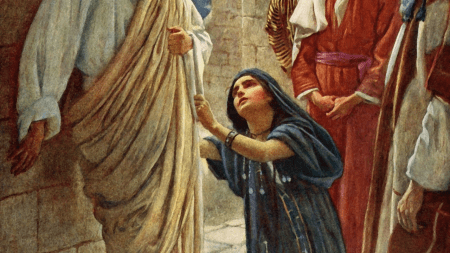
Touching Him

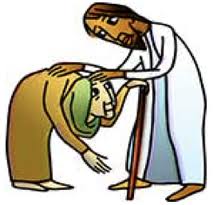
“A woman suffering from bleeding for twelve years, who had spent all she had on doctors and yet could not be healed by any, approached from behind and touched the end of his robe. Instantly her bleeding stopped.

45 “Who touched me?” Jesus asked.

When they all denied it, Peter said, “Master, the crowds are hemming you in and pressing against you.”

Luke 8:43-45, (Matthew 9:20-22)

I just had to touch Him.

I had to reach out and somehow get His attention. It was no longer an option. I bled all the time and it wouldn’t stop. It was constant, and it had been 12 miserable years. No one or nothing could cure this, no doctor, no medicine. I was so desperate. It had to stop, you must understand, I was dying.

I had spent so much money, on so many doctors.

I had nothing left. Each doctor promised a cure and my hopes were always dashed. But then I heard about a teacher named Jesus, I was told He had the power to raise the dead and heal every disease He encountered. I don’t really know why, but instantly I knew only He could heal me.

I had an issue of blood, that meant I was ritually unclean and all that I touched became unclean. The temple was off-limits to me, I had been cut off from sacrifice and any kind of personal forgiveness for my sins. In my darker moments, I really wondered if God really had forsaken me? Was I damned?

It had been 12 terribly exhausting years.

What I had to do must be done secretly and quietly. I knew I just somehow had to touch this man. I would have to wriggle my way through the crowd to get close enough. I would be violating ritual law, if I got caught and I’d be harshly censured and condemned.

But I was always tired. Sometimes I barely could walk without fainting.

The crowds were packed all around Him, but honestly, I knew all I needed was just a simple touch. I knew Jesus had the power. I just knew it. I needed somehow to get close enough; I knew that everything depended on me somehow connecting with Him.

So I waited and watched. I tried to jockey myself and get in the right position. The crowds were tightly surrounding Jesus, I had to push, drive and squeeze. Sometimes I had to get on my hands and knees. But in that split second when He passed, I just managed to grab just the very outside corner of the tassel of His head covering.

And immediately the flow stopped. Just like that! I felt it inside, and immediately knew what happened. Finally I knew, deep down, I had been healed! I was clean.

Please understand dear one, only Jesus can free you. If you can only reach out and touch Him, He will change you– forever.

Christ is the Good Physician. There is no disease He cannot heal; no sin He cannot remove; no trouble He cannot help.”

    James H. Aughey

So What’s Next ?

Mark 10:53, ESV

God has touched you in a profound way, (at least I hope so.) Only He could’ve done this. You’re not the same person now. Just like Jesus healed blind Bartimaeus, you too can really see. The beggar becomes a follower. (Mark 10:46-53.)

So what’s next?

There is always another step to take as we follow Jesus. Everyday there is something new. Our salvation is given freely, but we discover that it’s something active–more like a flowing stream and less like a stagnant pool. If we truly have been “healed,” we’ll want to follow. And now each day is a joyous adventure.

After all, we’ve been terribly blind for a long, long time.

Bartimaeus would never be able to truly explain what had happened to him, at least not in a perfect or complete way to the others–but no matter, it really wasn’t necessary. (But I must believe he tried.) He could see!

  • Jesus: “Go your own way.”
  • Bartimaeus: “..followed Him on the way.”

He was now a true follower. No longer a blind beggar, but he now was a true companion of Jesus and the “church.” He now walked with other believers in the Master’s band of disciples. (Having been blind and instantaneously given sight changed him forever.)

So what happened next?

I suspect Bartimaeus followed the Lord all the way. Although scripture doesn’t say what happened, I believe this ‘ex-blind’ man was now a visible witness to any with eyes to see. Bartimaeus became an authentic witness–God’s megaphone to the power and mercy of Jesus Christ.

I can’t say exactly. Each believer has a different story.

But I do know tomorrow’s life episode is going to be something fantastic, and a challenge. The fruit of the Holy Spirit is given to each who are truly being discipled to follow. The road in front of you just might be excruciatingly hard, but truly there is joy in our journey with Jesus.

“You called, You cried, You shattered my deafness, You sparkled, You blazed, You drove away my blindness, You shed Your fragrance, and I drew in my breath, and I pant for You.”

   Augustine

I Came to Love You Late

regret

Regrets are a funny thing.

You really start to gather them when you’re middle-aged. I’m 63 now and am surprised (and somewhat disturbed) by my memories of things gone by. I guess this is one of the job hazards of getting old. But that’s the deal.

I guess what really bothers me the most are all the missed opportunities.

I wonder what life could have been like if I had accepted Christ at a younger age. A lot of pain would’ve been averted and perhaps I might have loved Jesus deeper than I do now. Some of us come to love Jesus late in life. There is so much time frittered away.

I regret the years spent in rebellion and disobedience. I remember the words of a 70-year-old man who had just received Christ, “Why did I wait so long for this to happen?”

“But one thing I do: forgetting what lies behind and straining forward to what lies ahead,”

Philippians 3:13

Paul learned to adjust his vision to his calling. He no longer lets his past sin and regret define him, choosing rather forget the past and press into the future. He did understand his sin and guilt. He also knew that his sin was atoned for by Jesus’ blood. 

The solution to our regret is to focus on God’s total forgiveness. Past, Present, Future.

Paul clearly saw what lay ahead of him. Heaven was his destination, and, it’s our calling as well; it’s where we truly belong, made righteous in the loving presence of Jesus.

Peter tells us that our past sin was enough. We have wasted enough time doing evil. I don’t know about you, but I had a bellyful of sin, and it’s time for me to lay aside all my foolishness and rebellion and instead live for God. Enough is enough.

You have had enough in the past of the evil things that godless people enjoy—their immorality and lust, their feasting and drunkenness and wild parties, and their terrible worship of idols.”

1 Peter 4:3

Thinking about my past keeps me humble and broken (which is no small thing)! But it also cements me into the joy of His marvelous amazing grace. I now know Jesus’ love.

I am completely forgiven! The joy I now have is incredible.

David, that great sinner-king, also understood the joy of forgiveness. He wanted us to believe in it as well:

Oh, what joy for those
    whose disobedience is forgiven,
    whose sin is put out of sight!

Yes, what joy for those
    whose record the Lord has cleared of guilt,
    whose lives are lived in complete honesty!

Psalm 32:1-2

“We are to be re-made. All the rabbit in us is to disappear-and then, surprisingly, we shall find underneath it all a thing we have never yet imagined: a real Man, an ageless god, a son of God, strong, radiant, wise, beautiful, and drenched in joy.”

     C.S. Lewis

Blind From Birth

John 9:1-7

As he was walking along, he saw a man blind from birth.

“Master,” his disciples asked him, “why was this man born blind? Was it a result of his own sins or those of his parents?”

“Neither,” Jesus answered. “But to demonstrate the power of God. All of us must quickly carry out the tasks assigned us by the one who sent me, for there is little time left before the night falls and all work comes to an end. But while I am still here in the world, I give it my light.”

Then he spat on the ground and made mud from the spittle and smoothed the mud over the blind man’s eyes, and told him, “Go and wash in the Pool of Siloam” (the word Siloam means “Sent”). So the man went where nd washed and came back seeing!

Up to now I’ve tried to approach these posts from the first person viewpoint. Ihoped to understand those who met face-to-face with Jesus. I wanted to grasp what they were seeing through their own eyes. But I intend with this post to revert back to a more traditional approach to this passage.

First, we’re introduced to a man who is blind from birth.

I can’t even imagine what that would be like (just as he probably could imagine having sight). I’ve been told that he probably didn’t have a “dream” life–that requires having seen images (a dog, a tree, a mean person) and this wasn’t available to him. He never saw the color red, or seen a mountain. (He didn’t have the circuitry.)

I suppose we can only imagine what blindness like this would be.

Somehow I’ve come to an idea that this represents fallen men–we’re spiritually blind to the workings and truths of Jesus’ Kingdom. It seems a pretty good explanation of each of us–“blind from birth.”

Secondly, notice the response of the disciples who first met this unfortunate man. They don’t see his needs, rather they want to know the theology behind this. Perhaps that’s how we respond much of the time–we don’t see the needs, we only want to know the reasons. We’re not wise or discerning enough to see what’s going on–in short we’re not equipped to love or show mercy. (We haven’t got the circuitry.)

Perhaps this is how we operate as immature Christians.

We don’t engage the need, but rather we like having great theology over understanding compassion. If we really don’t love needy people, we miss so much. We don’t ever grow up. It’s easy to philosophize–it’s hard to get down and serve and really love others.

It’s funny but Jesus declares Himself to be the light of the world while speaking to the man who is born blind.

Third, we discover the gentle mercy that Jesus has when He meets needy people. Now the Lord does accommodate His followers, but not at the expense of engaging the need of the moment. Jesus is full of compassion–most especially when He meets broken people–and as His followers, we must grasp this.

Good theology is not the primary calling of Jesus’ followers.

As I mature in Christ I’m learning (slowly) that people are His real focus. He has come, not to theologize or philosophize, but to meet needs! Sure the reasons why become clearer, but that really isn’t Jesus’ primary goal. People are, not having impeccable theology.

Classes in systematic theology are good, but soup kitchens are better.

The miracle happens, and Jesus’ love and desire to restore this man is ‘front and center.’ The Lord’s methodology is interesting. Spit and mud, wiped on the blind man’s eyes. In Genesis we discover that God made man out of dirt and dust of the ground. Perhaps what He’s doing here mirrors that work.

And it’s also important to understand that Jesus never performs the exact same healing in the exact same way. For some reason He ‘tailors’ His work to the individuals deepest need. I suppose He doesn’t want us to grab a hold of a formula, as that’s what we want to have.

The story is primarily about a blind man’s healing.

It’s not theology, and it certainly isn’t about what is proper and acceptable. We really must understand this, and we really need to understand the tremendous mercy and power of God to both heal and restore.

Image: MCCC. Text from the “Living Bible,” published by Tyndale House