How Things Happen

burst=fireworks

31 He put another parable before them, saying, “The kingdom of heaven is like a grain of mustard seed that a man took and sowed in his field. 32 It is the smallest of all seeds, but when it has grown it is larger than all the garden plants and becomes a tree, so that the birds of the air come and make nests in its branches.”

33 He told them another parable. “The kingdom of heaven is like leaven that a woman took and hid in three measures of flour, till it was all leavened.”

Matthew 13:31-33, ESV

These are perhaps the three most potent verses in the entire Bible. And whenever you find “potency” you will find a strong possibility of exponential growth. It may be a steady synergy, or an explosive fission. Either way, it’s going to grow!

Both the seed and the yeast have so much in common. They are two sides of the same proverbial coin. And they represent explosive growth. If they are unleashed, watch out! They are both “pep and power” and now set loose they will take off.

The seed is put in the ground and the yeast in the flour. And the farmer and the baker both do their initial work of planting or kneading, and then they just stand back, their work is pretty much done. They now just let “nature” take its course.

These parables Jesus taught here are small— but hardly less significant because of their brevity. These two can bury you with all they imply and mean. When we think clearly about yeast in your cupboard and that single seed in its package, we should see the “life” that resides in them, and the potential that waits.

I think much about the Church. At times, I admit I get frustrated with it. I get judgmental, and fearful that it won’t survive into the next century.  I truly understand that I can be critical. At times my friends must deal with my “ugliness,” but still they put up with me. (They are true friends.)

The kingdom is growing, and advancing. I love the wonderful promise in Isaiah 9:6, (usually read at Christmas time only. A mistake.) But Isaiah 9:7 is also pretty amazing too,

“His government and its peace
    will never end.
He will rule with fairness and justice from the throne of his ancestor David
    for all eternity.
The passionate commitment of the Lord of Heaven’s Armies
    will make this happen!”

Let it grow, let it grow! 

*

ybic, Bryan

kyrie elesion.

Jesus Is Light in My Darkness

LightinMyDarknessI have been so blessed to have Bryan Lowe allow me to share my thoughts and poetry here at Broken Believers. It’s a blessing I never would have known if not for the many years I spent suffering from major clinical depression. I love how God uses our suffering to shower us with blessings.

But I know that when in the midst of suffering that truth is difficult, if not impossible, to see. I believe that is why He has inspired me to write the poetry I have written and to publish it in a book called Light in My Darkness: Poems of Hope for the Brokenhearted. This book is now available at Amazon.com and you can even “Look Inside”

I am especially excited about this book because my son created the cover for me with original art. I shared with him my idea for the cover, read him a few of the poems, and he took it from there.

I also want to take a moment to thank Bryan for writing the foreword and to share here what he wrote:

“Never underestimate the sheer power of poetry. It is formidable. Linda knows this, and she has compiled this book from direct experience. And that is remarkable. I hope you’ll read this with an inquisitive heart and an eager mind. Good poetry should carry a weight of truth wherever it might lead. All that it requires is all of you. Poetry requires your full attention, at least to appreciate it fully.

Linda honors God in what she has written. I know her intention is to bring Him glory, and she does it fearlessly. What you read here comes from life’s furnace— things will be imparted through these poems. I pray the Lord’s blessing on this little book.

Read this book. Squeeze out the truth each poem has. I know that the author would appreciate it immensely.”

And he’s right—I would appreciate it. But even more importantly, I would love to know that those who read my poetry are blessed to find God’s Light in their darkness.


aasignLinda

You can find Linda’s website at http://lindakruschke.wordpress.com/


cropped-christiangraffiti1.jpg

A Broken System

mental-health

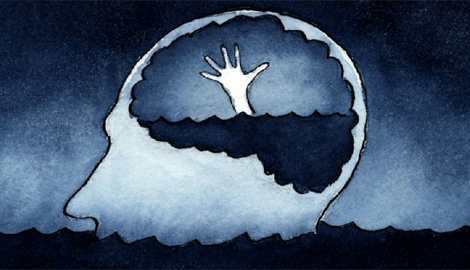
Sixty million Americans – that’s one in five adults – will experience a mental illness in the coming year. That means every one of us knows someone who is living with a mental illness – depression, anxiety, schizophrenia, an eating disorder, bipolar disorder, borderline personality disorder and some additionally have a substance abuse.”

The stats are staggering. They are also easily forgotten. (It seems that we approach life not as it is, but as we want it to be.) But consider this:

• Half of all adults will suffer from mental illness in their lifetime.
• Half of all chronic mental illness begins by the age of 14.
• One in five children will have a mental illness by age 18.
• Ninety percent of people who die by suicide also had mental illness.

Brokenbelievers is not just a “niche” site– we’re dealing with hardcore issues that are significant for far too many. Mental illness is a pervasive and terrible issue in our society. Christians must witness to what Jesus can do in the midst of this. We are his witnesses.

Accentuating this, our mental health care system is broken. Jails and prisons have become “dumping grounds” for afflicted people. I guess that this is considered “routine” for us. Imagine the outcry if, instead of doing this to the mentally ill, we did incarcerated those with diabetes? Yet we do so because that’s the way the system works.

There are many beautifully competent people who toil in the mental health field. Some of the kindest and caring can be found working in these places. They deserved to be commended, not vilified.

The landscape is strewn with casualties. Mental illness will affect half of adults in their lifetimes, and the collateral damage can’t even begin to be quantified. Our therapists, nurses and doctors have a grisly job security. Money can never fix our system of dealing with those with a mental illness.

Many of us will disagree about what to do.

Perhaps we should advocate a multi-prong approach. Brokenbelievers exists for Christian believers that are having to work out their faith in the presence of a tenacious illness. It’s good to have someone that understands depression or other issues in the life of a disciple of Jesus Christ.

We must think differently– and do differently. With God’s help we can.

bry-signat (1)

cropped-christiangraffiti1.jpg

Sources:

https://www.nami.org/Learn-More/Mental-Health-By-the-Numbers

http://www.huffingtonpost.com/kay-warren/hope-for-mental-illness_b_8045810.html

OCD: Rituals and Obsession

“I couldn’t do anything without rituals. They invaded every aspect of my life. Counting really bogged me down. I would wash my hair three times as opposed to once because three was a good luck number and one wasn’t. It took me longer to read because I’d count the lines in a paragraph. When I set my alarm at night, I had to set it to a number that wouldn’t add up to a ’bad’ number.”

“I knew the rituals didn’t make sense, and I was deeply ashamed of them, but I couldn’t seem to overcome them until I had therapy.”

“Getting dressed in the morning was tough, because I had a routine, and if I didn’t follow the routine, I’d get anxious and would have to get dressed again. I always worried that if I didn’t do something, my parents were going to die. I’d have these terrible thoughts of harming my parents. That was completely irrational, but the thoughts triggered more anxiety and more senseless behavior. Because of the time I spent on rituals, I was unable to do a lot of things that were important to me.”

People with obsessive-compulsive disorder (OCD) have persistent, upsetting thoughts (obsessions) and use rituals (compulsions) to control the anxiety these thoughts produce. Most of the time, the rituals end up controlling them.

For example, if people are obsessed with germs or dirt, they may develop a compulsion to wash their hands over and over again. If they develop an obsession with intruders, they may lock and relock their doors many times before going to bed. Being afraid of social embarrassment may prompt people with OCD to comb their hair compulsively in front of a mirror-sometimes they get “caught” in the mirror and can’t move away from it. Performing such rituals is not pleasurable. At best, it produces temporary relief from the anxiety created by obsessive thoughts.

Other common rituals are a need to repeatedly check things, touch things (especially in a particular sequence), or count things. Some common obsessions include having frequent thoughts of violence and harming loved ones, persistently thinking about performing sexual acts the person dislikes, or having thoughts that are prohibited by religious beliefs. People with OCD may also be preoccupied with order and symmetry, have difficulty throwing things out (so they accumulate), or hoard unneeded items.

Healthy people also have rituals, such as checking to see if the stove is off several times before leaving the house. The difference is that people with OCD perform their rituals even though doing so interferes with daily life and they find the repetition distressing. Although most adults with OCD recognize that what they are doing is senseless, some adults and most children may not realize that their behavior is out of the ordinary.

OCD affects about 2.2 million American adults, and the problem can be accompanied by eating disorders, other anxiety disorders, or depression.  It strikes men and women in roughly equal numbers and usually appears in childhood, adolescence, or early adulthood. One-third of adults with OCD develop symptoms as children, and research indicates that OCD might run in families.

The course of the disease is quite varied. Symptoms may come and go, ease over time, or get worse. If OCD becomes severe, it can keep a person from working or carrying out normal responsibilities at home. People with OCD may try to help themselves by avoiding situations that trigger their obsessions, or they may use alcohol or drugs to calm themselves.

OCD usually responds well to treatment with certain medications and/or exposure-based psychotherapy, in which people face situations that cause fear or anxiety and become less sensitive (desensitized) to them.

Source: http://www.nimh.nih.gov/index.shtml

cropped-christiangraffiti1 (1)