Promises that Give Me a Workout

a-cheerful-heart-is-good-medicine-christian-message-card-copy What a difficult struggle the last several days have been.  I have tried to function but have been broadsided by several things at once.  I have asked God to draw near, He has made me a promise that He would never leave me, or forsake me.  I hold on to this and will not let go.  Where would I be without them?

The Bible is full of God’s promises, especially the Psalms. I believe the Psalms have a special meaning for those who struggle with issues (like a mental illness.)  Many times when troubles have been abundant, I have opened my Bible and found a precious promise waiting for me that has proven to be a great comfort.

But we don’t have to go through troubled times to appreciate God’s promises. His blessings are new every morning. Thank God! The Lord has promised us freedom from anxiety, along with His peace that passes all understanding. Here are the ‘top five’:

  1. If we simply trust Him with everything (Philippians 4:6-7).
  2. He promised to supply all our needs (Philippians 4:19),
  3. With supernatural joy to His followers (John 15:11),
  4.  an abundant life (John 10:10)
  5. answered prayers (John 14:14)

“How I relate to the promises in the Word often we will determine the dimensions of my depression.” 

Its length, and depth, and width are determined by my action with the promises.  By squeezing out His promises I can find hope to continue on with life. For me, the Word is more important than life.

Some have described depression as the ‘common cold’ of the mental illness world.  If that is true, then God’s Word is the Vitamin C.  I can’t prevent a cold, but I sure can reduce its impact.  How severe will it get this time?

I woke up this morning, and before I even opened my eyes I could feel the oppression of depression.  I want to die, why did I wake up?  Maybe if I close my eyes I will be able to go back to sleep, and not wake-up. To the depressed, sleep (death’s cousin) is easiest way to escape. It provides a profound release from the anguish of depression. But there isn’t a 24 hour sleeping pill yet.

I find I want to deal with my depression in two ways: Escape or deny.  Both avoid the real world.  And both have a tremendous impact on the way I function.  God’s promises to help you are real and profound.  Properly administered, they offer hope and life beyond taking an anti-depressant.  Consider them to be the medicine your soul needs!   aabryscript

So You Want to Become Vulnerable?

freedom_by_ahmetorhan

“To love at all is to be vulnerable. Love anything and your heart will be wrung and possibly broken. If you want to make sure of keeping it intact you must give it to no one, not even an animal. Wrap it carefully round with hobbies and little luxuries; avoid all entanglements. Lock it up safe in the casket or coffin of your selfishness. But in that casket, safe, dark, motionless, airless, it will change. It will not be broken; it will become unbreakable, impenetrable, irredeemable. To love is to be vulnerable.”

 — C.S. Lewis, The Four Loves

Public speaking has never been a problem for me. All through high school, Bible college, as a street evangelist– nothing I’ve ever done really has ever been a concern.  But,  I have friends who rather submit themselves to hideous torture then to put themselves in that public position.  They are afraid of the spotlight, feel exposed and just a little too accessible in the lime light.

Becoming vulnerable in love is ‘above and beyond’ the fear of public speaking.  It is almost irrational in the way it takes charge.  We refuse to put out, with the fear of being that accessible.  We will not allow ourselves to become a victim.  But public speaking has nothing on loving someone deeply, because of the risk involved.

Men are the greatest perpetrators of this attitude.  We close ourselves off and keep our hearts protected and safe.  We cannot truly give our hearts away, because we cannot share that which is most intimate (we hate that word!).  I will refuse to become vulnerable to anyone, because of the risk I put myself in. To really “trust,” in deep way, is way too much exposure for us.

Our families cannot understand our emotional coldness.  They think that the problem is their fault.  They struggle to understand.  And we respond to their attempts to accommodate us with skepticism and fear.  We hold back and pathetically attempt to adjust to their efforts.  Selfishness ultimately wins the day.

Lewis reveals that our natural inclination is towards selfishness.  We try to hide and avoid the “nakedness” that love requires.  I am convinced that we will spare no effort to stay safe, becoming invulnerable to another’s inspection.  We wall up ourselves to the risks of love.  But learning to trust is one of life’s most difficult tasks.

Jesus Christ has come, to teach us how to love openly and freely.  He became vulnerable, laying aside his prerogative of being God.  He is teaching us to love like him. We will only truly heal when we risk it all, with our Father, and our brothers and sisters.

aabryscript

Whim-Whams

getty_rm_photo_of_woman_seen_through_eyeglasses_of_another

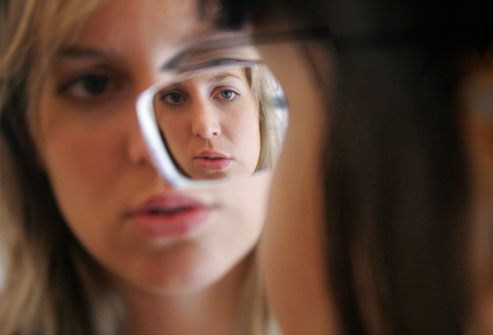
“In our family “whim-wham” is code, a defanged reference to any number of moods and psychological disorders, be they depressive, manic, or schizoaffective. Back in the 1970s and ’80s – when they were all straight depression – we called them “dark nights of the soul.” St. John of the Cross’s phrase ennobled our sickness, spiritualized it. We cut God out of it after the manic breaks started in 1986, the year my dad, brother, and I were all committed. Call it manic depression or by its new, polite name, bipolar disorder. Whichever you wish. We stick to our folklore and call it the whim-whams.”

— David LovelaceScattershot: My Bipolar Family

flourish2

Speaking in code is often our way of communicating to those who are curious. We seldom tell anyone we have bipolar disorder outright. Some of us tried, and failed; we fall back to “I’m just a little blue today,” or the classic, “I’m just woke up on the wrong side of the bed.” We really can be somewhat disingenuous.

All too often these are half-truths that deflect the sticky issues of a mental breakdown. We seek to salvage some kind of dignity, or evade the inevitable stigma that would certainly come if we told the truth. We choose to evade, but at a cost.

I struggle with the stigma of both bipolar disorder and epilepsy. I’m still uncomfortable when others seem uncomfortable with me. So, I have developed a general rule:

Bryan’s Rule #14, “Never reveal your illness, except to qualified people.”

I suppose this adds a layer of personal security. The occasions I have violated this rule have resulted in awkward pauses and odd looks. Afterwards, the relationship changed. It was as if I suddenly sprouted a second head, or something.

As Christian believers, I know we are supposed to walk in the truth. But exactly how truthful am I supposed to be? I’ve always had an iconoclastic streak, and I love stretching the social boundaries of others. Bipolar disorder has been an illness made-to-order for people like me.

Bryan’s Rule #15, “Openness can be a true step toward my healing.”

But it take truth to change. We really need to be honest by bringing things into the light. Obscuring the truth keeps us isolated and distant from others. Will speaking forthrightly about my bipolar disorder be a challenge? Of course. But necessary if I want to heal and cope.

I’m not advocating making a big sign and parading down Main Street. Just to be a bit more honest with others, and ultimately with ourselves. Let’s be comfortable with our own personal “whim-whams.”

aabryscript


How Does It Effect You?

depression-symptoms

There are four areas that chronic depression will effect you.

  1. Emotions
  2. Thoughts
  3. Physical
  4. Behavior

We need to really visualize the areas in order to understand. This grasp of the facts will not change a thing, but will only give you a sense of what depression is doing to you, or your loved ones.

Some will emphasize one or another. But all four areas play a part in this disease. We may think we can twist around these, but we’ll find we are still trapped by the evil ogre of depression. (And he takes all the prisoners he can.)

We are hostages to this sickness. Depression truly destroys lives and hopes. It comes uninvited, and springs its trap on us. It can immobilize us in an instant.

David knew what it was like to be a hostage of depression. In Psalm 32:3-4 he wrote:

“For when I kept silent, my bones wasted away
    through my groaning all day long.
For day and night your hand was heavy upon me;
    my strength was dried up[b] as by the heat of summer.”

Many readers will relate. It carries with it an authenticity of a man that is a dear struggler. His experience, and his willingness to write openly provides us with comfort and understanding.

Paul knew all about depression. He wrote in 2 Corinthians 7:6:

 “But God, who comforts the depressed, comforted us by the coming of Titus;”

Ancient writers called it “the Noonday Demon.” Winston Churchill called his depression, “the black dog.” Both definitions seem spot on.

Christians will ask me whether depression is caused by an evil spirit, or is it biological? I usually answer both. There is strong evidence that it is a mental illness; an illness like any other (e.g. diabetes, or migraines). It can be treated, to a degree, with meds. But there is a spiritual dimension as well requiring “spiritual warfare” on an serious level.

My own meds have helped me greatly. But strong prayer and worship have assisted me just as much. Reading the Psalms are really helpful. I have made the personal discovery that the presence of God is a great way to walk free.

When you’re truly desperate, you will find a way. Of that I’m convinced. I leave with Philippians 1:6:

” And I am sure of this, that he who began a good work in you will bring it to completion at the day of Jesus Christ.”

aabryscript