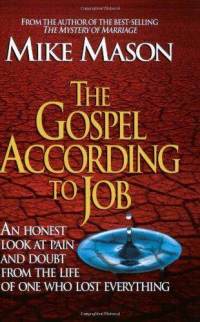
The Gospel According to Job

Today, I want to bring out this book, out into the spotlight.  It is a tremendous devotional that makes its way through the book of Job.  I have leaned on it, and it has held me nicely.  I challlenge you to get a copy of this, and to let it work in the confines of your spirit and mind. ––Bryan

A

Excerpt from “The Gospel According to Job,” by Mike Mason


“An Honest Look at Pain and Doubt from the Life of One who Lost Everything”

_______________________

A“Once I met a man who, like Abraham, had moved his entire household halfway around the world on the strength of a vision from God. When I asked him to tell me the story, he answered that there were three versions of that story, and which one did I want to hear? First, there was the version of the story that he told to Christians. Then there was the version he told to non-Christians. Finally, there was the truth. Job is a book that tells things from the third point of view. Probably, along with Ecclesiastes, it does this better than any other book in the Bible.

Not that the other Scriptures do not tell the truth. But Job tells the truth in a way that makes it almost impossible to pervert the truth into pious pabulum. A few years ago I went through a difficult time. Never mind what the problem was. It was nothing compared to the trials of Job. In fact, it was nothing at all compared to the sufferings of many of my neighbors right there on the quiet street where I lived.

But pain is pain, and suffice it to say that my pain was enough to drive me to my knees, totally defeated, half-crazy at times, and crying out for relief. Month after month the battles raged on, thick, dark, agonizing. I prayed, but somehow prayer did not ‘work.’ Usually nothing at all worked, except lying low and gritting my teeth until, for reasons entirely obscure to me, the straightjacket of oppression began to loosen a little––at least enough for me to get on with my life for another day or so before the screws tightened again. What else could I do? How was I to fight this?

In retrospect I can see that a large part of my anguish was rooted in the fact that there really was nothing I could do to control what was happening to me. I was absolutely helpless, and it is this, perhaps, that is the soul of suffering, this terrifying impotence. It is a little taste of the final and most terrifying impotence of all, which is death.

We Christians do not like to think about being absolutely helpless in the hands of our God. With all of our faith, and with all of His grace, we still prefer to maintain some semblance of control over our lives. When difficulties arise, we like to think that there are certain steps we can take, or attitudes we can adopt, to alleviate our anguish and be happy. Sometimes there are. But anyone who has truly suffered will know that when it comes to the real thing there is no help for it, no human help whatsoever.

Simply put, when we are in a deep dark hole we cannot think our way out; neither can we hope, sing, pray, or even love our way out. In fact there is absolutely nothing either we or anyone else can do to better our situation. We can have faith, yes; but in itself faith will not change anything. Neither faith, nor any other good thing that a person might have or do, can actually lift the cloud, move the mountain, or bring about an end to the problem.

Only the Lord Himself can do that, and when He does, as Exodus 6:6 puts it, “Then you will know that I am the Lord your God, who brought you out from under the yoke.” How will we know? Simply because nothing and no one else could possibly have done it. In this kind of crucible, therefore, we come to a new understanding of what it means to be saved, what it means to be snatched away from the brink of destruction.

Here we get down to the bedrock of the gospel. During my night of anguish, I turned to the book of Job, and there I began to make contact with the gospel in a way that somehow I never had in studying the New Testament. Reading Job, I found myself experiencing in new and astonishing depth the reality of Jesus’ promise in John 8:32,

 “You will know the truth, and the truth will set you free.”


cropped-christiangraffiti1.jpg

When Losers Are Loved

Before the bush, He calls to us

“Instead, God chose things the world considers foolish in order to shame those who think they are wise. And he chose things that are powerless to shame those who are powerful.”

1 Corinthians 1:27, NLT

God has particular preferences when it comes to peculiar people.  He selectively chooses.  These choices are made up in his mind and heart.  For us to criticize them, is by association, faulting God. It just happens to be that He likes losers. He choses uneven performers over the gifted and learned, (1 Cor. 1:26).

There have been very many men and women tossed out on the trash heap of humanity.  They are often regarded as useless and irrelevant. But God loves the outcast and forgotten.

We who are the disabled know weakness intimately. We must deal with it 24/7; and it never takes a holiday, We are broken believers who are in love with Jesus and still we are broken. Talk about having faith for healing? What about the faith to be sick?

People who have experienced dealings so harsh– most likely— there is little pride or arrogance left. These are usually the marginalized, the losers. People like Moses,

“Moses said to God, “Who am I that I should go to Pharaoh and bring the children of Israel out of Egypt?”

Exodus 3:11

Someone once said, “When God intends to use a man or woman He takes them and crushes them.”  The inevitable breaking is followed by a release of the Holy Spirit from their lives.  Moses is proof of God’s renovating presence.  You want the presence? Prepare for years of roughness, and misunderstanding. Prepare for the crushing.

At the burning bush, Moses was given the assignment of returning, confronting Pharaoh, and leading all the captives to the Promised Land of Canaan.  He had just spent 40 years as a refugee/shepherd.  In spite of a good education he had received while in Egypt as a prince, that wasn’t why he had been selected.

Moses has definite feelings of inadequacy and failure.  And his time in the desert did nothing to relieve this.  But a 40 year “prison” term will do that.  In chapter 4 of Exodus we read “the back and forth” conversation between Moses and the Lord God.  All of Moses’ objections were consistently volleyed back with comfort and promise.

As you read this, you may be aware of God’s presence.  He has called you to do something for him.  You have wandered off the path, gotten lost and suffered much.  The “desert” will do that.  But it all can be forgiven.  His alert grace is a velvet battering ram of grace and love.  He will (and does) discipline you–but only because he is passionately in love with your soul, and His glory.

aabryscript

cropped-christiangraffiti1-2

Tightrope Theology

As a person with a mental illness, it seems my issues are a matter of extremes.  Life seems uncontrollable; the wheels seem to always ready to come off of the wagon.  It strikes me as a semi-crazed place to be.  I look at the “norms” with envy, as their lives are crisp, healthy, and strong.

I once met a man that had a prophetic ministry who was speaking at a local church here in Alaska.  When I met with him, he looked at me intently.  He said many things, but the most significant was this. “You are an unstable man; you are like water.”  This was almost 30 years ago.  It has been an accurate prophecy and assessment since I heard it.  At first it stung, I hated it; but now, all these years later, I find a certain comfort in it.  God knows me; He understands.  I haven’t found any reason to be condemned for being Bipolar.

Those of us who walk the tightrope of sanity and insanity have One in heaven who not only knows us, but is on our side.  Hebrews 7:25 declares:

“Consequently, he is able to save to the uttermost those who draw near to God through him, since he always lives to make intercession for them.”

I must realize that I am not the “bad apple in the barrel,” nor am I cursed.  Rather the opposite is true.  I am the richest of all men, because of His radical grace that gets extended to the weakest. Those who “touch” my life are blessed by their contact with me, and since I have been so unnaturally “graced,” they become blessed by His presence through me. WOW! I simply need to be me, and they are drawn to you.

The issues that a mentally ill person (and those who are often a struggler and a rascal) faces are formidable.  But without His promises they are impossible.  The secular view is just to create a “zero sum” game.  It is to bring a person to some stupefied place of stasis.  Not exactly up–but not down either.  Stable, sort of.

It is very good to be stable.  But my goal can not be stability, but an obedience to a supernatural God who loves me supernaturally.  I simply can’t live without knowing that.  However, when I know it, I can handle the tightrope.  I will start to walk a “supernatural” walk.

You could say that God has a hobby, or a specialty.  It is weak and handicapped people.

He loves working with us and in us.  And I have become very much convinced that He pours out special favor on those of us who struggle so difficulty, those of us who will never fit in or be ‘normal.’

We need to come to that real and authentically holy place where we see God. But also in that place, and at the same time, we need to see ourselves as well.  And actually, both are most critical.  They are done imperfectly— but both must happen, nevertheless.

I exhort you to take on your tightrope.  You will only stay upright and cross it if you are aware of His grand love and presence.  It is an amazing thing to balance and walk, and if we fall?  Well, we drop into His net.  Get back up, and get in line again.  Secure your heart into the love of God for your soul.

aabryscript

cropped-christiangraffiti1-2


The Treasure Hidden Inside the Church

treasure-found

As Christians, often our Church and our theology tell us that mental illness, depression, and bipolar disorder have no place in a believer’s life.

As a result, we end up hiding and sneaking  into sessions with our therapists, and direct the conversation to minimize our exposure to any direct questions. In one way, we are the new “lepers of the Church.”   But I would like to suggest to you that it is we who may be closest to the Kingdom of God.

From a certain viewpoint, it is easier for us to approach the Father– in our brokenness, humility, and lostness.  And yes we have needs– a sound mind, a healthy body and we know it. But we have no illusions of wellness– nothing can convince us that we are well.  We know we are not.  We know we are broken and only our loving creator can mend us.  

You should think and say that the Church needs us.  An Archbishop was given an ultimatum by the Huns who surrounded his cathedral. “You have 24 hours to bring your wealth to these steps”, the war-leader declared.   The next morning the Archbishop came out leading the poor, the blind, the lame, and the lunatics.  “Where is your treasure?  Why have you brought out these, people?”  The Archbishop said this, “These are the treasures of the Church, these who are weak are our valuables.  They make us rich.”

I’m afraid the the Western Church no longer sees its “treasures” or wealth like it should.  We have let the ‘government’ pick-up the burdens of health care.  We have tried to operate our churches like successful businesses and definitely have no room for the desperately weak. The mind-set is routine and predictable–that “they only take, and never give.”

But the handicapped have much to teach the Church.

We the weak are ‘sprinkled’ by the Lord into each local church (each church has one or two.)  We are not victims of our illness or addiction.  We admit we are the ones so broken that everyone has given up on us. But we have reached out, and touched the hem of His garment. “And in love’s service, only the wounded can serve.”

 My plea is directed to the local churches, and their leadership. You must decide what you are going to do with us, the handicapped. Will you accept us– and we are many? But we do admit and insist that we should not trivialized or diminished. We often have discovered grace in a way you haven’t, we have been loved in a way that you can only dream.

“It’s not about perfection; it’s about our intimacy with God, or our connection, our relationship with God. Once we get through that, once we realize that we can be imperfect, flawed, broken; those kinds of things are the ingredients of spirituality.”

–Mike Yaconelli

cropped-christiangraffiti1-2

*