Memories That Shame Us

And they heard the sound of the LORD God walking in the garden in the cool of the day, and the man and his wife hid themselves from the presence of the LORD God among the trees of the garden. But the LORD God called to the man and said to him, “Where are you?” 10 And he said, “I heard the sound of you in the garden, and I was afraid, because I was naked, and I hid myself.” 

Genesis 3:6-10, ESV

There is a good chance that some of your memories are pretty awful.

When we get looking back we can see shameful, dark things.  Some of us carry things that are profoundly evil, and they go with us wherever we go.

It’s no secret that guilt and mental illness travel hand in hand, for they are brothers. They have tormented us for a terribly long time. They are like playground bullies who have no fear– they only have hatred for us.

I’m quite convinced that the only way to move on is to have Jesus Christ fully cleanse you, and that includes your dark humiliations.  The human tendency is for concealment. We take considerable effort to conceal and cloak our past lives. (Both Adam and Eve understood personal shame.)

I remember back when my dad discovered that one of our dogs had killed a chicken.  He took that dead chicken and wired it around that dog’s neck. That dog wore that chicken for weeks.  It was awful, and it began to putrefy. The smell was terrible.  I can still see that dog, staggering and tongue lolling out and slobbering.  My dad said it was the only cure for a “chicken killer.”  The dog would get very sick, attached to this rotting carcass.  It was a sobering lesson for a young boy to see.

Somehow, that is what our past disgrace has done to us.  

Sure we have moments when we can almost forget.  But, for the most part, it is just a temporary reprieve.  We slide back and rediscover the pain; it’s just waiting for us.   The cost of our mental health is staggering.  

Many of us are driven by a mad movement toward drugs and alcohol.  We are compelled to escape the pain, and for a little while it seems to work. (This is called “co-morbidity.” Which is ‘fancy talk’ for a dual problem.)

It’s like filling a bucket with corrosive acid.  It will eat its way out.

Most of us would quickly trade this mental pain, this misery;  for a physical one. Something shameful that was done 20 or 30 or 50 years ago continues its destructive work.  Our conscience will not allow us to dispose of our self-disgust in this easy, cavalier manner.  We need a ‘hazmat’ crew to help us clean up mentally and spiritually.

You have to forgive yourself.  

You must, or you will destroy yourself and those closest to you as well!

Often we believe these things are simply moldy walls; they seem to just need a coat of paint. Our problem is that it will only cover for a short time.  After 20-30 layers are applied, we realize this isn’t really the answer. Nothing we can do is ever enough.  We must have Jesus– we must!

-Bryan Chapell

Full repentance is critical. Don’t scuff off this first step.  The blood of Jesus isn’t some nicety. It is foundational for salvation. We are to, by faith, start the obedience. Our blistering sin and guilt are absorbed in Jesus’ death and resurrection.

“When someone becomes a Christian, he becomes a brand new person inside. He is not the same anymore. A new life has begun!”

2 Corinthians 5:17, LB

The Extraordinary Breath of Jesus

“Jesus said to them again, “Peace be with you. As the Father has sent me, I also send you.” 22 After saying this, he breathed on them and said, “Receive the Holy Spirit. 23 If you forgive the sins of any, they are forgiven them; if you retain the sins of any, they are retained.”

John 20:21-23 (19-23)

This is the second “peace be with you” in this passage. So why the duplication of this peace proclamation? The disciples are sequestered and scared in the upper room (v. 19; and Luke 24:36. Having peace is being emphasized–the disciples were afraid of the Pharisees, but they also were undone by Jesus’ surprise visit.

Peace was definitely a precious commodity for them.

Jesus gives his disciples a mission to do, and they must be as ‘familiar’ with Jesus just as Jesus is with God. The disciples had followed him for three years–seeing incredible miracles, and hearing profound teaching, they’re ready, they just need power.

In track and field, there’s a relay race where a baton is passed from runner to runner, and maybe that’s how it’s working here? We see the same idea in John 17:18.

The baton has now been passed to the disciples.

The breath of the risen Jesus is necessary (and yes, he’s breathing.) What went down here, I don’t know exactly. But Jesus recognizes that his 12 followers will need this to do his work. Also, we might consider Adam in Genesis 2:7 where God’s breath brought him to life, which is pretty awesome when you think of the parallels.

The Holy Spirit energizes these men to do this new work.

The disciples were pretty much observers, but now they are to take up the ‘mantle’ of Jesus’ work. This is a definite duplication, which connects with the idea of one seed producing many others (John 12:24.) That’s how the Kingdom will come to people.

Verse 23 intrigues me. It seems that our life comes from the breath of Jesus. And it’s the Holy Spirit that gives both power and the authority that’s needed to function like Jesus. We now have the ability to pronounce forgiveness to the new believer, and yet that doesn’t seem a function of the Church today.

I wonder why this is so?

This entire passage as a doozy. It clearly declares the Churches new role as we follow in his footsteps. Disciples are to do exactly what Jesus does–with his breath and authority–filled with the Holy Spirit.

If we neglect these things (it seems anyway) we’re going to fall flat on our face.

“The work of Jesus for His disciples on resurrection Sunday gives an ongoing pattern for His work among His people. Jesus wants to continue this fourfold ministry of assurancemission, the Holy Spirit and authority to His people today.”

From David Guzik’s website

Number Them


          “So teach us to number our days that we may get a heart of wisdom.” –ESV

 
“Teach us how short our lives  really are so that we may be wise.” –NLT

 “Oh! Teach us to live well!
      Teach us to live wisely and well!”– MSG 

Psalm 90:12, three different translations

Growing up we must learn different things.

We’re taught the alphabet, how to brush our teeth and use deodorant.  We need to be educated, or tutored into many different skills.  Our teachers direct and guide us, they provide for us an understanding of the skills we need to acquire.  As we advance through their instruction, we grow in proficiency.

The Psalmist comes to the realization that he needs to develop a particular skill.  He desperately wants to craft his life to be honorable and obedient.  He turns to God and seeks His aid.  The psalmist seeks a ‘teacher’ who will instruct him.

Our own lives are often chaotic and foolish. 

We live in a great deal of ignorance, strained relationships and bad decisions.  Most definitely we are ‘saved by faith,’ but the course of our lives can still be difficult. There is much to be learned in the spiritual world. We’ll make many mistakes.

The author of Psalm 90 doesn’t want to continue doing stupid things.  He has a need, and he is pretty adamant that God will help him.  Part of what he understands is that he needs to get ahold of the reality of the ‘shortness’ of his life. That’s a good start.

He must understand that he has a limited lifespan–an expiration date. 

He refuses the deception that life will just always continue unfolding.  He doesn’t buy it.  He counts on God to pace him, and to keep him from recklessly wasting his life.  He is asking for restraints. He must learn to say “no” and say “yes” to many things.

I encourage you to consciously make this step.  Be deliberate in this.  If we lack wisdom, we need to ask Him for it.  Apart from His presence, our lives grow increasingly irrational.  Living without restraints will lead us into more foolishness and despair. We must learn to say “no.”

“Making the best use of the time, because the days are evil.”

Ephesians 5:16, ESV


Frederick, [Handling Giftedness]

Fredrick-big
Frederick, the ‘prophetic’ mouse

I have always loved to read. I was given books by my mother, and these books were like gold. I had been a avid patron of the library, but terrible at returning books. I had pretty much been branded as “persona non grata” by the librarians of my hometown library at the ripe old age of 12.

I have fond memories of some fine books. But perhaps the most influential of them all was a title called, “Frederick” by Leo Lionni.  It won the ’68 Caldecott ‘back in the olden days.’ It very well could be one of best children’s books ever written. ( I realize now that many of these books that shaped me were prophetic in their own way.)

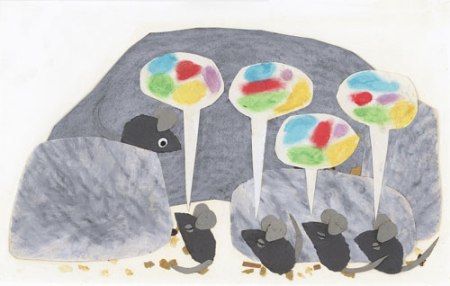
We see Frederick, who is a young field mouse, off on excursion to find food with his four brothers. They must fill their pantry for the cold winter that’s coming. They are quite successful (it appears) and all seems well.

However, there is a bit of a problem with Frederick. While the other mice are ‘busting their mouse-butts’ he sits quietly thinking. They question him repeatedly, trying to motivate him (or shame him perhaps?)  There seems to be a general consensus against him, which is verging on open warfare.

But Frederick insists that he is needed to do this. He says that he is ‘working’. He is collecting sunlight, absorbing it until it’s needed.  He takes in colors, and then words. He just seems soak up these really wonderful experiences, and he seems a bit “clueless” (that’s not the right word), maybe a bit “preoccupied.”

FrederickFinally in the dead of winter, sheltered deep underground, their supplies are running low. One of the mice turns to Frederick, and asks him to share what he has collected. And he does precisely that. They sit in a circle and Frederick shares the sunlight, and the rich colors and the beautiful words he has stored up for them. Their little ‘mouse-hearts’ are deeply touched by Frederick’s contribution.


In so many ways, this has become a parable, or metaphor of my life. As a eight year old, I could hardly have foreseen how my life would unfold. I do however had a deep sense of being different, even then. My mental illness, mixed with being “gifted”, and then combined with being isolated and dirt-poor, worked in me.

Essentially, we all are products of our personal history.  What we have experienced good or bad develops us.  It did me.  I think what “Frederick” wants to do for us is to process uniqueness, gifting and steadfastness.  One of the things that the Holy Spirit has been speaking to me for the last few years is this, “Bryan, can you receive from the giftedness of other believers?”

We really must make room for “Fredericks” and what they can bring to us.  We will be drastically weakened if we won’t– or can’t.  Jesus faced a ton of resistance as He began to minister.  There is nothing new about that.  But it didn’t touch His spirit.

“Now Joseph had a dream, and when he told it to his brothers they hated him even more.”

Genesis 37:5

bry-signat (1)

cropped-christiangraffiti1.jpg

&

fredrick-small