Rembrandt’s Prodigal Son

Rembrandt-The_return_of_the_prodigal_son
Rembrandt, “The Return of the Prodigal Son,” c. 1661

17 “But when he came to himself, he said, ‘How many of my father’s hired servants have more than enough bread, but I perish here with hunger! 18 I will arise and go to my father, and I will say to him, “Father, I have sinned against heaven and before you. 19 I am no longer worthy to be called your son. Treat me as one of your hired servants.”’ 20 And he arose and came to his father. But while he was still a long way off, his father saw him and felt compassion, and ran and embraced him and kissed him. 21 And the son said to him, ‘Father, I have sinned against heaven and before you. I am no longer worthy to be called your son.’ 22 But the father said to his servants, ‘Bring quickly the best robe, and put it on him, and put a ring on his hand, and shoes on his feet. 23 And bring the fattened calf and kill it, and let us eat and celebrate. 24 For this my son was dead, and is alive again; he was lost, and is found.’ And they began to celebrate.

Luke 15:17-24, ESV

Two hundred and eighty-nine words– these describe the life of every man, woman, and child who has ever lived. These 289 words reveal to us a God who loves far too much, way too easy. Perhaps we sort of expect that he will ‘appropriately’ punish his son– at least put him on probation at least. It only makes sense. But we find that is legalism talking.

“Every saint has a past, and every sinner has a future.” 

Many of us have lived as prodigals, and we have spent our inheritance like ‘drunken sailors.’ We really have nothing at all to show for it. The prodigal, completely destitute, takes the only work he can find. (Imagine a good Jewish boy feeding hogs.)

He is so far gone that he starts inspecting the filthy slop buckets for something to eat.

Many of us will understand his despair. Often there comes to us a crystalline moment of simple awareness. The prodigal, sin-crusted and impoverished, still has a lingering memory of the Father’s house.

The servants there had far more than him right now. Sometimes I wonder if in our captivity, we instinctively want to go home, if only in our minds, to be a servant there.

The Father has dreamed of this precise moment.

The parable says, “He saw him–felt compassion–ran out to him–embraced him–and kissed him.” The Father is a whirlwind of agape love. I’ve read the Parable of the Prodigal Son a hundred times or more. It never loses its punch. I simply want to bring some observations: 

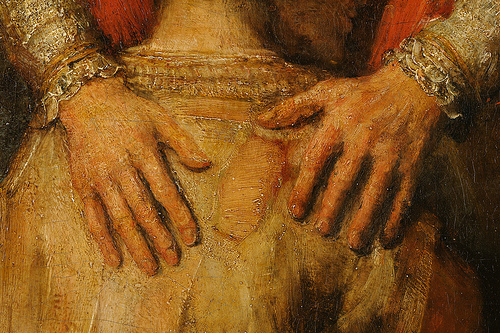
  • We see that his father receives him with a tender gesture. His hands seem to suggest mothering and fathering at once; the left appears larger and more masculine, set on the son’s shoulder, while the right is softer and more receptive in gesture.
  • The son’s head is downy, almost like a newborn’s. We must enter the kingdom like little children. 
  • The Prodigal Son seems to be protected by his father. He snuggles near the Father’s breast. It’s love that holds him there.
  • Consider his sandals. It has taken a long time for him to come home. 
  • Standing at the right is the prodigal son’s older brother, who crosses his hands in stoic judgment; we read in the parable that he objects to the father’s compassion for his brother.
  • We see his mother in the background in the painting, and a seated steward or counselor. One stands in profound joy, the other in sits in stunned perplexity.

But Rembrandt had painted the Prodigal once before, when he was considerably younger. And it is a very good painting. The prodigal is happy and gay; there is absolutely no indication of the consequences of sin.

The Prodigal Son in the Brothel, 1635

He’s a charming young man at the height of his popularity, and we see him at a happy party. He is spending the inheritance of his father.

But Rembrandt chooses at the very end of his life to re-paint it to reflect reality.

This is one of the last paintings he will do, and it is the Prodigal Son–destitute and repenting. I can only imagine; the years have taken a toll and he doesn’t really feel his first painting is enough. He wants to paint what is true.

He now is painting our spiritual condition.

We are given a work that some critics call as the greatest painting ever completed. The painting is now in St. Petersburg, Russia. It is seldom seen by visitors. It is a clear echo of the grace of God for fallen men and women. Like the father in the painting, He’s ready to forgive every sin saturated son and daughter.

The Father’s Prodigal

bry-signat (1)


Hiding Our Wounds

Brennan Manning Quote
“You are the light of the world. A city set on a hill cannot be hidden. 15 Nor do people light a lamp and put it under a basket, but on a stand, and it gives light to all in the house.”

Matthew 5:14-15, ESV

Overall, I think this Manning quote is a great observation. We, the torn and wounded, often try to hide, secluding ourselves in the “Island of Misfit Toys.” (Got to love those 60s Christmas cartoons.) We pretty much accept our lot as damaged merchandise.

Maybe we choose to isolate ourselves more than we want to admit. Could that be what we do? Are we still embarrassed and ashamed by all that we’ve done? That’s quite possible.

This may come as a shock, but the Church doesn’t need any more gifted people.

But it does need broken people who understand ‘the giftedness of the flawed.” When we conceal, we diminish the Church by our absence. We can ostracize ourselves, through a self imposed shame— but the Church will suffer. We need to show them that everyone can be healed, even screwy ‘fruit-cakes’ like us.

I recently had the privilege of speaking to a class of young Bible college students.

My subject was decidedly not on being successful, but on being a failure. Whole courses are geared toward ministerial success– but where are the ones for failure? I think that it just might be even more important, in the long run.

No human effort is going to erase your past.

I have tried and it can’t be done. I have blitzed my brains on drugs and booze, but I still remember the people I’ve hurt. (And I pray for them.) There really isn’t a cure for the evil we have done. I believe in forgiveness. And I hold to the idea that are sins are never to be a subject of  guilty accusation–

“He will again have compassion on us;
    he will tread our iniquities underfoot.
You will cast all our sins
    into the depths of the sea.”

Micah 7:19

Our dark iniquity is put in a very deep place. But there are the memories of an unkind word, or a sad and dark foolishness that we must learn to live with. There will be many regrets, and we face the terrible consequences of our sins, but it’s enough to know that all is under the blood of Jesus.

We are indeed forgiven. Completely.

We are now to live as forgiven sinners, yet precious in God’s eyes. We discover that although the Father has no favorites among His children, but He does have intimates. We are to live the rest of our lives for His glory, exploring that intimacy.

“Leave the broken, irreversible past in God’s hands, and step out into the invincible future with Him.”

  Oswald Chambers

Memories That Shame Us

And they heard the sound of the LORD God walking in the garden in the cool of the day, and the man and his wife hid themselves from the presence of the LORD God among the trees of the garden. But the LORD God called to the man and said to him, “Where are you?” 10 And he said, “I heard the sound of you in the garden, and I was afraid, because I was naked, and I hid myself.” 

Genesis 3:6-10, ESV

There is a good chance that some of your memories are pretty awful.

When we get looking back we can see shameful, dark things.  Some of us carry things that are profoundly evil, and they go with us wherever we go.

It’s no secret that guilt and mental illness travel hand in hand, for they are brothers. They have tormented us for a terribly long time. They are like playground bullies who have no fear– they only have hatred for us.

I’m quite convinced that the only way to move on is to have Jesus Christ fully cleanse you, and that includes your dark humiliations.  The human tendency is for concealment. We take considerable effort to conceal and cloak our past lives. (Both Adam and Eve understood personal shame.)

I remember back when my dad discovered that one of our dogs had killed a chicken.  He took that dead chicken and wired it around that dog’s neck. That dog wore that chicken for weeks.  It was awful, and it began to putrefy. The smell was terrible.  I can still see that dog, staggering and tongue lolling out and slobbering.  My dad said it was the only cure for a “chicken killer.”  The dog would get very sick, attached to this rotting carcass.  It was a sobering lesson for a young boy to see.

Somehow, that is what our past disgrace has done to us.  

Sure we have moments when we can almost forget.  But, for the most part, it is just a temporary reprieve.  We slide back and rediscover the pain; it’s just waiting for us.   The cost of our mental health is staggering.  

Many of us are driven by a mad movement toward drugs and alcohol.  We are compelled to escape the pain, and for a little while it seems to work. (This is called “co-morbidity.” Which is ‘fancy talk’ for a dual problem.)

It’s like filling a bucket with corrosive acid.  It will eat its way out.

Most of us would quickly trade this mental pain, this misery;  for a physical one. Something shameful that was done 20 or 30 or 50 years ago continues its destructive work.  Our conscience will not allow us to dispose of our self-disgust in this easy, cavalier manner.  We need a ‘hazmat’ crew to help us clean up mentally and spiritually.

You have to forgive yourself.  

You must, or you will destroy yourself and those closest to you as well!

Often we believe these things are simply moldy walls; they seem to just need a coat of paint. Our problem is that it will only cover for a short time.  After 20-30 layers are applied, we realize this isn’t really the answer. Nothing we can do is ever enough.  We must have Jesus– we must!

-Bryan Chapell

Full repentance is critical. Don’t scuff off this first step.  The blood of Jesus isn’t some nicety. It is foundational for salvation. We are to, by faith, start the obedience. Our blistering sin and guilt are absorbed in Jesus’ death and resurrection.

“When someone becomes a Christian, he becomes a brand new person inside. He is not the same anymore. A new life has begun!”

2 Corinthians 5:17, LB

The Extraordinary Breath of Jesus

“Jesus said to them again, “Peace be with you. As the Father has sent me, I also send you.” 22 After saying this, he breathed on them and said, “Receive the Holy Spirit. 23 If you forgive the sins of any, they are forgiven them; if you retain the sins of any, they are retained.”

John 20:21-23 (19-23)

This is the second “peace be with you” in this passage. So why the duplication of this peace proclamation? The disciples are sequestered and scared in the upper room (v. 19; and Luke 24:36. Having peace is being emphasized–the disciples were afraid of the Pharisees, but they also were undone by Jesus’ surprise visit.

Peace was definitely a precious commodity for them.

Jesus gives his disciples a mission to do, and they must be as ‘familiar’ with Jesus just as Jesus is with God. The disciples had followed him for three years–seeing incredible miracles, and hearing profound teaching, they’re ready, they just need power.

In track and field, there’s a relay race where a baton is passed from runner to runner, and maybe that’s how it’s working here? We see the same idea in John 17:18.

The baton has now been passed to the disciples.

The breath of the risen Jesus is necessary (and yes, he’s breathing.) What went down here, I don’t know exactly. But Jesus recognizes that his 12 followers will need this to do his work. Also, we might consider Adam in Genesis 2:7 where God’s breath brought him to life, which is pretty awesome when you think of the parallels.

The Holy Spirit energizes these men to do this new work.

The disciples were pretty much observers, but now they are to take up the ‘mantle’ of Jesus’ work. This is a definite duplication, which connects with the idea of one seed producing many others (John 12:24.) That’s how the Kingdom will come to people.

Verse 23 intrigues me. It seems that our life comes from the breath of Jesus. And it’s the Holy Spirit that gives both power and the authority that’s needed to function like Jesus. We now have the ability to pronounce forgiveness to the new believer, and yet that doesn’t seem a function of the Church today.

I wonder why this is so?

This entire passage as a doozy. It clearly declares the Churches new role as we follow in his footsteps. Disciples are to do exactly what Jesus does–with his breath and authority–filled with the Holy Spirit.

If we neglect these things (it seems anyway) we’re going to fall flat on our face.

“The work of Jesus for His disciples on resurrection Sunday gives an ongoing pattern for His work among His people. Jesus wants to continue this fourfold ministry of assurancemission, the Holy Spirit and authority to His people today.”

From David Guzik’s website