Jumpstarting a Prayer Life

We must (MUST!) pray as believers in Jesus. Prayer is the oxygen of our spiritual life. We must breathe, or else. When I go to my doctor she puts an 0ximeter on my finger so she can assess how my lungs are using oxygen. I suppose if we would put it on our “spiritual finger,” might it reveal something?

We don’t know exactly how to pray, I think communicating with God isn’t natural. We must be taught. The disciples wanted desperately how to pray–they didn’t know how, (Luke 11:1-2). So, we too must have Jesus teach us.

We can only learn how if the Spirit teaches us.

Also, we must practice praying. We may do it terribly rotten, but we should never give up–it’s not natural–it’s supernatural. But we learn by doing. We may get discouraged but keep at it. Even if you’re a pro, the Holy Spirit will make sure you keep learning. Our walk should always grow deeper.

For me praying the Psalms is good practice, and there are 150 of them. The Jewish people have a 4000-year start on us–they’ve used the Psalms as their prayer/praise book. My sense is that this covers every human need–the entirety of our spiritual walk!

I think that Psalms 103 might be a great place to get started.

I’ve been told by some that the “Lord’s Prayer” is quite useful as well. I guess if you honestly take it phrase by phrase, something good will happen. I’m still learning (and I suspect I still will).

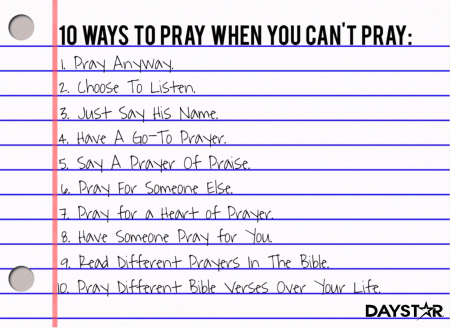
Below we find a way to jumpstart our prayer life. I hope you can use it.

One more thought. “Conversational Prayer” is a good thing for me lately. Talk with Jesus as if He was in the same room with you (He is) and just converse. Share your ups and downs, and it’s okay if you feel messed up. Relax. He’s your Father!

He absolutely loves talking with you.

When Teachability Rides a Chariot

I think this post will wander around a bit, we’ll see if the Father will speak to us somehow.

I really think our lives are made up of the decisions we’re making. At least, it sometimes sees that way.

Some decisions are like ‘forks’ in the road.  They’re made and then they shunt us in another direction. Most are minor–(will it be McDonalds or Pizza Hut?) But the biggies really alter us–very quickly we see that the road is going to take us in a radically different path.

Sometimes, if we’re honest, we will admit to backtracking; retracing our route back to the point we turned.  A lot of time it’s too late, and the moment has past. But we will sometimes learn that sometimes even our detours are part of the journey. (Amazing, isn’t? But He controls it all, and that’s comforting.)

I think I’m starting to learn how to receive correction from others. 

I’ve been mulling over the decision of the Ethiopian eunuch in Acts 8:30-31, he wanted to understand the truth:

“So when Philip ran toward the chariot, he heard the man reading from Isaiah the prophet [on his Kindle]. Philip asked, “Do you understand what you are reading?”
 31 He answered, “How can I understand unless someone explains it to me?” Then he invited Philip to climb in and sit with him.”

We see here such a very ‘thoughtful humbleness’– a teachableness of the heart that this eunuch seems to have learned.  He is confident enough in himself to acknowledge that he just doesn’t know. He invites Philip to a Bible study in the chariot.

We are responsible for our receptivity to truth. 

It’s our personal decision to either seek or not seek, to learn, or not to learn.  No one else can do this for us.  We come to a decision point and we go the way things seem to direct us, or we don’t. Again, we must choose.

Sometimes to not make a decision, is a decision.

The book of Proverbs is saturated with ideas on being guided by our humility when it comes in contact with truth.  Furthermore, there are many warnings about receiving correction and reproof gracefully.  For me, I’m learning slowly to receive hard counsel.

When my wife and I made the decision to work in the migrant camps in Mexico there was one elder who kept saying “no!” At first it was a real issue for us. We sort of resented it. But we began to see the blessing of his resistance. It caused us to really analyze our decision, and “count the cost.” We were stepping into a very hard place, and we needed that voice. We were being called to break in “new ground.” It was to be a challenge.

It seems that scriptural truth is almost always negative when it’s first encountered. It often irritates more than it comforts.

It often will not sit well, and I will try to shake it off.  But truth can be remarkably persistent.  ‘Forgive your brother’, the Holy Spirit says.  And you say right away, ‘Not a chance!’  But, give it time, and the Word will soften rock.  If you respond properly, humbly, you be able to make the right decision.

One more thing, Jesus told us in Matthew 18:3,

“I promise you this. If you don’t change and become like a child, you will never get into the kingdom of heaven.”

We’ll need to be a complete alteration in our hearts if we are to accommodate His command.  Becoming a child is more difficult as an adult– then becoming an adult is for a child.  Becoming small again takes a great amount of brokenness and it’s never really mastered.

God fully intends to work with you in this. 

God wants you to learn teachableness. He brings others to direct you. The Holy Spirit ignites the Word that’ll light your path. He doesn’t seem to ever give up.  He is wonderfully persistent–He never really does give up.

“The intelligent man is always open to new ideas. In fact, he looks for them.”

Proverbs 18:15, LB

Our Heavy Weight

“The bridge of grace will bear your weight, brother. Thousands of big sinners have gone across that bridge, yea, tens of thousands have gone over it. Some have been the chief of sinners and some have come at the very last of their days but the arch has never yielded beneath their weight. I will go with them trusting to the same support. It will bear me over as it has for them.”

CH Spurgeon

Quite often many of us deal with guilt and condemnation. We live in sinful bodies, and it seems that we actually cherish things that God has told us are wrong, and not part of an authentic Christian walk.

We’ve got an enemy that condemns and accuses. Our sin can be compared to “hooks” that Satan can latch on and pull us toward dark things. I personally don’t believe that a Christian can be demon-possessed. The Holy Spirit resides in the believer–He protects us with His presence.

The believer can be oppressed but never possessed.

Life can be very challenging when we choose sin over holiness. Often we really don’t have a fear of God. A healthy believer knows that he or she will stand and give an account of the way we live. Rewards will be given, and judgment will be passed on all that we’ve done.

When God saves a person He really does save a person.

We need not feel condemnation or guilt, Jesus was punished for our sin. His poured out blood is sufficient for everyone. He died so we won’t. He was risen to give us power over all of these nasty dark things. He becomes the bridge that holds our weight.

Be encouraged saint, as His holiness is given to each of us. We must choose it.

Number Them


          “So teach us to number our days that we may get a heart of wisdom.” –ESV

 
“Teach us how short our lives  really are so that we may be wise.” –NLT

 “Oh! Teach us to live well!
      Teach us to live wisely and well!”– MSG 

Psalm 90:12, three different translations

Growing up we must learn different things.

We’re taught the alphabet, how to brush our teeth and use deodorant.  We need to be educated, or tutored into many different skills.  Our teachers direct and guide us, they provide for us an understanding of the skills we need to acquire.  As we advance through their instruction, we grow in proficiency.

The Psalmist comes to the realization that he needs to develop a particular skill.  He desperately wants to craft his life to be honorable and obedient.  He turns to God and seeks His aid.  The psalmist seeks a ‘teacher’ who will instruct him.

Our own lives are often chaotic and foolish. 

We live in a great deal of ignorance, strained relationships and bad decisions.  Most definitely we are ‘saved by faith,’ but the course of our lives can still be difficult. There is much to be learned in the spiritual world. We’ll make many mistakes.

The author of Psalm 90 doesn’t want to continue doing stupid things.  He has a need, and he is pretty adamant that God will help him.  Part of what he understands is that he needs to get ahold of the reality of the ‘shortness’ of his life. That’s a good start.

He must understand that he has a limited lifespan–an expiration date. 

He refuses the deception that life will just always continue unfolding.  He doesn’t buy it.  He counts on God to pace him, and to keep him from recklessly wasting his life.  He is asking for restraints. He must learn to say “no” and say “yes” to many things.

I encourage you to consciously make this step.  Be deliberate in this.  If we lack wisdom, we need to ask Him for it.  Apart from His presence, our lives grow increasingly irrational.  Living without restraints will lead us into more foolishness and despair. We must learn to say “no.”

“Making the best use of the time, because the days are evil.”

Ephesians 5:16, ESV