God Keeps Your Tears in a Bottle

by Linda L. Kruschke

I have cried many tears in my life.

If you have never cried, you can stop reading right now. But if you have shed tears for yourself or for others, or if like me you have shed some without even knowing why or where they came from, take heart. God knows the tears you have shed. Psalm 56:8 says so. Here are several translations of that wonderful verse:

Record my lament;
       list my tears on your scroll —
       are they not in your record? (NIV)

You have taken account of my wanderings;
         Put my tears in Your bottle
         Are they not in Your book? (NASB)

You keep track of all my sorrows.
      You have collected all my tears in your bottle.
      You have recorded each one in your book. (NLT)

Write down my poem of sadness.
      List my tears on your scroll.
      Aren’t you making a record of them? (NIRV)

I love the image of God keeping all my tears in a bottle. I can envision shelves filled with bottles in Heaven, each with a name on it, and an accompanying scroll documenting every tear and lament. Or maybe it is just one huge bottle with all of our tears mingled together.

Today tears are being shed in dark rooms where children are being held as sex slaves, in Africa as people remain homeless and without food and water, in the United States as many remain jobless, in hospitals and on the streets where the mentally ill are forgotten, in homes around the world where people are spiritually lost and have no hope.

We live in a fallen and painful world.

Tragedies happen and humans are not always kind to one another. And so tears are shed. It is hard to fathom God collecting every single one, but He does. He notices and He records each tear and each lament.

The more I think about it, I like the idea that God has mingled all our tears together. The Psalm does refer to God’s “bottle” in the singular. And if He has collected every tear in that bottle, then mingled with our own are the tears of Jesus. In John 11, the apostle records this event: “Jesus wept.” (John 11:35.)

In this passage, Jesus weeps when He learns of the death of Lazarus.

When they see Him weeping, the people say “See how he loved him!” John 11:36. But I don’t think Jesus was weeping because Lazarus was dead – He knew He was going to raise Lazarus from the dead. Rather, I think He wept because of the compassion He felt for humanity as we weep over our own tragedies and losses. It is us that He loved so much that it brought Him to tears.

So if you weep today, remember that God is collecting your tears in His bottle, and mixing them with the tears of our dear Savior. Not only that, but God will deliver you from the final trial that lead to tears by redeeming your soul.

Psalm 116:8-9 (NIV).

Linda’s blog is at anotherfearlessyear.net  Please check out all she has to say and listen to her heart.
You may copy and use or distribute this post freely in its entirety please.
We’re a member.

p

A New Face, or a New Heart?

James H. Aughey

We live in challenging times. As people of faith, we’re slowly learning what Jesus really wants us to recognize. It seems every generation must understand all over again. Sometimes it seems we are taking two steps forward, and one step back. Oh well.

The Church must reacquaint itself with the total love of God for all people once again.

The Father hasn’t given up on us. Repeatedly, over and over, (and then over again) we learn about His unreal faithfulness to the Church and His love for all people. But sometimes we have a hard time believing these things. Honestly, we’re not what we should be, but thank God we’re not like we were. We’re learning this as well.

He’s more faithful than the most loyal person who has ever lived!

And we also must understand this. He is always seeking those who are on the margins: the lame, blind, sick and crippled. But thank God He’s still in the business of ‘collecting’ people who are desperate. (And if you can’t really see this, perhaps you should.)

The Church, and the churches we attend, are meant for those who are sick–the outcasts. It’s primarily a hospital, and the “sentinels” (pastors and elders, and others) must understand this. We must know and believe this. And we must know for ourselves the love “that passes all understanding.”

Jesus loves everyone, but if you must know, He’s specifically looking for the outcasts.

A really good study is those persons in scripture, who in their neediness, scream out “Son of God, have mercy on me.” There are 4-5 in the Gospels who said that. Although they modify this plea/prayer in slightly different ways, all of them are terribly desperate.

I encourage you to study this out, and get a deep handle on it. 

Our churches mustn’t lose sight of this kind of love, and if your fellowship isn’t doing this, just maybe you’re the one called to implement it. And if this isn’t possible, you might consider moving on. (I loathe to advise this.)

But please reject ‘the country club’ version of the Church.

It isn’t right and it’s not the heart of God. It’s religion that comes to us in its gradient forms of foolishness. It doesn’t really reflect the intense seeking of God. Somehow, along the way, churches got lost in the routine efforts of a religious routine.

The challenge is not just getting seekers to renounce the pigpen like the prodigal did. Most understand and are ready to do this. But sometimes the issue is within us, the Church– we dare not become the older brother– (Luke 15:1-2 and vv. 30-32). Usually we will be one or the other.

The question facing the Church is this:

Do we want to see face lifts, or a heart transplant?

One is for looking better, the other describes an entire overhaul. One is cosmetic, the other is a matter of life and death and reaches the heart. One is relatively minor, the other is definitely not. What kind does your Church have?

We really must sort this out.

I suppose the sooner the better.

To Give Beyond Giving

“Calling his followers to him, Jesus said, “I tell you the truth, this poor widow gave more than all those rich people.”

Mark 12:43, NCV

Heaven uses scales that earth knows nothing about.  Jesus calls out to His disciples, and they gather up close.  Life has a way of teaching us incredible things.  Circumstances usually make the best instructors.  These disciples did not need a didactic lecture.  They needed an authentic example of how of giving was processed through the economy of heaven.

The widow’s desperate poverty becomes the prime matrix of giving to the Father.  Her deposit was miniscule, hardly even enough for Jesus to even acknowledge.   Two pennies– laughable at best.  Many would give thousands more that day.  The widow gave everything she had.  The big ticket guys gave a very small precentage from their bank account.

The money box was a place of worship. 

Jesus acknowledged what this very poor widow did.  Some stood close to money box, and they would evaluate the giving of each one.  The text tells us that many came “with large sums of money.”  But Jesus declared the “widow’s mite” to be supreme.  Her pathetic gift was of a utmost value.

Upside down.  The view of heaven has turned everything on it’s head. 

Our first impression is almost always wrong.  This poor widow has been exalted to a place of example.  She now takes the spotlight as the model for us. Jesus makes her his Director of the Treasury for the KoG.  Two pathetic pennies!  And she becomes an astonishing pattern for us.


Frederick, [Handling Giftedness]

Fredrick-big
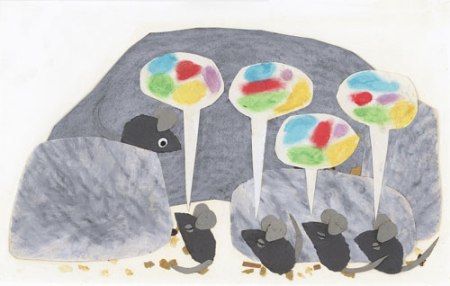
Frederick, the ‘prophetic’ mouse

I have always loved to read. I was given books by my mother, and these books were like gold. I had been a avid patron of the library, but terrible at returning books. I had pretty much been branded as “persona non grata” by the librarians of my hometown library at the ripe old age of 12.

I have fond memories of some fine books. But perhaps the most influential of them all was a title called, “Frederick” by Leo Lionni.  It won the ’68 Caldecott ‘back in the olden days.’ It very well could be one of best children’s books ever written. ( I realize now that many of these books that shaped me were prophetic in their own way.)

We see Frederick, who is a young field mouse, off on excursion to find food with his four brothers. They must fill their pantry for the cold winter that’s coming. They are quite successful (it appears) and all seems well.

However, there is a bit of a problem with Frederick. While the other mice are ‘busting their mouse-butts’ he sits quietly thinking. They question him repeatedly, trying to motivate him (or shame him perhaps?)  There seems to be a general consensus against him, which is verging on open warfare.

But Frederick insists that he is needed to do this. He says that he is ‘working’. He is collecting sunlight, absorbing it until it’s needed.  He takes in colors, and then words. He just seems soak up these really wonderful experiences, and he seems a bit “clueless” (that’s not the right word), maybe a bit “preoccupied.”

FrederickFinally in the dead of winter, sheltered deep underground, their supplies are running low. One of the mice turns to Frederick, and asks him to share what he has collected. And he does precisely that. They sit in a circle and Frederick shares the sunlight, and the rich colors and the beautiful words he has stored up for them. Their little ‘mouse-hearts’ are deeply touched by Frederick’s contribution.


In so many ways, this has become a parable, or metaphor of my life. As a eight year old, I could hardly have foreseen how my life would unfold. I do however had a deep sense of being different, even then. My mental illness, mixed with being “gifted”, and then combined with being isolated and dirt-poor, worked in me.

Essentially, we all are products of our personal history.  What we have experienced good or bad develops us.  It did me.  I think what “Frederick” wants to do for us is to process uniqueness, gifting and steadfastness.  One of the things that the Holy Spirit has been speaking to me for the last few years is this, “Bryan, can you receive from the giftedness of other believers?”

We really must make room for “Fredericks” and what they can bring to us.  We will be drastically weakened if we won’t– or can’t.  Jesus faced a ton of resistance as He began to minister.  There is nothing new about that.  But it didn’t touch His spirit.

“Now Joseph had a dream, and when he told it to his brothers they hated him even more.”

Genesis 37:5

bry-signat (1)

cropped-christiangraffiti1.jpg

&

fredrick-small