“Earth’s crammed with heaven,
And every common bush afire with God,
But only he who sees takes off his shoes;
The rest sit round and pluck blackberries.”
― Elizabeth Barrett Browning
Just beyond our earthly vision there exists the world of the invisible. There are things happening all around us. Things that are of a spiritual essence but no less real because we can’t see them.
“When the servant of the man of God got up early the next morning and went outside, there were troops, horses, and chariots everywhere. “Oh, sir, what will we do now?” the young man cried to Elisha.
16 “Don’t be afraid!” Elisha told him. “For there are more on our side than on theirs!”17 Then Elisha prayed, “O Lord, open his eyes and let him see!” The Lord opened the young man’s eyes, and when he looked up, he saw that the hillside around Elisha was filled with horses and chariots of fire.”
2 Kings 6:15-17, NLT
Elisha’s servant saw the physical presence of the enemy. It was a fearful sight to see and the servant was afraid. They were surrounded. There was no escape–no way out. All seemed lost.
Elisha’s concern for his servant is touching. He didn’t rebuke or harshly correct the young man. He simply prayed and then it was done. The servant would see what actually existed. You might say that he would really see for the first time.
The Bible is the best way to perceive the imperceptible. It frames and then guides us into what is really real. It is God’s of introducing us to what is really real. The Holy Spirit delights in revealing truth to our incredulous souls.
We have severe limitations as men and women. We have to be instructed in these things. We’re not equipped to perceive the supernatural. It is not a part of our lives. I find when God shows me what is really out there I get a bit freaked out. I need the firm hand of the Father in those times.
And I said: “Woe is me! For I am lost; for I am a man of unclean lips, and I dwell in the midst of a people of unclean lips; for my eyes have seen the King, the Lord of hosts!”
Isaiah 6:5, ESV
Consider the prophet Isaiah when he came in contact with the “real” world. He was completely undone. I can’t imagine acting any differently. I probably would become unglued.
A thought on this subject for you to consider:
“It is not the objective proof of God’s existence that we want but the experience of God’s presence. That is the miracle we are really after, and that is also, I think, the miracle that we really get.”
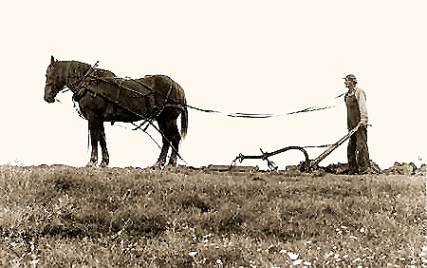
A farmer slowly walks behind his plow. The ground is hard and unyielding, but the steel cuts the heavy sod like a knife. He is preparing the soil for receiving the seed. He knows that what he is doing is imperative and he shouts out to encourage the horse. Its getting late and he wants to cut another furrow before night.
Plodding behind the plow he thinks many things. He can break up the ground, till and fertilize it, sow the seed— and then wait. He is powerless it get the seed to germinate and grow. He is limited to cultivating the soil and waiting. That is all he can really do, and he accepts this powerlessness. He can do everything right, and still not have a crop. All he can do is his part.
The farmer works in partnership with God. He is dependent on Him to grow the seed. The farmer must rely on the weather to meet and engage the planted seed. There are no shortcuts here. He does all he can, and then hopes that it is enough.
Farming is a joint endeavor between man and God. The man does what he has to do. God takes what the man has done and then finishes it. The crop will grow because He wills it. The farmer plays a part for sure, but ultimately God must become involved. Afterall, He makes the seed to sprout and grow.
We can say decisively that the pursuit of holiness in a Christian’s lifeis a joint endeavor between a believer and God.
Each have made the effort. The Christian does what is necessary, and then the seed is finally sown. It is then up to God to make the seed become the seedling. But each must work to finish the growth.
No one can attain holiness in their life apart from the work of preparation (it’s indeed work). The man must prepare the ground through plowing and cultivating. The farmer works the ground in order to make the ground ready. On the other hand, God provides both the environment and the growth needed to grow the seedling. Both the farmer and God must do their work.
A life of holiness is not automatic. It will never come at measured pace, trickling into our souls at a mechanized rate. (It would be nice if it would). Rather it seems to come, in fits and spurts, sputtering rather than simply flowing.
Holiness is like a steamy Amazon jungle, vibrant and full of life. It is saturated with things living and green. It is not like an arid and sterile desert. Holiness is pulsating and powerful, full of lush growing things.
Becoming a person of holiness is the grandest adventure for the human soul. It defies our tendency to be rigid and legalistic. It is quite the opposite. It is tapping into life itself, and who is up to the task? Our morbid ideas of what holiness are not worthy of what really is.
Yes, to be holy is to work. Just as the farmer must prepare the soil for the seed, we too must guide our plows. God is ready to sow, and we should be ready to be ready. That is if we want to be fruitful and productive.
“Oh, the fullness, pleasure, sheer excitement of knowing God on earth!”
“You have been raised to life with Christ. Now set your heart on what is in heaven, where Christ rules at God’s right side.”
Colossians 3:1, CEV
Paul’s explanation is given that is meant to clarify things for us. Perhaps it is too simple, too straight-forward. We seem to prefer the complex; ideally a 12 point plan, on ‘PowerPoint’, that makes us feel holy and strong, and even ‘spiritual.’ We’d feel much better if it was just a question of intelligence, rational mind and ‘practical thinking.’ Paul shares with this young Church of the Colossians. By the time he gets to chapter 3, he is ready to communicate an essential truth, which is meant to challenge our weak and faulty understanding.
“You have been raised to life with Christ.” The truth is this; the real world starts for you when you understand your resurrection as already taken place. You were once dead, and now you are alive! The life that you live is a resurgent life. You have awakened from death. Essentially, you entered ‘piggyback’ on Jesus. He has carried you into the deepest place in heaven.
It all can make sense if, “set your heart on what is in heaven.”This is the first mention of us taking action. Up to now, Jesus has did everything. But at this precise moment, we must act– to set our heart on the deep priority of eternity. To commence becoming who you really are. You’re now a spiritual man, or woman, who just so happens (at this point) to have a physical body.
It is a place of triumph and power, “where Christ rules at God’s right side.”This is no inconsequential place. This is the ‘very center of the center.’ The presence of God is all-powerful, and all-knowing. And it is accurate to say that we have been brought into that same atmosphere, where we breathe in the ‘shekinah’— that is God’s glory.
Embedded in this single verse in Col. 3:1 is a vigorously rich sense of how and what is the spiritual life. It should never be formulaic or mechanical. (We will not find our intellect charging the way into God’s presence.) Simply, we must believe in our hearts what has happened already. We enter by faith. It is so easy, but can be quite challenging. You are now a ‘citizen’ of heaven.
“But we are citizens of heaven, where the Lord Jesus Christ lives. And we are eagerly waiting for him to return as our Savior.”
24 Then the people complained and turned against Moses. “What are we going to drink?” they demanded.25 So Moses cried out to the Lord for help, and the Lord showed him a piece of wood. Moses threw it into the water, and this made the water good to drink.
It was there at Marah that the Lord set before them the following decree as a standard to test their faithfulness to him.”
Exodus 15
In this brief narration we have a graphic portrait of the condition of many within the Church today. The situation is becoming critical and its effects are devastasting. Some call it ‘crossless Christianity,’ ‘cheap grace’ or the ‘new cross.’ The writer of Exodus 15 calls it ‘bitter water.’
The children of Israel had begun to murmur. They demanded water for the long and hot journey through the Sinai desert. Coming to the ‘springs of Marah’ they discovered it bitter and undrinkable.
Moses responds directly to directly quell this potential rebellion. He begins to cry out to the Lord (what else can you do?) and begs the Lord for wisdom. He must know the next step. “So Moses cried out to the Lord for help,”
There was a tree, a piece of wood, and when that wood was tossed into the waters, the water were made sweet.
********
Today– people are waiting— searching for water. And never, ever has there been such a desperate search. They stampede to any new well on the horizon, and they search for anything. Any well will do. Most will seek there lives away, only to perish at the ‘end.’ They’re chasing a mirage.
The Church is to be a well, an oasis in a dry and desperate land. But the water is becoming ‘bitter.’ We have defiled it with ‘sin and self.’ Friends, please understand— the ‘bitterness’ of our ‘uncrucified’ flesh pollutes our wells. We have poisoned our own selves.
We need ‘the cross.’ It is a sweet source for our ‘bitterness.’
We must return to ‘the old rugged cross.’ We need to embrace its reality again. Jesus, himself said this: “Whoever doesn’t bear his cross, and follow me cannot be my disciple.’ Those who followed after Him needed no preacher to interpret.
Rome had a nasty habit of executing her criminals publicly. Everyone who had listened to Jesus Christ had seen people crucified.
One Roman general, after suppressing a Jewish rebellion crucified 2,000 men at one time. The roads into Jerusalem were lined with crosses of dying men. This was done purposefully and publicly.
Every man and woman would see the terrible price of resisting Rome. This would result in death, and there are no halfway about it. A cross is a radical thing. There is nothing ‘halfway’ about it. It demands ‘no less than all.”
The Cross is in danger of being misinterpreted’ today. Our cross seems somehow different. It seems softer, and more padded, it doesn’t rub us the wrong way.” It allows us much: our favorite habits, our prideful ways, and our self-centered ideas. It would seem that what we call ‘our cross’ has a built-in ‘life-support’ system that keeps our old man alive just a little bit longer.
********
Dr. A.W. Tozer in an article entitled “The Old Cross and the New” wrote:
“The new cross is not opposed to the human race, rather it is a friendly pal, and if understood aright, it is the source of oceans of good clean fun, and innocent enjoyment. His life motivation is unchanged, he still lives for his own pleasure, only he takes delight in singing choruses and watching religious films, instead of singing bawdy songs, and drinking hard liquor. The accent is still on enjoyment, though the fun is on a higher plane morally, if not intellectually.The new cross does not slay the sinner, but redirects him.”
The old cross is a symbol of death. It stands for an abrupt and violent end of a human being.
“Examine yourselves to see if your faith is genuine. Test yourselves. Surely you know that Jesus Christ is among you; if not, you have failed the test of genuine faith.”
2 Corinthians 13:5
Are we really carrying the cross of the Bible? Is our faith real? Are we carrying the real cross? We cannot be really His disciples unless we do so, and we are apostate if we do not.
“Then, calling the crowd to join his disciples, he said, “If any of you wants to be my follower, you must turn from your selfish ways, take up your cross, and follow me.”




![How Things Grow, [Work]](https://brokenbelievers.com/wp-content/uploads/2017/02/plow1930s-2.jpg?w=427)





 Broken Believers