A Friend of Sinners and the Ungodly

Anthony van Dyck – Christ Healing the Paralytic, 1619

“No matter how low down you are; no matter what your disposition has been; you may be low in your thoughts, words, and actions; you may be selfish; your heart may be overflowing with corruption and wickedness; yet Jesus will have compassion upon you. He will speak comforting words to you; not treat you coldly or spurn you, as perhaps those of earth would, but will speak tender words, and words of love and affection and kindness. Just come at once. He is a faithful friend – a friend that sticketh closer than a brother.”

–D.L. Moody

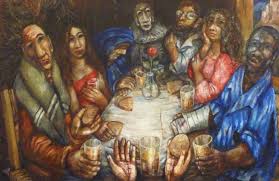
“The Son of Man has come eating and drinking, and you say, ‘Look at him! A glutton and a drunkard, a friend of tax collectors and sinners!’”

Luke 7:34

The Church Collects Sinners

The following excerpt is from the devotional book, “Living the Message,” by Eugene H. Peterson.  This pastor-professor is probably the person I want to grow up to be like; he has a gentleness and eloquence that is seldom seen–and highly respected.
Dr. Peterson died in 2018.
The author of many books, and his translation of the Bible, titled “The Message” is regarded by many as a masterpiece of the English language. 
Additionally, he has recently focused on the pastor, and on the many issues, a pastor might face.  He understands being a servant of the Gospel and the Church. 
I encourage you to read his stuff.  

***********

“When Christian believers gather in churches, everything that can go wrong sooner or later does.  Outsiders, on observing this, conclude there is nothing to this religious business, except perhaps, business…and a distant one at that.  Insiders see it much differently.”
“Just as a hospital gathers the sick under one roof and labels them as such, the Church collects sinners.” 
“Many people outside are just as sick as the ones inside, but their illnesses are either undiagnosed or disguised.  It is similar with sinners outside the church.”

********

 Some other quotes by Eugene Peterson:

  • “All the persons of faith I know are sinners, doubters, uneven performers. We are secure not because we are sure of ourselves but because we trust that God is sure of us.”
  • “When we submit our lives to what we read in scripture, we find that we are not being led to see God in our stories but our stories in God’s. God is the larger context and plot in which our stories find themselves. “
  • “When we sin and mess up our lives, we find that God doesn’t go off and leave us- he enters into our trouble and saves us.”
  • “American religion is conspicuous for its messianically pretentious energy, its embarrassingly banal prose, and its impatiently hustling ambition.”
More Eugene Peterson Quotes…
 
 
bry-signat (1)

Grabbing On to Psalm 27!

This is a perfect Psalm for broken believers–those who sometimes struggle to believe. We can understand because we each have encountered difficult things–hard things. So buckle up, here are my comments on Psalm 27. I really hope that they might help you through your personal mess.

I sometimes use the Message Bible:

Light, space, zest—
    that’s God!
So, with him on my side I’m fearless,
    afraid of no one and nothing.

When vandal hordes ride down
    ready to eat me alive,
Those bullies and toughs
    fall flat on their faces.

Man alive, we tolerate so much darkness. But the believer understands that God not only chooses him/her, but protects them. There is going to be difficulty, that much I understand. I can’t and won’t sugarcoat this. I’m not naive.

“Vandal hordes;” and “bullies and toughs” are motivated by darkness–Satan’s kingdom. The psalmist David sees trouble up ahead, he’s very real here and definitely not a ‘pie-in-the-sky’ optimist. But he’s very much convinced of their defeat.

When besieged,
    I’m calm as a baby.
When all hell breaks loose,
    I’m collected and cool.

I’m asking God for one thing,
    only one thing:
To live with him in his house
    my whole life long.
I’ll contemplate his beauty;
    I’ll study at his feet.

There’s a place of safety for David. He’s being blasted right and left by the enemy, but in that place, he finds “calmness.” He’s protected and you could say he wears spiritual body armor. Wearing that David discovers that he’s bullet-proof, for he wears a vest of spiritual steel.

The house of God is crucial, and he wants to live in it, to “contemplate” the wonder of the Spirit of God. David sees it as his castle that stands in resistance against all those who want to destroy him. And believe me, it is his complete focus.

He injects the word “study” which tells us that he’s found Someone that teaches him the things he needs.

That’s the only quiet, secure place
    in a noisy world,
The perfect getaway,
    far from the buzz of traffic.

God holds me head and shoulders
    above all who try to pull me down.
I’m headed for his place to offer anthems
    that will raise the roof!
Already I’m singing God-songs;
    I’m making music to God.

David is aware that the world is a noisy place (v. 5). But he knows that the very presence of God is a place of quiet and security, it’s “the perfect getaway,” that exists for everyone who believes.

Worship is critical here.

I think it not only exalts and glorifies God but it also is the best way of protecting himself. David is exuberant here, he can hardly contain himself! Perhaps we really don’t understand–it seems rather excessive–may be too zealous for us.

In v. 6 we see the spiritual effort of God holding David in place. He understands that there are many who are trying their best “to pull” him away from the security of God.

7-9 Listen, God, I’m calling at the top of my lungs:
    “Be good to me! Answer me!”
When my heart whispered, “Seek God,”
    my whole being replied,
“I’m seeking him!”
    Don’t hide from me now!

9-10 You’ve always been right there for me;
    don’t turn your back on me now.
Don’t throw me out, don’t abandon me;
    you’ve always kept the door open.
My father and mother walked out and left me,
    but God took me in.

Wow! “the top of my lungs” is pretty intense. The passage speaks of seeking–that’s the key of this whole thing. To be an authentic seeker has to be a “heart” issue, and never a brain thing. Heart followers certainly understand the difference.

Note that the presence of God is David’s entire focus. One of his petitions here is “don’t hide from me now.” As a New Testament guy, I know that it isn’t really possible. Jesus promised me He would dtay with me. See John 14:15-17.

If you’re struggling, like David did, you’re in good hands. Even though it seems like God is distant, He’s not. “God took me in” is a statement of real faith. David knows that the Father’s love is beyond the love of a father or mother.

And now the comes the finale!

11-12 Point me down your highway, God;
    direct me along a well-lighted street;
    show my enemies whose side you’re on.
Don’t throw me to the dogs,
    those liars who are out to get me,
    filling the air with their threats.

13-14 I’m sure now I’ll see God’s goodness
    in the exuberant earth.
Stay with God!
    Take heart. Don’t quit.
I’ll say it again:
    Stay with God.

“Point me” and “direct me” is David’s discipleship to his Father’s ways. He speaks of enemies (“dogs” and “liars”) who are trying very hard to destroy him. “Out to get me” is David’s assessment of the hard things that come.

David is convinced that God is always very good to him, he understands this. It’s the same for the NT believer, although Satan nips at our heels, God protects us–He’s on our side.

He exhorts us twice to “stay with God.”

Maybe that’s where a lot of issues come. “Don’t quit” is David’s plea. This is stated throughout Paul’s epistles written for us.

What a wonderful Psalm. So much security here (as well as the opposition). Psalm 27 is written to us rascals and inconsistent believers in Jesus. I exhort you to spiritually digest this passage. It’s yours!

Illustration: Solomon’s Temple. I’m using “The Message,” a translation by Eugene Peterson.

Oh God, Why is This Happening to Me?

book_of_Job-570x377
“Why have you made me your target?…Why do you hide your face?…Why should I struggle in vain?…Why does the Almighty not set times for judgment?…Why then did you bring me out of the womb?”

Job 7:20, 13:24, 9:29, 24:1, 10:18

Didn’t Job get “hammered?” His monumental suffering is unparalleled in history. He is essentially a godly man who loses everything (except his faith). Job must pick up the pieces after “catastrophic ” sudden pain and total loss.

Job is being tested with the ultimate horrors. Will he “curse God and die” as his wife suggests? Will he cave in to the final four (his friends) and agree to their twisted theology? (You have to read chapters 38-39 to find out).

The Book of Job has been regarded as inaccessible and archaic by many.

Unfortunately many believe this assessment and look elsewhere for comfort. I would agree that Job is a challenging book, but so is Macbeth or Plato. (I guess you should find an easier translation).

Job is less an explanation and more a revelation of suffering. “Why” questions go unanswered. “Who” questions matter. I suppose this seems unfair. It certainly seems so, but straight answers in a fallen world won’t get any mileage at all.

One more thing. The Book of Job is about “twisted” theology. Job’s friends “toe-the-party-line” of theology that is logical. But don’t be mislead by their pronouncements, for they seem reasonable but they are flawed. It is a doctrine without love.

“If I have the gift of prophecy and can fathom all mysteries and all knowledge, and if I have a faith that can move mountains, but do not have love, I am nothing.”

1 Cor. 13:2

You can’t split your theology from love and get away with it.

When you read “Job’s friends” you must remember that. These are lessons it takes a long time to learn.

The broken believer, hobbled by chronic illness, has much to learn from Job. He is like “the poster child” for those afflicted. My mental illness is an issue (of course) but God is fully in control. He brings beauty out of the ashes.

“To bestow on them a crown of beauty
    instead of ashes,
the oil of joy
    instead of mourning,
and a garment of praise
    instead of a spirit of despair.
They will be called oaks of righteousness,
    a planting of the Lord
    for the display of his splendor.”

Isaiah 61:3