Zero Condemnation

Condemnation-Condemnation can go viral among believers.  Not only does it infect us, but we become ‘carriers’ that often can sicken others spiritually.  Our attitudes and thinking can become quite disturbed, and we then communicate that to our family and friends.
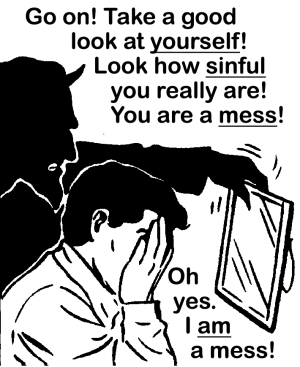
To be perfectly honest, condemnation is not easily defined.  But it seems to be  the feeling that we are being judged for our sin.  It carries a judicial sense that a verdict has been spoken over our lives–and we are guilty as charged.  Condemnation carries a sense of finality or doom.  It has an idea of irreversible punishment. (Conviction, on the other hand is hopeful and comes with promise.)

People who are trying to live with condemnation feel as if they are waiting for an executioner to appear.  There lives are filled with dread and foreboding. But it all seems right. Life unfolds for them in dark paranoia.  On the other hand conviction will lead us to compassion and mercy, but condemnation is a lie and falsehood.  There is a profound sense of guilt which a believer is able to push back–but only so far.  It is heartbreaking to see, especially when you understand the scope of the battle that is taking place.

“Therefore, there is now no condemnation for those who are in Christ Jesus.”

Romans 8:1

The human race is under the righteous judgement of God for our sin.  We cannot pretend that this isn’t real.  Just a cursory overview of history supports this fact, with our wars and famines.  In our natural state, we excel at mistreatment of others.  There is a viciousness and an evil that is embedded in our hearts.

But Jesus is our Savior, He came in the pattern of a sacrificial lamb.  He took on all of your sin, and evil.  He absorbed it, and took your guilty verdict.  He was your sacrifice.  What Jesus did was complete and total.  He just didn’t take a percentage of your sin, He took everything from you–no matter how dark and evil.  He siphoned it all away. and He carried all your weight. He took all the punishment.

Condemnation comes when we find a reason not to believe this.

Condemnation-flattenedThere is almost always doubt involved, and it seems too good to be true, after all.  There is also a entrenched concept of justice, right and wrong.  Believers with a real feeling for ‘the scales of justice’ find themselves without any hope. They lose the concept of mercy and grace for their sins.

“Then I heard a loud voice in heaven say: “Now have come the salvation and the power and the kingdom of our God, and the authority of his Messiah. For the accuser of our brothers and sisters, who accuses them before our God day and night, has been hurled down.”

Revelation 12:10

There is an evil presence in this world.  It accuses us, and confuses us.  His name is Satan– and he is all together evil.  He makes a concerted effort to try to destroy us.  He floods us with wickedness and darkness.  If you will not stand against him, he will bring you down. However, you must understand this, he has been defeated.  But I must reinforce this, without Christ, there can be no immunity from the darkness of condemnation.

bry-signat-1cropped-christiangraffiti1 (2)

&


The Hidden Blessings of the Long Struggle

freelancing-struggle

by Jonathan Coe

It’s a familiar story. A person has become a Christian in recent years and is engaged in spiritual practices–prayer, Bible study, meditation, church attendance, fellowship, tithing, and/or the sacraments. They have listened closely to their pastor or priest and have developed some formulas that are supposed to help them overcome the problems, sins, and weaknesses in their lives.

They’ve heard sermons and/or read books that have titles that start with “Three Steps,” “Five Keys,” and “Four Ways,” that are supposed to lead them to the abundant Christian life. They see progress in their lives but are discouraged because they still struggle with certain sins, problems, and/or weaknesses. Some feel like they can’t overcome the very deep negative legacy from the unhealthy family they grew up in.

Church leadership would do many believers a service by teaching them about how God can bring good out of their protracted struggle. No, it’s not God’s will for us to habitually sin , but God, in his tender mercies can work redemptively in this long and frustrating battle against profound sin.

One of the first good things that can come out of a long battle with a character flaw or problem is deliverance from a formulaic Christian faith. “Do these three things and your problem will go away” you learn from a best–seller, but your problem doesn’t go away. The fallen human heart is a complex and formidable thing, and these canned approaches are a little like taking a squirt gun to a forest fire.

When people experience sustained adversity, their lives feel out of control, and they will often grab on to formulas to give them a sense of righting a ship that’s taking on water. Unfortunately, they end up trusting in the formulas more than God himself.

Faith in formulas will always eclipse faith in God.

The Christian life is more about a restful trust in a Person than embracing a set of principles (no matter how spiritual those principles may sound.)

The New Testament is clear on the centrality of faith (not self–effort or formulas) in the overcoming life:

When asked by his disciples what they must do to do the works God requires, Jesus answered, “The work of God is this: to believe on the one he has sent” (John 6:28, 29). When describing the person who overcomes the world, the Apostle John said, “He who believes that Jesus is the Son of God” (I John 5:4, 5).

The failure of formulas is a good experience because it drives the believer to faith in the living God. In this faith, there is a wonderful exchange: I give Christ my pitiful attempts to live the victorious Christian life and he gives me his transforming power to overcome sin. However, this exchange may not happen overnight; it may be a process that takes years.

For those of you in a long struggle, please be comforted by the mercies of God that endure forever. If he can forgive a murderer and adulterer like David, he can forgive you and me. Please take the advice that Winston Churchill gave the British people during World War II: “Never, never, never, never give up ” or listen to the lyrics from a U2 song called “Miracle Drug” : ”There is no failure here, sweetheart/ Just when you quit.”

Even better is C.S. Lewis from The Business of Heaven:

“I know all about the despair of overcoming chronic temptations. It is not serious, provided self–offended petulance, annoyance at breaking records, impatience, etc. don’t get the upper hand. No amount of falls will really undo us if we keep on picking ourselves up each time. We shall of course be very muddy and tattered children by the time we reach home, but the bathrooms are already, the towels put out, and the clean clothes in the airing cupboard. The only fatal thing is to lose one’s temper and to give it up. It is when we notice the dirt that God is most present in us: it is the very sign of his presence.”

I say Amen.

ybic,

Jonathan Coe

&

Bryan’s note: Jonathan is a very old friend. He deeply loves Jesus. He is wise and he is aware. He is a writer, blogger, and a house-painter. (He is also a Dodgers fan, which I suppose he can find forgiveness for). I am made a rich man by knowing him.

It’s Friday, but Sunday’s Coming!

easter
 “he humbled himself in obedience to God
    and died a criminal’s death on a cross.”

Philippians 2:8

Dr. Tony Campolo tells the story of a little preaching competition that he had with his pastor during services at the church where he attends. Dr. Campolo tells how he preached the “perfect” sermon, perfect in every way. He had taken the congregation to the heights of glory. And as he sat down beside his pastor, Dr. Campolo patted him on the knee and simply said, “Top that.” The older black pastor looked at him and said, “Boy, watch the master.”

It was a simple sermon, starting softly, building in volume and intensity until the entire congregation was completely involved, repeating the phrases in unison. The sermon went something like this.

It’s Friday. Jesus is arrested in the garden where He was praying. But Sunday’s coming.
It’s Friday. The disciples are hiding and Peter’s denying that he knows the Lord. But Sunday’s coming.
It’s Friday. Jesus is standing before the high priest of Israel, silent as a lamb before the slaughter. But Sunday’s coming.
It’s Friday. Jesus is beaten, mocked, and spit upon. But Sunday’s coming.
It’s Friday. Those Roman soldiers are flogging our Lord with a leather scourge that has bits of bones and glass and metal, tearing at his flesh. But Sunday’s coming.
It’s Friday. The Son of man stands firm as they press the crown of thorns down into his brow. But Sunday’s coming.
It’s Friday. See Him walking to Calvary, the blood dripping from His body. See the cross crashing down on His back as He stumbles beneath the load. It’s Friday; but Sunday’s a coming.
It’s Friday. See those Roman soldiers driving the nails into the feet and hands of my Lord. Hear my Jesus cry, “Father, forgive them.” It’s Friday; but Sunday’s coming.
It’s Friday. Jesus is hanging on the cross, bloody and dying. But Sunday’s coming.
It’s Friday. The sky grows dark, the earth begins to tremble, and He who knew no sin became sin for us. Holy God who will not abide with sin pours out His wrath on that perfect sacrificial lamb who cries out, “My God, My God. Why hast thou forsaken me?” What a horrible cry. But Sunday’s coming.
It’s Friday. And at the moment of Jesus’ death, the veil of the Temple that separates sinful man from Holy God was torn from the top to the bottom because Sunday’s coming.
It’s Friday. Jesus is hanging on the cross, heaven is weeping and hell is partying. But that’s because it’s Friday, and they don’t know it, but Sunday’s a coming…”


Dr. Tony Campolo

Campolo’s web site: http://www.tonycampolo.org/

(This sermon is in an audio format as well: http://tonycampolo.org/its-friday-but-sundays-coming/)


1brobry-sig4

cropped-christiangraffiti1 (1)

“The Sheep Dip”

sheep+003

“It is not my business to judge those who are not part of the church. God will judge them. But you must judge the people who are part of the church. The Scripture says, “You must get rid of the evil person among you.” 

1 Cor. 5:12-13

a

We live in time of staggering sin.  It’s saturating everything and everybody— the world, and the Church . Our rebellion has gone viral.  We’ve been so inured and taken by it we find we just can’t imagine thinking apart from its influence.  Two generations ago things were astonishingly simple.  Todays sin has gotten superbly sophisticated— or has it?

Paul in his note to the Corinth church was compelled to point out a few things.  The culture in Corinth was like a communal ‘sheep dip’.  Everyone went through it.  It saturated everything— it soaked everyone, from head-to-toe.

This extreme atmosphere of sin pushed Paul to take a stand.  Most likely he would never had to do this.  But, the conditions demanded he respond to the sin that was raging everywhere.  And perhaps by doing this publicly, he could see people saved from feeling ‘the flames’.

The Church in 1 Cor. 5 felt that they were doing the right thing by accepting people living in continuous sin.  It seems as if their liberal hearts were opened to receive sinners of all varieties.  In their thinking, this made themselves as the Corinthian church quite remarkable, maybe even exceptional.

Paul however, will not be manipulated by human logic.  He instead presses us with him, to the good and the true.  He admits (point blank, mind you) that he has no authority over the lost, the secular, and the world.  He has nothing, ‘zilch’ to say about the way the heathen behave.  “It’s none of my business’ says Paul.  And he turns, and walks away.

We Christians, as believers however, are his business.  Paul, like a great ‘lens,’ focuses on you, and on me.  As part of the Church we are brought under its oversight and its direction.  It dictates to us now what is proper for us– acceptable, and honoring.  But the ‘worldling’, he goes free, doing whatever he desires. We however, come into a direct and sure correction of our ways.

What is your sphere of influence, and how far does it extend?  For Paul, he recognized his boundries.  And we must see ours.  The urge to intervene is very strong. We must back off.  But even though we detach from our worldly commitments, we are still to be a strong, sure light in their midst.  But we are not to be the judges of this world system. But the Church is a whole other matter.

bry-signat (1)

cropped-christiangraffiti1.jpg

*