Making Progress

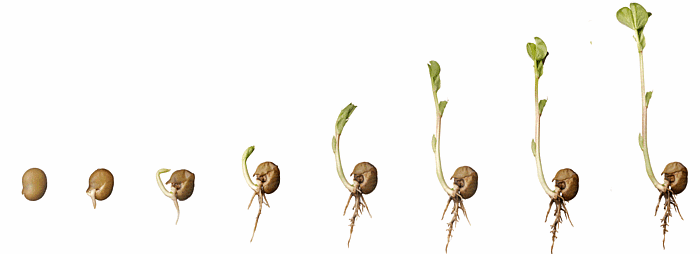
The earth produces the crops on its own. First a leaf blade pushes through, then the heads of wheat are formed, and finally the grain ripens.

Mark 4:28, NLT

This concept of physical growth is now applied by Jesus to us.  He has cultivated us, and we must insist on a maturation.  We sprout, and extend ourselves in a growth that means, ‘there is now life’ here.  Life is not mechanically rigid.  It has nothing to do with plastic, steel girders or cement.  It is emphatically not a concrete issue.  It is life!  It has a very different definition.

Jesus takes a seed, that seed splits open.  A green leaf pushes through, and it is growing!  Put into the ground, and watered, it will have life!  It is living.  This all seems easy and obvious now.  “Of course,” we say.  “I understand that.”  But when Jesus taught this (even as simple as it is) the implications were profound.  The earth seemed to shake when He declared this truth.

There was a rigidity to the spiritual world in Jesus’ day. 

This principle of life, and growth, and greenness was not at all descriptive of Pharisees.    The legalistic and cold hardness was unmoving, unrelenting and unyielding.  For many, this is a really major issue–the spiritual life was supposed to be have more organic freshness, then this.

But a living life of spiritual growth should be more than that; it was meant to be energizing and life-giving.  I remember seeing a mannequin in a mall (it was dressed in nicer clothes than I was.)  But although this display was in human form, it was definitely inanimate.  Going up to it, I tried to talk with him.  I wanted to explain things of the Spirit, but he just stood there, staring.  He was decidely devoid of real life.

Ridiculous?  Perhaps.  But having eternal life is profound.  We are like department store mannequins that have been made to really live.  And there is a growth that now takes place.  There is a supernatural, organic development–its this that should really infuse us with the life of the Spirit.  Our life is constantly and wonderfully changing, it should infuse us with a joy and elation we can’t keep a lid on.

Blessings,

Bryan

Despondency and David’s Theology

For those on the mat and wrestling, things can move very fast.  Our adversary is strong, and he knows us too well.  He is counterintuitive and quite aware of the sequence of moves needed to pin us to the floor.  He is dangerous.  And he also despises us.

I get bewildered and rattled by his attacks.  He knows how to pressure me at just the right time, and he refuses to follow the rules. He is no gentleman, you might say that he is both a cheater and a bully.

Of course I am talking about Satan and his team of demons.  I will not dispute their reality with you.  There is almost as much scriptural support for his existence as there is for Jesus’.  His hostility is  toward God and His people, and his viciousness cannot be camouflaged.  Evil is real, and believe this– Satan has a terrible, and ugly plan for your life.

As a mentally ill Christian, my depression quickly morphs into despondency.  When I sink to that level I start to abandon hope.  It’s like I’m in a lifeboat and decide that I should abandon it and tread water on my own.  Despondency is not rational and just a little bit is deadly.

David knew all about desperation and disheartenment.  He had been chased by his enemies, and maneuvered into the most difficult of situations.  To observe him at a distance we would say that “there is no hope for him in God.” Even God can’t save him, he is reprobate.  We would be convinced that there is nothing for him in God’s thinking.  Nothing.

It would be so easy to make this judgement.  For David was a moral failure; he was an adulterer and a brazen killer.  David had sinned deeper and more intensely than Saul ever had.  Join with the crowd, “There is no hope for him in God!”  No hope, none, nada, zero.

“Yet I am always with you;
you hold me by my right hand.

You guide me with your counsel,
and afterward you will take me into glory.

Whom have I in heaven but you?
And earth has nothing I desire besides you.

My flesh and my heart may fail,
but God is the strength of my heart
and my portion forever.” 

–Psalm 73

David defied the theology of his day.  He embraced the Lord God with a desperate passion.  It was not orthodox or logical.  You could say it was disturbing.  But David would not let go of God!  He hung on, and continued to sing in faith.

I encourage you besieged brother, and embattled sister.  Hold on to Him, even if it defies logic or theology.  Seek His promises with a fervency, open your heart to Him with a passion.  Remember that sin can and will destroy you.  It is part of Satan’s stratagem.  Sing in the cave, and never lose hope. Never.

*

bry-signat (1)

cropped-christiangraffiti1.jpg

The Joyful Necessity of Dying Daily

Eye+Fetch+Photography+Stormy+Wheat+Fields+by+Diane+Loft (1)
Photo by Diane Loft

“We know that our old sinful selves were crucified with Christ so that sin might lose its power in our lives. We are no longer slaves to sin.”

Romans 6:6, NLT

“There are two things which the Church needs: more death and more life— more death in order to live; more life in order to die.”

C.A. Fox

The need of this moment is critical. Many believers have never came to this point of ‘knowing.’ Maturity comes when one realizes that crucifixion has dealt with the old man. We died when He died, we were there when He died, we were part of that event. Romans 6 is all about a believers ‘co-crucifixion’ with Jesus Christ. Calvary was far more than a religious event— it was where our sin was terminated. It was more than just a penalty carried— it was where our old nature put to death.

“My old self has been crucified with Christ. It is no longer I who live, but Christ lives in me. So I live in this earthly body by trusting in the Son of God, who loved me and gave himself for me.”

Galatians 2:20

Sin has no power to sway a dead man. A man who is dead doesn’t respond to a girl in a leopard skin bikini. (It doesn’t matter if she is insanely gorgeous). He no longer can be tempted to sin. Why?  Because he is dead. This is not an issue of semantics, it is not poetic interpretation of a metaphor. It rings true in heaven and it is quite real here on earth.

Sin should no longer remain in power of a believer’s life. We believe that our sins have been dealt with on the cross, that Jesus took our sins from us, bearing them as a ‘sacrificial lamb.’ But the same is true to say, “My sinful nature was also crucified with him.”

“I tell you the truth, unless a kernel of wheat is planted in the soil and dies, it remains alone. But its death will produce many new kernels—a plentiful harvest of new lives.”

John 12:24

The principle is from farming. A kernel of wheat will bring an abundance. But it must be buried first. The dead seed miraculously sprouts. At the moment of death it suddenly receives a new life. The dead seed grows into a bountiful harvest. This is the New Testament principle of dying to self. A few things:

  • we are not sinless— we must deal daily with the sinful part of us,
  • this must be taken by faith, much like anything else from God, Heb. 11
  • discipline aids our quest for holiness, 1 Tim. 4:8
  • it accentuates the role of water baptism, it’s a daily reckoning, Rom. 6:4,
  • temptations can be really strong, but He enables us, 1 Cor. 10:13
  • this is a God honoring way to live.

Crucifixion should always be taken by faith in God’s Word and it will lead to resurrection. Crucifixion weakness is necessary for resurrection power. Jesus shares his life with us— his power is given to his people. He shares all that He is so we might become like him.

“Do not let sin control the way you live; do not give in to sinful desires. 13 Do not let any part of your body become an instrument of evil to serve sin. Instead, give yourselves completely to God, for you were dead, but now you have new life. So use your whole body as an instrument to do what is right for the glory of God.”

Romans 6:12-13

We’ve been given a gracious teacher in the person of the Holy Spirit. He will never condemn our feeble efforts to be holy. Be encouraged: God delights to make the weakest of us strong. He has done all He can to work holiness into our hearts.

bry-signat-1-1


cropped-christiangraffiti1.jpg


Don’t Waste Your Sorrows


062_dont_waste_your_sorrows

These little troubles are getting us ready for an eternal glory that will make all our troubles seem like nothing.”

2 Cor. 4:17, CEV

“Before God could bring me to this place He has broken me a thousand times.”                                   

Smith Wigglesworth


As we move toward maturity, over time and through circumstance, we will start to develop exciting new ways of thinking.  We engage the Word and combined with our relationships with people we start the work of God.  We soon learn that the Kingdom of God flows through relationships, almost exclusively.

Pain and sorrow are some of the more intense ways the Lord reaches down and into our lives.

Rick Warren has written, “God intentionally allows you to go through painful experiences to equip you for ministry to others.” 


I think that as we dwell on this we will start to see the hand of God, moving things around in our complicated lives.  As we attend class in this school of the Spirit, we learn things that will change our life and ministry.

But we must consider that we can waste our pain and sorrows by not engaging the issues properly.  Will I submit, or will I grow sullen and cynical? Will I worship through my tears?  Surrendering to Christ is not a once-in-a-lifetime event.  It is a daily, and even hourly process.  I regard any kind of cynicism though, as a hungry predator who is hunting me.  Very dangerous, and I am highly suspectable.

Pain is the way the Father reaches me, he isn’t too concerned about our comfort (it isn’t the real issue, after all.)  When I hurt, I invaribly look for Jesus.  And that cannot be all bad.  Through the trials and pain I begin to reconnect with my Father.  Without the trials, I doubt we would ever call out for His help.

“Don’t waste your sorrows.”  It is easily said but seldom done.  We start to stagger by the weight of our personal issues.  Overwhelmed by the pain we start to panic and grab things, and throw them overboard, to lighten the load.  We can be confused, and will do whatever we must do to stay afloat.  But unless we take these sorrows well, we are just short-circuiting God’s intentions.

C.S. Lewis once commented on our issues,

“Experience: that most brutal of teachers. But you learn—my God do you learn.”

The darkness intends to absorb us.  Satan uses our own bitterness and frustration to do this.  Our discipleship is no longer valid if we commence doing our own will and desires.  Even though we get “flaky” the Father will always love us. But we dare not waste our pain, it comes at too big of a price.

bry-signat (1)

cropped-christiangraffiti1.jpg