The Joyful Necessity of Dying Daily

Eye+Fetch+Photography+Stormy+Wheat+Fields+by+Diane+Loft (1)
Photo by Diane Loft

“We know that our old sinful selves were crucified with Christ so that sin might lose its power in our lives. We are no longer slaves to sin.”

Romans 6:6, NLT

“There are two things which the Church needs: more death and more life— more death in order to live; more life in order to die.”

C.A. Fox

The need of this moment is critical. Many believers have never came to this point of ‘knowing.’ Maturity comes when one realizes that crucifixion has dealt with the old man. We died when He died, we were there when He died, we were part of that event. Romans 6 is all about a believers ‘co-crucifixion’ with Jesus Christ. Calvary was far more than a religious event— it was where our sin was terminated. It was more than just a penalty carried— it was where our old nature put to death.

“My old self has been crucified with Christ. It is no longer I who live, but Christ lives in me. So I live in this earthly body by trusting in the Son of God, who loved me and gave himself for me.”

Galatians 2:20

Sin has no power to sway a dead man. A man who is dead doesn’t respond to a girl in a leopard skin bikini. (It doesn’t matter if she is insanely gorgeous). He no longer can be tempted to sin. Why?  Because he is dead. This is not an issue of semantics, it is not poetic interpretation of a metaphor. It rings true in heaven and it is quite real here on earth.

Sin should no longer remain in power of a believer’s life. We believe that our sins have been dealt with on the cross, that Jesus took our sins from us, bearing them as a ‘sacrificial lamb.’ But the same is true to say, “My sinful nature was also crucified with him.”

“I tell you the truth, unless a kernel of wheat is planted in the soil and dies, it remains alone. But its death will produce many new kernels—a plentiful harvest of new lives.”

John 12:24

The principle is from farming. A kernel of wheat will bring an abundance. But it must be buried first. The dead seed miraculously sprouts. At the moment of death it suddenly receives a new life. The dead seed grows into a bountiful harvest. This is the New Testament principle of dying to self. A few things:

  • we are not sinless— we must deal daily with the sinful part of us,
  • this must be taken by faith, much like anything else from God, Heb. 11
  • discipline aids our quest for holiness, 1 Tim. 4:8
  • it accentuates the role of water baptism, it’s a daily reckoning, Rom. 6:4,
  • temptations can be really strong, but He enables us, 1 Cor. 10:13
  • this is a God honoring way to live.

Crucifixion should always be taken by faith in God’s Word and it will lead to resurrection. Crucifixion weakness is necessary for resurrection power. Jesus shares his life with us— his power is given to his people. He shares all that He is so we might become like him.

“Do not let sin control the way you live; do not give in to sinful desires. 13 Do not let any part of your body become an instrument of evil to serve sin. Instead, give yourselves completely to God, for you were dead, but now you have new life. So use your whole body as an instrument to do what is right for the glory of God.”

Romans 6:12-13

We’ve been given a gracious teacher in the person of the Holy Spirit. He will never condemn our feeble efforts to be holy. Be encouraged: God delights to make the weakest of us strong. He has done all He can to work holiness into our hearts.

bry-signat-1-1


cropped-christiangraffiti1.jpg


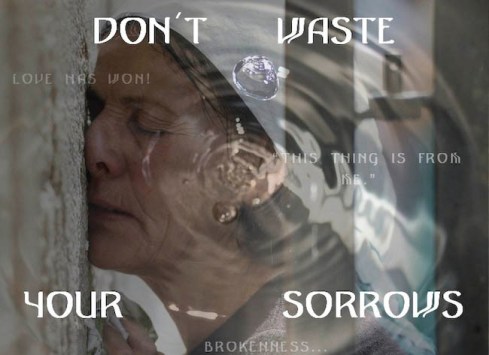
Don’t Waste Your Sorrows


062_dont_waste_your_sorrows

These little troubles are getting us ready for an eternal glory that will make all our troubles seem like nothing.”

2 Cor. 4:17, CEV

“Before God could bring me to this place He has broken me a thousand times.”                                   

Smith Wigglesworth


As we move toward maturity, over time and through circumstance, we will start to develop exciting new ways of thinking.  We engage the Word and combined with our relationships with people we start the work of God.  We soon learn that the Kingdom of God flows through relationships, almost exclusively.

Pain and sorrow are some of the more intense ways the Lord reaches down and into our lives.

Rick Warren has written, “God intentionally allows you to go through painful experiences to equip you for ministry to others.” 


I think that as we dwell on this we will start to see the hand of God, moving things around in our complicated lives.  As we attend class in this school of the Spirit, we learn things that will change our life and ministry.

But we must consider that we can waste our pain and sorrows by not engaging the issues properly.  Will I submit, or will I grow sullen and cynical? Will I worship through my tears?  Surrendering to Christ is not a once-in-a-lifetime event.  It is a daily, and even hourly process.  I regard any kind of cynicism though, as a hungry predator who is hunting me.  Very dangerous, and I am highly suspectable.

Pain is the way the Father reaches me, he isn’t too concerned about our comfort (it isn’t the real issue, after all.)  When I hurt, I invaribly look for Jesus.  And that cannot be all bad.  Through the trials and pain I begin to reconnect with my Father.  Without the trials, I doubt we would ever call out for His help.

“Don’t waste your sorrows.”  It is easily said but seldom done.  We start to stagger by the weight of our personal issues.  Overwhelmed by the pain we start to panic and grab things, and throw them overboard, to lighten the load.  We can be confused, and will do whatever we must do to stay afloat.  But unless we take these sorrows well, we are just short-circuiting God’s intentions.

C.S. Lewis once commented on our issues,

“Experience: that most brutal of teachers. But you learn—my God do you learn.”

The darkness intends to absorb us.  Satan uses our own bitterness and frustration to do this.  Our discipleship is no longer valid if we commence doing our own will and desires.  Even though we get “flaky” the Father will always love us. But we dare not waste our pain, it comes at too big of a price.

bry-signat (1)

cropped-christiangraffiti1.jpg


The Treasure Hidden Inside the Church

treasure-found

As Christians, often our Church and our theology tell us that mental illness, depression, and bipolar disorder have no place in a believer’s life.

As a result, we end up hiding and sneaking  into sessions with our therapists, and direct the conversation to minimize our exposure to any direct questions. In one way, we are the new “lepers of the Church.”   But I would like to suggest to you that it is we who may be closest to the Kingdom of God.

From a certain viewpoint, it is easier for us to approach the Father– in our brokenness, humility, and lostness.  And yes we have needs– a sound mind, a healthy body and we know it. But we have no illusions of wellness– nothing can convince us that we are well.  We know we are not.  We know we are broken and only our loving creator can mend us.  

You should think and say that the Church needs us.  An Archbishop was given an ultimatum by the Huns who surrounded his cathedral. “You have 24 hours to bring your wealth to these steps”, the war-leader declared.   The next morning the Archbishop came out leading the poor, the blind, the lame, and the lunatics.  “Where is your treasure?  Why have you brought out these, people?”  The Archbishop said this, “These are the treasures of the Church, these who are weak are our valuables.  They make us rich.”

I’m afraid the the Western Church no longer sees its “treasures” or wealth like it should.  We have let the ‘government’ pick-up the burdens of health care.  We have tried to operate our churches like successful businesses and definitely have no room for the desperately weak. The mind-set is routine and predictable–that “they only take, and never give.”

But the handicapped have much to teach the Church.

We the weak are ‘sprinkled’ by the Lord into each local church (each church has one or two.)  We are not victims of our illness or addiction.  We admit we are the ones so broken that everyone has given up on us. But we have reached out, and touched the hem of His garment. “And in love’s service, only the wounded can serve.”

 My plea is directed to the local churches, and their leadership. You must decide what you are going to do with us, the handicapped. Will you accept us– and we are many? But we do admit and insist that we should not trivialized or diminished. We often have discovered grace in a way you haven’t, we have been loved in a way that you can only dream.

“It’s not about perfection; it’s about our intimacy with God, or our connection, our relationship with God. Once we get through that, once we realize that we can be imperfect, flawed, broken; those kinds of things are the ingredients of spirituality.”

–Mike Yaconelli

cropped-christiangraffiti1-2

*

Reign in Me, Again

“I will serve my King with a true heart.”

The Lord will reign forever and ever.”

Exodus 15:18

” Whatever the Lord pleases, he does,
    in heaven and on earth,
    in the seas and all deeps.”

Psalm 135:6

I am persuaded that Americans simply do not “process” this concept of sovereignty, especially when it’s endowed in a person.  A recent trip to London I observed a deep commitment to the royal crown.  Some people are said to be ‘lactose intolerant;’ I think we are ‘lordship intolerant.’

America is a broad, an open and friendly nation, characteristics worthy of emulation.  But we are also rebellious and arrogant people. Our nation was born out of revolution to a sovereign king.

“O Lord, God of our fathers, are you not God in heaven? You rule over all the kingdoms of the nations. In your hand are power and might, so that none is able to withstand you.”

2 Chronicles 20:6

Jesus reigns and rules the Universe.  There are no competing gods trying to take his place, no competition for his job.  He is the ultimate Sovereign. He is a King (with a capital K,) and he is worshipped as ‘the King of kings.’ Imagine a universe, out of control, without laws, without a ruler. It would be pure anarchy; it would be like hell itself.

Without any apology, the Bible proclaims that God is totally sovereign, ordaining, ruling, and disposing of all things as He will. If He has no control over the universe, then our faith in Him becomes an utter absurdity. It matters if God is in control, or not. It effects everything.

  • Nothing surprises God
  • Nothing is a setback to His plans
  • Nothing can thwart His purposes, and
  • Nothing is beyond His control

“His sovereignty is absolute. Everything that happens is uniquely ordained by God. Sovereignty is a weighty thing to ascribe to the nature and character of God. Yet if He were not sovereign, He would not be God. The Bible is clear that God is in control of everything that happens.”

Joni Eareckson Tada

My heart must change.  I must set aside those American attributes of rebellion and pride. There isn’t room for them. You see, I belong to a new kingdom now, a new King.  He is not in danger of losing His throne– but I am.  And He rules everything in His universe, not with an iron fist, but with an open hand with nail prints for all to see.

aabryscript

cropped-christiangraffiti1-2