“I tell you the truth, a grain of wheat must fall to the ground and die to make many seeds. But if it never dies, it remains only a single seed.25 Those who love their lives will lose them, but those who hate their lives in this world will keep true life forever.”
John 12:24-25, NCV
Often believers are attempting to ‘hear God’ only to bolster their position, reputation, ‘connections’ and prestige. There’s no talk about falling down and dying as Jesus revealed in John 12. If I’m extremely occupied with knowing God’s will it will maneuver me into a completely wrong position. Discipleship was never meant to be a celestial self-improvement plan.
When I get over-concerned about ‘my’ discipleship, acquiring the praise of men and achieving a modicum of honor, I end up ‘missing the boat’. Life was not meant to profit from, but ‘to fall and die.’ There is a deadly danger of becoming self-aware and self-absorbed. And this is ‘the spirit of the age’.
Nothing will ever go right if we try to hear the Lord while we avoid falling and dying. To put it another way. There can be no resurrection without a crucifixion first. We must die if we are going to live. We must become weak before we can understand power.
Will you realign your life to include ‘falling, and dying?’
Do you really want to hear Him? Will you realign your life to include ‘falling, and dying?’ Will you begin to readjust the way you approach yourself and others?Modern popular versions of our faith will almost always lack this ‘death-life’ component. These versions are often designed to reflect our society. And we are terribly self-centered. We will not ever grow and mature unless we consent to ‘falling and dying’.
Beware of the church whose leaders do not ‘limp.’
Beware of the church whose leaders do not ‘limp.’ Dying to self is a challenging and vital component to our faith that will bring us into an astonishing fruitfulness. That is what happens to those who die–they bring life to others.
As believers in Him who passionately loves the world, we are on our knees asking that the Father would bring you salvation. We lift you up in our prayers, so that you will have an immediate and definite contact with the Holy Spirit. We have consecrated you to Him. You are now marked and set apart, as we await further instructions from our Father.
There is no happiness, no real satisfaction apart from Him. Just stop trying, you are getting nowhere. The pain and guilt are real, aren’t they? There is in you a deep sadness–a grief. But the Lord sees it, and absorbs it for you. He sets you free, not for you to duplicate the sin, but to set you free from it. His action on your life is meant to liberate you.
Dear one, you struggle so intensely and have so many issues. We know this, but we have prayed, and we gathered you up to Him. (You are now a real target, thanks to us.) All of the issues you face from now on, have been initiated by God, and us who pray. I hope they won’t be too many. That you’ll respond to them, and turn to Him.
You are welcome to join us, we are indeed waiting just for you.
So enter into the grim arena. Already we have stepped into its ugly locales. You can meet us there. We know that there is no one who can keep us from His Spirit. You will find us standing against gladiator, and lion and sin. You are welcome to join us, we are indeed waiting just for you.
“And I am certain that God, who began the good work within you, will continue his work until it is finally finished on the day when Christ Jesus returns.”
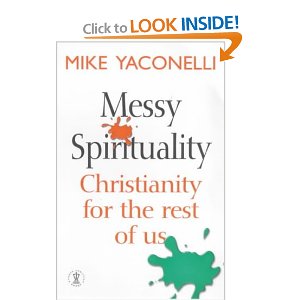
“Messy Spirituality:” A Book Excerpt by Mike Yaconelli
“For as long as I can remember, I have wanted to be a godly person. Yet when I look at the yesterdays of my life, what I see, mostly, is a broken, irregular path littered with mistakes and failure. I have had temporary successes and isolated moments of closeness to God, but I long for the continuing presence of Jesus.
Most of the moments of my life seem hopelessly tangled in a web of obligations and distractions. I want to be a good person. I don’t want to fail. I want to learn from my mistakes, rid myself of distractions, and run into the arms of Jesus. Most of the time, however, I feel like I am running away from Jesus into the arms of my own clutteredness. I want desperately to know God better. I want to be consistent. Right now the only consistency in my life is my inconsistency. Who I want to be and who I am are not very close together. I am not doing well at the ‘living-a-consistent-life’ thing.
I don’t want to be St. John of the Cross or Billy Graham. I just want to be remembered as a person who loved God, who served others more than he served himself, who was trying to grow in maturity and stability. I want to have more victories than defeats, yet here I am, almost 60, and I fail on a regular basis.
If I were to die today, I would be nervous about what people would say at my funeral. I would be happy if they said things like “He was a nice guy” or “He was occasionally decent” or “Mike wasn’t as bad as a lot of people. ”Unfortunately, eulogies are delivered by people who know the deceased. I know what the consensus would be.“Mike was a mess.”
You might say Christianity has a tradition of messy spirituality. Messy prophets, messy kings, messy disciples, messy apostles. From God’s people getting in one mess after another in the Old Testament to most of the New Testament’s being written to straighten out messes in the church, the Bible presents a glorious story of a very messy faith. Sounds like you and I are in good company.
A few years ago, I was introduced to a group of uncouth Christians who call themselves “the Notorious Sinners.” These are men from all walks of life who meet once a year to openly share their messy spirituality with each other. The title ‘Notorious Sinners’ refers to the scandalous category of forgiven sinners whose reputations and ongoing flaws didn’t seem to keep Jesus away.
In fact, Jesus had a habit of collecting disreputables; he called them disciples. He still does. I like people who openly admit their ‘notoriousness’—people who unabashedly confess they are hopelessly flawed and hopelessly forgiven. Graciously, these men invited me to be a part of their group. The ‘Notorious Sinners’ meet yearly at spiritual-retreat centers, where from the moment we arrive, we find ourselves in trouble with the centers’ leadership.
We don’t act like most contemplatives who come to spiritual-retreat centers— reserved, quiet, silently seeking the voice of God. We’re a different kind of contemplative— earthy, boisterous, noisy, and rowdy, tromping around our souls, seeking God, hanging out with a rambunctious Jesus who is looking for a good time in our hearts.
A number of us smoke cigars, about half are recovering alcoholics, and a couple of the men could embarrass a sailor with their language. Two of the ‘Notorious Sinners’ show up on their Harleys, complete with leather pants and leather jackets. I admit I run with a rough crowd—Christians whose discipleship is blatantly real and carelessly passionate, characterized by a brazen godliness. Unafraid to admit their flaws, unintimidated by Christians who deny their own messiness, these guys sometimes look like pagans and other times look like Jesus.
They are spiritual troublemakers, really, which is why they look like Jesus (who was always causing trouble himself ). They are full of mischief, laughter, and boisterous behavior, which is why they look like pagans. Truly messy disciples. The ‘Notorious Sinners’ are definitely a bizarre mix of the good, the bad, and the ugly, living a spirituality which defies simple definitions.
Oh, and they are some of the most spiritual men I know.”
___________________________
Messy Spirituality [Book] by Michael Yaconelli, Karla Yaconelli in Books
By Michael Yaconelli, Mike Yaconelli, Karla Yaconelli – Zondervan (2007) – Paperback -192 pages-ISBN 0310277302
I Guess I’m Not a Very Good Christian . . . Do you feel like: I don’t pray enough I don’t read my Bible enough I don’t share my faith enough I don’t love God enough I’m not committed enough I’m not spiritual enough Then this book is for you.
Messy Spirituality was written for the silent majority of us who have been convinced that we just don’t do Christianity right. We spend most of our lives worried about what we don’t do instead of what we have done, focused on our imperfections instead of God’s fondness for the imperfect. Why?
Because we’ve been bombarded with books, tapes, talks, seminars, and movies convincing us that real Christianity is all about perfection. Michael Yaconelli dares to suggest that imperfection, infiniteness, and messiness are, in fact, the earmarks of true Christianity; that real Christianity is messy, erratic, lopsided . . . and gloriously liberating.
What if genuine faith begins with admitting we will never have our act completely together? Maybe messy disciples are exactly the kind of imperfect people Jesus came to earth for and whose company he actually enjoyed–and still enjoys.
If you want to find Jesus today, look for him in the midst of burned-out believers, moral misfits, religious incompetents . . . men and women whose lives are, well, messy.
Messy Spirituality is a strong antidote for the spiritual perfectionism in us all. Here are truths that can cut you loose from the tyranny of ought-to’s and open your eyes to the deep spirituality of being loved, shortcomings and all, by the God who meets you and transforms you in the midst of a messy and unpredictable life.
There is the unquestionable presence of affliction that is present in our lives. Affliction is the general term for specific instances of trials, tribulations, persecutions, emotional or physical pain and suffering.
The ancient Assyrians used the word for “affliction” as the same word to describe their method of a public execution, which involved being impaled to the ground. Rocks were gradually piled high until the victim expired. The combination of being impaled and the rocks piled on you was quite devastating.
And you know what? That is a terribly specific concept of what afflictions feel like. Just ask someone, it is exceedingly terrible to be in pain and feel ‘buried’ at the same time. There is a feeling of suffocating in suffering. Some have described it, like being ‘hit with a 2×4’. You have just been completely blindsided.
In the letters from the Early Church there was a patentability, or openness when it came to persecution and pain. The writers of the New Testament operated out of a profound awareness of the pain of the believers of their day.
“We think you ought to know, dear brothers and sisters, about the trouble we went through in the province of Asia. We were crushed and overwhelmed beyond our ability to endure, and we thought we would never live through it.” 2 Cor. 1:8
“We are pressed on every side by troubles, but we are not crushed. We are perplexed, but not driven to despair.” 2 Cor. 4:8
“You have greatly encouraged me and made me happy despite all our troubles.” 2 Cor. 7:4
‘The Ostrich Effect’ in Affliction
One of the most extensive arguments concerning ‘affliction’ develops around the nature of the atonement. The thought is that Jesus died and rose to bless me. Sin and sickness, poverty or lack are not part of God’s plan for the redeemed.
Now, it is possible to refute this in this little post. But I will try to nudge you a bit to examine the issues of the Early Church. Know however that there are many people who will follow the ostrich’s example and bury their heads to avoid reality of affliction. But, I can understand this impulse– this desire to honor God, even if we “play word games” with our faith.
I also know first-hand that the struggles are hard. Wrestling with them is a brutal way to live the abundant life. Failure and frustration are trying to short circuit our faith. And our faith must be protected and valued.
“Afflictions add to the saints’ glory. The more the diamond is cut, the more it sparkles; the heavier the saints’ cross is, the heavier will be their crown.”
–Thomas Watson
What Does the Scripture Say About Affliction?
“Dear friends, don’t be surprised at the fiery trials you are going through, as if something strange were happening to you.” 1 Peter 4:12
“…where they strengthened the believers. They encouraged them to continue in the faith, reminding them that we must suffer many hardships to enter the Kingdom of God.” Acts 14:22
“I have told you all this so that you may have peace in me. Here on earth you will have many trials and sorrows. But take heart, because I have overcome the world.” John 16:33
“The wisdom of God appears in afflictions. By these He separates the sin which He hates, from the son whom He loves. By these thorns He keeps him from breaking over into Satan’s pleasant pastures, which would fatten him indeed, but only to the slaughter.”
-James H. Aughey
I want to try to visit this subject again. We will trust that ‘real light’ will come to our twilight worlds.











 Broken Believers