Comprehensive Protection

daniel3

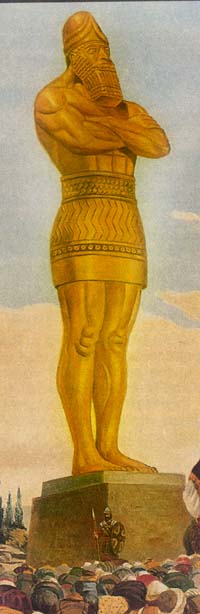
The Book of Daniel contains the acts and welfare of the Jewish people in Babylon. They are captives and so many of the stories shared here are accounts of spirituality under duress. King Nebuchadnezzar, in an attempt to unify his kingdom, proclaims himself to be a god. He commissions a 90-foot statue to be erected; he orders that, on a prearranged moment, all would fall down and worship.

Thgold statueere are three Jewish men: Shadrach, Meshach, and Abednego who are brought to the king with the charge of ‘failure to worship.’ They refused to bow at the statue at the signal. They were observed standing when everyone else was kneeling. Non-compliance to the king meant the death penalty, but that doesn’t deter the three.
Their faith will not allow them to sin in this way.

They are resolute. The first, second, and third commandments clearly forbid the worship of all idols. There were no other options. Perhaps they valued their souls more than they valued their lives. In some things, there can be no accommodation– no compromise. Standing before the king and threatened with death, they declare their allegiance to the living God.

Dan. 3:16-18:

 “Shadrach, Meshach, and Abednego answered and said to the king, “O Nebuchadnezzar, we have no need to answer you in this matter. 17 If this be so, our God whom we serve is able to deliver us from the burning fiery furnace, and he will deliver us out of your hand, O king. 18 But if not, be it known to you, O king, that we will not serve your gods or worship the golden image that you have set up.”

The king is enraged.

Few have ever spoken and defied him like this (and lived). He orders the furnace to be heated up like never before.  Here the king is making a statement. He will not tolerate this kind of ‘rebellion’ in his kingdom. All of his governing leaders will witness what he does to ‘traitors.’ These Hebrews must be made an example.

Then King Nebuchadnezzar was astonished and rose up in haste. He declared to his counselors, “Did we not cast three men bound into the fire?” They answered and said to the king, “True, O king.” 25 He answered and said, “But I see four men unbound, walking in the midst of the fire, and they are not hurt; and the appearance of the fourth is like a son of the gods”

(v.v. 24-25)

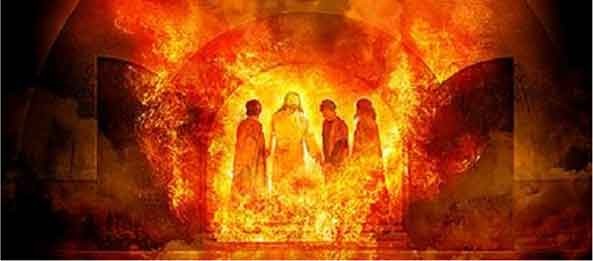
Shadrach, Meshach, and Abednego are thrown into the fire. The men who escorted them are killed by the heat. Ironically, Nebuchadnezzer can’t protect his own men from death while the three Jews are not touched, not even a little.

They are joined by a fourth man and they walk around in the midst of the flames.

Suddenly, Nebuchadnezzer realizes that the God of Israel is not only a real God, but a force to be reckoned with. The men’s faith has saved them. (And his men are dead.)

The complete story is quite compelling. The king orders all that the real God be worshipped. Henceforth, no one shall ever speak against this God. Shadrach, Meshach, and Abednego are promoted in the kingdom.

The lessons for today are many,

  1. God’s Word is to be obeyed no matter what it costs.

  2. When confronted, we must never hedge over our beliefs.

  3. God is present with us in our furnace, we’re never alone.

  4. In the fire, our faith will ultimately triumph. One way or another.

We may be standing in similar times. Faith will be tested. The Word must be believed and trusted. It is ‘comprehensive protection’ for our lives. Obedience to God will lead us into difficult places, but faith will triumph.

“When you have no helpers, see your helpers in God. When you have many helpers, see God in all your helpers. When you have nothing but God, see all in God. When you have everything, see God in everything. Under all conditions, stay thy heart only on the Lord.”

    Charles Spurgeon

The Deep Pit

“I waited patiently for the Lord to help me,
    and he turned to me and heard my cry.
He lifted me out of the pit of despair,
    out of the mud and the mire.
He set my feet on solid ground
    and steadied me as I walked along.”

3″He has given me a new song to sing,
    a hymn of praise to our God.
Many will see what he has done and be amazed.
    They will put their trust in the Lord.”

Psalms 40:1-3, NLT

Psalm 40 is jam packed with great and wonderful truth. It contains freedom for the Christian– a way out for the broken believer. We do well when we use it, and that’s what it’s there for. The deep pit has been used over many centuries as the way God teaches us to sing certain songs. But that doesn’t make it easier, does it?

Verse 1

I waited patiently for the Lord to help me, and he turned to me and heard my cry.

Waiting is a critical word, it should not be regarded as trivial. In our daily walk we must be patiently seeking the Lord, that comes first. Admitting you need help is the first step. And guess what? You need help. 😁

The word ‘wait’ is special, it’s kawvah in Hebrew. It can mean ‘to bind together by twisting.‘ It can be used with the idea of braiding strands of rope together. It is never a passive act that just happens. Waiting on God is to be done with intentional purpose.

Remember that the Lord is not some distant deity on a hill far away.

He’s not hiding from you. It’s really quite the opposite.

He is closer to you than you think. He is responsive and aware. He hears your cries and wants to act; He is not deaf, but our patience is critical. Waiting on Him is crucial to being free. We must bind and twist our hearts and live our life to His desires.

Verse 2

He lifted me out of the pit of despair, out of the mud and the mire. He set my feet on solid ground and steadied me as I walked along.

The seeable terrain can be awful, with muddy paths and mucky pits. Things that pull you down and suck you in. They’ll trap the traveler. But the Holy Spirit is quite able to lift us out. He picks us up and secures us. He uses the rope of God’s Word.

He is way more willing to save us, than we are to being saved.

Solid ground is where we are meant to be. It’s become a place of firm standing and secure footing. He makes us steady and He keeps us safe. The Holy Spirit now has intimate care over your soul.

Verse 3-4

“He has given me a new song to sing, a hymn of praise to our God.

Many will see what he has done and be amazed. They will put their trust in the Lord.

Some of the greatest songs are the ones that come from those just delivered from the pit.

These are ‘pit songs,’ offered to God from sincere and true hearts that have once been trapped. There’s something solid heard from the hearts of those redeemed from disaster.

These songs no longer sound religious or contrived.

“YOU CAN SEE GOD FROM ANYWHERE IF YOUR MIND IS SET TO LOVE AND OBEY HIM.”

A.W. Tozer

From our deepest pits come our greatest praises.

There is a passionate quality that saturates these ‘pit praises’ that is highly treasured by God, and esteemed and valued by the Church– a sense of authenticity starts to be finally heard. We can finally start to see that our pits become ‘launching pads’ of true songs of deliverance.

Bored in Heaven, [You Must Understand What Real Worship Is]

“For God is the King of all the earth: sing ye praises with understanding.”

Psalm 47:7, KJV

Human beings are meant to worship. And specifically, to worship God. If we choose to deny this salient fact, we change nothing. Worship defines us, and who we worship is our decision. But it will happen. Our very DNA includes this proclivity.

Among believing Christians there can be an ‘oh hum’ attitude toward ‘worship’. It seems to us to be a tolerated part of our gatherings. Often worship is nothing more than a sequential chain of events that must be endured, for ‘religious reasons,’ but seldom for an authentic spiritual purposes.

The worship of heaven still worries some. It seems too intense, and a bit (shall we say) fanatical for our likings. Our standards are high, after all it will be eternal. At our very best worship is not of an ‘eternal grade’. It may be good and all– but we envision something more, a thing that engages us on an eternal level.

The fault can be with our ‘earthly’ levels of worship.

Worship leaders are doing their best to engage us. Many are busy with their own lives, with all its all consuming issues. However they can lead and direct us into worship every Sunday. They quickly learn to mollify and ‘reduce’ their approach, to the ‘lowest common denominator’ in order to please their congregations.

But worship still sizzles, and the ‘need’ to worship is embedded inherently within. If we don’t choose to worship idols, we take on the task of worshipping the real God. And that real adjustment will truly change us.

If worship is boring, you’re doing it wrong. You see boredom and worship are antithetical. They are  ‘miles’ apart. Worship must be an exclusive focus of a ‘burning heart’ not bound with the mundane occurrences of the day. If you are  an average ‘Joe, or Jane’ worship leader, you will understand this.  At times you may experience this ‘tension’ of earth and heaven. But remember, heaven begins now, and not later.

aabryscript

cropped-cropped-christiangraffiti1.jpg


Worshiping With a Knife

 by the Forward

In Genesis 22, we have the story of Abraham and Isaac on Mt. Moriah.

Abraham has tied up his son on an altar to offer him as a sacrifice in obedience to God’s direction (v. 2). This is faith being tested to the ultimate extreme. And Abraham shows us how faith really works.

“Then on the third day Abraham lifted his eyes and saw the place afar off. And Abraham said to his young men, “Stay here with the donkey; the lad and I will go yonder and worship, and we will come back to you.”

Genesis 22:4-5

This is the first time that  the word “worship” is used in the Bible.

It sets the singular tone for all the scriptures on this subject. I guess what is interesting is there were no musical instruments involved. There was just these needful things:

  • stones,
  • wood,
  • rope,
  • fire,
  • a knife,
  • and Isaac, (the would-be ‘lamb.’)

There was just a handmade altar, and a sharp knife.

In the end, Abraham raises his knife, and then suddenly, (to the relief of us all) he is stopped. His faith has withstood the test, and he has truly ‘worshiped.’

But the Angel of the Lord called to him from heaven and said, “Abraham, Abraham!” So he said, “Here I am.” And He said, “Do not lay your hand on the lad, or do anything to him; for now I know that you fear God, since you have not withheld your son, your only son, from Me.”

Gen. 22:11-12

Principle One: There really can’t be worship without sacrifice.

Recovering this truth concerning worship is critical. It seems we delegate ‘worship’ to a select few who are talented and gifted. We probably don’t do this deliberately, but sometimes we feel it makes a better presentation. We all want to look good, even as Christians.

Principle Two: The first worshiper didn’t use a guitar, but a knife.

This difference keeps the idea of sacrifice in its definition. There isn’t worship without sacrifice. The knife thrust that he was ready to wield wasn’t backed up by drums or piano. Yet Abraham understood worship every step to Moriah with the knife in his belt.

So, brothers and sisters, because of God’s mercies, I encourage you to present your bodies as a living sacrifice that is holy and pleasing to God. This is your appropriate priestly service.”

Romans 12:1

Ultimately, we must realize our sacrifice is the Lamb of God. It’s His blood on God’s altar for our sins. As believers, our faith firmly rests in this spiritual fact.

We of all people have cause to really worship.

And no sacrifice should be too great for Him who gave Himself for us.