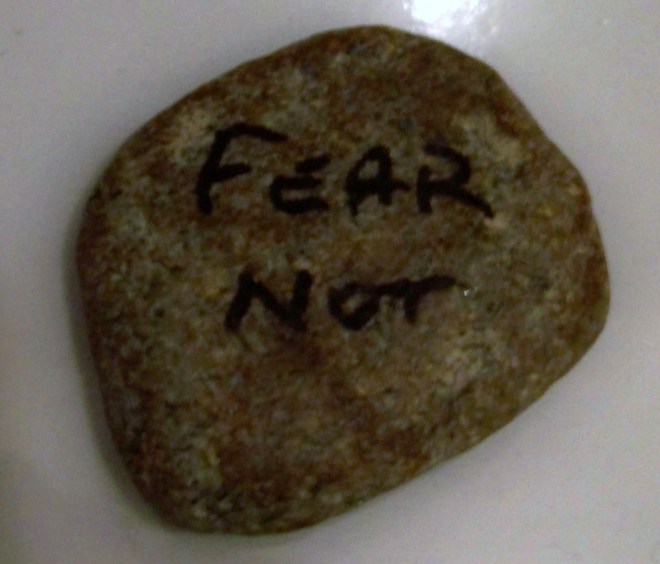
Don’t Be Afraid, Just Trust

“Be strong and very courageous. Be careful to obey all the law my servant Moses gave you; do not turn from it to the right or to the left, that you may be successful wherever you go. 8 Keep this Book of the Law always on your lips; meditate on it day and night, so that you may be careful to do everything written in it. Then you will be prosperous and successful.

9 Have I not commanded you? Be strong and courageous. Do not be afraid; do not be discouraged, for the LORD your God will be with you wherever you go.”

Joshua 1, NIV


 I remember taking a ride  in a glass bottomed boat in the tropics.  Such a deep and vivid display rolled out before me.  It was beautifully complex, and my tiny view into the depths was quite exceptional.  To think, this is all unfolding even when we aren’t looking.  It is a world completely beyond our own.  There are several valid  and living principles embedded in these verses.  As we gaze into these depths we are magnificently drawn to Him in many ways.  These verses are sublime.   Thinking such thoughts is one of reasons we were created for.

The promises of God are really not that hidden or secret.  We only have to look into this “leather bound’  book.  When we look to the point of exclusion of everything else,  we are sure to see things that we never dreamed of.  In Joshua, chapter 1, we get a deep view of how God starts touching a human soul.  Certain issues get negotiated.  Joshua is brought into compliance to God’s intention.

And us.  What can we say?  Some of us may hold that Joshua was the exception and substantially distinct.  But I think, in a most sincere way possible, he was the norm.  When God deals most exceptionally with our open hearts.  He will always bring us to the compliance of Joshua.  What Joshua did was quite exceptional, and yet it was very ordinary and only moderately intense. Faith translates and makes the transition.

These verses somehow magnetically draw us to obedience.  The command is to courageous.  Courage is definitely a very rare commodity for us.  Joshua is brought to this point, and he must trust to the place of personal loss, or whatever it takes.

Success is being  highlighted.  And than the Word, and when you mix the two, it develops into something that is spiritually elegant and complete.  Meditating, or the original Heb. which means to ruminate, brings us to the delightful moment of digestion.  We can never just take in God’s Word.  We must “process it.”  That takes not just time, but chewing and swallowing.  It is not gulped, but it has to be assimilated.  It must be “intelligently chewed.”  We must nibble, and never try to gulp, no matter how sweet it is.

Joshua was requested to keep the Word, completely and situational in front of him.  Success would come, but only come if he would simply obey.  Obedience seems like such a bitter truth.  I must confess, I honestly hate obedience.  Christianity can be terribly hard it seems, especially so when it is active, real and “in place.”  I admit I’m not 100 per cent sure.  But I know enough that I should trust, but although it took me fifty years.

One of the main themes found in these verses is the idea  the idea that God’s presence is that it is specifically focused on me.  When He concentrates on me, when He makes me His bullseye, it has a momentum to transform me.  God’s rich presence starts to foment in me, I can transform into another person.  Joshua was changed as he processed rightfully the nearness of his Father.  Help me Lord, to follow you into this intimacy.  Give me your understanding, inject yourself into here, in my feeble thought and understanding.

Psalms 16, Study–“Something Good”

Psalm 16

7 I will praise the LORD, who counsels me;
   even at night my heart instructs me.
8 I keep my eyes always on the LORD.
   With him at my right hand, I will not be shaken.

 9 Therefore my heart is glad and my tongue rejoices;
   my body also will rest secure,
10 because you will not abandon me to the realm of the dead,
   nor will you let your faithful one see decay.
11 You make known to me the path of life;
   you will fill me with joy in your presence,
   with eternal pleasures at your right hand.


This is perhaps one of the most beautiful parts of scripture.  There are so many truths enmeshed in this text.  It’s like a chocolate chip cookie, with truth spread through each bite. (Silly analogy, I know.)  But when we examine it and bring ourselves to obey it, His riches flow directly into us.

There must be an understanding, and verses 7-8 brings Him very close to us.  We connect in a special way.  The Psalmist describes us having a direct awareness of His close presence.  But he also describes his general attitude toward the Presence of God.  He wants to be aware–24 hours a day, continuously.

Verses 9-10 are describing a victory over death.  The Psalmist has come to a definite point, he can no longer see death the way everyone else does.  He understands it to be a very silly charade, and somehow he sees through it.  Because of the Lord’s intervention, he comes to this delicious point.  The ugly obscenity of death, is completely undone.

This confidence of the Psalmist is further extended.  He thinks and feels like he  is bulletproof.  Nothing touches or degrades his faith.  He walks out into life and into the confusion.  But you must understand this.  His faith in God has made him “teflon.”  And indeed he does process a deep understanding of the source of love and joy, he knows it.  As he taps into this, he will now have the real possibility of overcoming the darkness, that could very easily absorb him.

The deep truths of this particular Psalm has the incredible potential to transform us into supernatural people.  As we focus on Psalm 16, and endeavour to make it our own, it will change us and it has the power to revolutionize us in a most profound way.  I say, let it come.

Psalm 16, Study– “He is Always Good”

 Psalm 16

1 Protect me, God,
       because I trust in you.
 2 I said to the Lord, “You are my Lord.
       Every good thing I have comes from you.”
 3 As for the godly people in the world,
       they are the wonderful ones I enjoy.
 4 But those who turn to idols
       will have much pain.
    I will not offer blood to those idols
       or even speak their names.

 5 No, the Lord is all I need.
       He takes care of me.
 6 My share in life has been pleasant;
       my part has been beautiful.

Psalm 16:1-6,  New Century Version

This Psalm is profoundly deep, and the themes it discusses are definitely significant.  The Psalmist has a steady and direct confidence in all that swirls around him.  He knows that God is available and perched to protect him.  To a certain extent he thinks that as he gives himself over to Him, he will be protected and watched over.  He sees that God’s innate goodness is available to the needs his soul has.

We operate and function completely surrounded.  There is no way we can diminish God’s goodness.  It’s the way He functions–He will never be bad, but only and completely good.  The Psalmist goes on to proclaim the wonderfulness of God’s people.  They are outstanding, they are terrific.  He loves those who belong to Him.  The Psalmist understand these two incredible concepts:  God’s goodness and God’s people.  These two resources will help him deal with the future.

The Psalmist abhors the falseness of idolatry.  When you have truly experienced the reality of God, just being with  idols will truly bring you to despair and futility.  In the piercing light, we cannot imagine a substitute.  He knows that God rules and directs.  The Psalmist will not budge or falter.  God sits on the throne, exclusively, and He doesn’t share it with an idol.  Nothing can change that, especially no false maneuvering or manipulation here on earth.  He will still be God.  The Psalmist speaks,

“No, the Lord is all I need.
       He takes care of me.
 6 My share in life has been pleasant;
       my part has been beautiful.”

He has a “razor’s edge” understanding of all that has been given him.  God Himself is his source.  God is the well he draws water out of.  God is the complete source of all his needs.  Can you say that?  Will God, your Father provide for a struggling “you?”

As we analyze this Psalm, we are brought into this sense that the believer has been led into a confidence, and an assurance of God’s exceptional goodness.  The writer clearly speaks of “pleasantness” and “being beautiful.”  Without a doubt, these key words will adjust, and assist us to savor His grace.  He has made things to be pleasant and beautiful.  We must take this confidence, and weave it into our lives.

^

ybic, Bryan

Suicide– A Second Look

The World Health Organization estimates that approximately 1 million people die each year from suicide. What drives so many individuals to take their own lives? To those not in the grips of suicidal depression and despair, it’s difficult to understand. But a suicidal person is in so much pain that he or she can see no other option.

Suicide is a desperate attempt to escape suffering that has become unbearable. Blinded by feelings of self-loathing, hopelessness, and isolation, a suicidal person can’t see any way of finding relief except through death. But despite their desire for the pain to stop, most suicidal people are deeply conflicted about ending their own lives. They wish there was an alternative to committing suicide, but they just can’t see one. 

Suicide is not chosen; it happens
when pain exceeds
resources for coping with pain.

Because of their ambivalence about dying, suicidal individuals usually give warning signs or signals of their intentions. The best way to prevent suicide is to know and watch for these warning signs and to get involved if you spot them. If you believe that a friend or family member is suicidal, you can play a role in suicide prevention by pointing out the alternatives, showing that you care, and getting a doctor or psychologist involved.

Common Misconceptions about Suicide

FALSE: People who talk about suicide won’t really do it.
Almost everyone who commits or attempts suicide has given some clue or warning. Do not ignore suicide threats. Statements like “you’ll be sorry when I’m dead,” “I can’t see any way out,” — no matter how casually or jokingly said may indicate serious suicidal feelings.

FALSE: Anyone who tries to kill him/herself must be crazy.
Most suicidal people are not psychotic or insane. They must be upset, grief-stricken, depressed or despairing, but extreme distress and emotional pain are not necessarily signs of mental illness.

FALSE: If a person is determined to kill him/herself, nothing is going to stop him/her.
Even the most severely depressed person has mixed feelings about death, wavering until the very last moment between wanting to live and wanting to die. Most suicidal people do not want death; they want the pain to stop. The impulse to end it all, however overpowering, does not last forever.

FALSE: People who commit suicide are people who were unwilling to seek help . 
Studies of suicide victims have shown that more then half had sought medical help within six month before their deaths.

FALSE: Talking about suicide may give someone the idea.
You don’t give a suicidal person morbid ideas by talking about suicide. The opposite is true –bringing up the subject of suicide and discussing it openly is one of the most helpful things you can do.


Source: SAVE – Suicide Awareness Voices of Education

Excellent site: http://www.metanoia.org/suicide/

More info: http://www.helpguide.org/mental/suicide_prevention.htm