The Swamp of Despondency, [Pilgrim’s Progress]

 
Trapped, and unable to move
“Has the Lord redeemed you? Then speak out!
   Tell others he has redeemed you from your       enemies.
  For he has gathered the exiles from many lands,
      from east and west,
      from north and south.
 Some wandered in the wilderness,
      lost and homeless.
 Hungry and thirsty,
      they nearly died.
 “Lord, help!” they cried in their trouble,
      and he rescued them from their distress.”

            Psalms 107:2-6

Recently watched the new release of the movie “Pilgrim’s Progress” and I have to say, it’s remarkably close to the book, which often is not the case when a movie is based upon a book.  In his book, Pilgrim’s Progress, John Bunyan has written one of the most beautiful allegories about the journey we all travel as a believers.

The book describes the hero, Christian, and his journey from the City of Destruction to his heavenly destination, the Celestial City. Now there’s one part of Pilgrim’s Progress that I want to focus on today –walking througH (or sinking into) the Swamp of Despondency!

At one point during their travels, Christian and his companion suddenly find themselves there….into this particular swamp. Still bearing  a burden, Christian begins to quickly sink in the mire.  His traveling companion manages to get out, but he returns to the City of Destruction without giving aid to Christian.  Christian is left all alone and sinking even deeper in the mire, until Help, the allegorical figure for the Holy Spirit, pulls him free from the muck.

Christian then asks Help why this dangerous plot of land has not been mended so that poor travelers might go safely to the Celestial City. Help replies, “This miry slough is such a place that cannot be mended.”

How true it is in real life!  As hard as we try to avoid them, whether young in the Lord, or spiritually mature…swamps of despondency seem inevitable, and we must struggle through them!

Charles Spurgeon once wrote to his students in the book, “Lectures to my Students”,

  • “Fits of depression come over most of us.  Usually cheerful as we may be, we must at intervals be cast down.
  • The strong are not always vigorous, the wise not always ready, the brave not always courageous, and the joyous not always happy.
  • There may be here and there men of iron…but surely the rust frets even these.”

There are times in our lives when we will struggle through the swamps of despondency — but praise God that He has provided us a helper for those times of need!  We need to press through, seeking and trusting the power of the Holy Spirit to pull us out of those nasty swamps, and set our feet back upon the Rock of our salvation.

Let’s also look around us to see our brethren who may be struggling in the swamps of despondency, so that, rather than abandoning them, we might give them a hand on their journey to “the Celestial city”!

Source: http://www.worthydevotions.com/christian/depression

cropped-christiangraffiti1 (2)

Treasures Found in the Clay

“But we have this treasure in earthen vessels, that the surpassing greatness of the power may be of God and not from ourselves; we are afflicted in every way, but not crushed; perplexed, but not despairing”

2 Corinthians 4:7-8 (NASB).

Paul speaks of treasure, or of something of tremendous worth. We seldom place value on things with the same intensity that God does. Its obvious that as a culture our values aren’t really biblical. Paul understands this overriding principle of the eternal over the temporary. God’s power–treasured. Our weakness– accepted.

The rationale for this “making room” for the power must be understood. Its only when we grasp this holy ‘mechanism’ can we sparkle and shine as believers. It is of God, not of ourselves. Paul says that we are afflicted in everyway imaginable. From disease, to injury, to difficult relationships, to a simple toothache. Believers run the full gamut of affliction.

It all is significant, it all means something!

As a former Army medic, some of the worst injuries were “crushing” ones. The human body experiences things that are so heavy that they simply collapse.  At times like these it seems the best you can do is make a pile.  To be crushed is a terrible thing.

God’s Rubik’s Cube

He says that we are “perplexed”. The word means, “to feel completely baffled by.” It’s when something is so complicated that we can’t figure it out. Have you ever been given a ‘Rubik’s Cube?’ You twist and turn, trying to get the same colors on the same side. Every move affects the outcome. And you just can’t seem to get it right.  (I once peeled of all the colored stickers off and re-stuck them, but I was having “ego problems” that day.)

God gives His children a spiritual ‘Rubik’s Cube.’

It maybe a family crisis, or a medical issue. You could be trying to figure out your spouse. But the problem is that it totally baffles you. There is no rhyme or reason that you can see. Everyday you try again and again.

There are some things that so confuse and mystify that we begin to doubt everything we have been taught. But, we are not to despair. Despair is not for the believer. We may not understand, we are baffled by the present circumstances. We may come close, but we can not despair. God has promised that he will use this time of affliction, and its outcome will be glorious.

 “And I am convinced that nothing can ever separate us from God’s love. Neither death nor life, neither angels nor demons, neither our fears for today nor our worries about tomorrow—not even the powers of hell can separate us from God’s love.”

Romans 8:38

In the KJV of Romans 8:38, the phrase used is “nor things present.” What is your present predicament? It cannot separate you from the love of God. He cares for you, even if the moment is hard and miserable. God often tests His real friends more severely then the lukewarm ones.

At the end, God will not look you over for medals, or diplomas, He will look you over for scars.

bry-signat (1)

cropped-christiangraffiti1.jpg


Little Pieces of Obedience

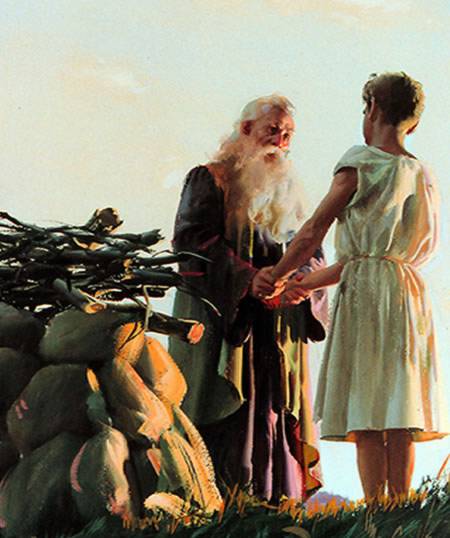
abraham_isaac_1

“It was by faith that Abraham offered Isaac as a sacrifice when God was testing him. Abraham, who had received God’s promises, was ready to sacrifice his only son, Isaac, 18 even though God had told him, “Isaac is the son through whom your descendants will be counted.”19 Abraham reasoned that if Isaac died, God was able to bring him back to life again. And in a sense, Abraham did receive his son back from the dead.”

Hebrews 11:17-19, NLT

The faith of Abraham is understood by believers everywhere. This simple man followed God to a obscure mountain in Judea. He came fervently, and yet logically to the command of the Lord. Abraham’s confident assurance would carry him to Mt. Moriah were he would sacrifice his son. He would prefigure God’s own sacrifice of Jesus Christ, His only Son.

There were many steps Abraham had to take: the knife, the rope, the firewood, the donkey. There was a dozen details to arrange. Abraham would have had to plan ahead of time to prepare. I’m relatively certain he had ample time to consider what he was doing. The enormity of it all would’ve been staggering.

Hebrews reveals that ‘faith’ was what enabled Abraham. It was faith followed by a dozen little obediences that strengthened him to follow God’s instructions. Abraham would obey God, through faith, by doing many little things. All would lead up to the ‘big thing,’ the offering up of his only son.

I believe that no act is too small. Heavy doors swing on small hinges. Tiny obediences make for big ones. And sometimes we can’t tell them apart. It seems that several times during our daily grind we face little choices that often determine a far greater meaning. I’ve been told that there are flowers in alpine valleys that no man will ever see. Their sole beauty is visible only to God. Obedience is often like this. But the Lord knows.

God meets every act of obedience to Him with a smiling grace.

Hebrews 11 is known as the believer’s ‘hall of fame’. In its verses we’re pounded by the idea that the faith is visible only through obedience. What we do is as significant as what we believe. It has always been so.

“…but the people who know their God shall be strong, and carry out great exploits.”

Daniel 11:32, NKJV

Little obediences prepare us for big ones. If we won’t obey in the small ones, how will we in the big ones? The prophet Daniel spoke of a remnant that would do astonishing things, and that the core of their fame would come from knowing God. This is faith made visible. The ‘great exploits’ spring out of a faith in a strong God. To be regarded in this way would be wonderful, but faith needs those little obediences to be able to do the great ones. 

We must reclaim the reality that the details of our lives are not trivial.

bry-signat (1)


cropped-christiangraffiti1.jpg

A Cross That Amuses Us

“If I see aright, the cross of popular evangelicalism is not the cross of the New Testament. It is, rather, a new bright ornament upon the bosom of a self-assured and carnal Christianity. The old cross slew men, the new cross entertains them. The old cross condemned; the new cross amuses. The old cross destroyed confidence in the flesh; the new cross encourages it.”

–AW Tozer

“Then Jesus said to his disciples, “If anyone wants to follow after me, let him deny himself, take up his cross, and follow me.”

Matthew 16:24, CSV

Take Up the Cross and Follow Him ] When He had called the people to Himself, with His disciples also, He said to them, “Whoever desires to come after Me, let him deny himself, and take up his cross, and follow Me.”

Mark 8:34