A Failure to Understand [An Excerpt]

cropped-depressionmeds1.jpg

Excerpt from “A Firm Place to Stand”

BY MARJA BERGEN

I’m disappointed when friends and family who know me well say things that reveal a gross misunderstanding of depression and how it affects those of us who suffer from it. One person close to me thought depression was something we bring on when we feel sorry for ourselves. Perhaps she thought we liked the attention.

Sufferers of depression would do anything to feel happy and vibrant again. When I’m depressed, many friends keep me at arm’s length. I don’t blame them. It’s not pleasant to be around me when I can’t find anything to talk about except my pain. Depression does that to you: It turns your thinking inward; all you can wrap your mind around is the misery you feel. You end up feeling very alone.

Another person complained to me about an acquaintance with depression who couldn’t manage to do anything more than lie on the sofa. “Couldn’t he just try and make himself do something?” she asked. Nothing I said could convince her that this was an illness that, like other illnesses, couldn’t be helped by simple willpower. Those who have never experienced depression find it difficult to understand how profoundly a brain disorder can affect the entire body.

A long time ago, when I was bordering on psychosis, my doctor put me in a seniors’ care facility for a few days to give me relief from the stress I faced at home. I called a close family member to let her know where I was. She advised me, “You’ve got to pull yourself together and be strong. You have to try harder.” That was insensitive. I was at the facility because I was doing my best to recover – I wasn’t living with eighty and ninety-year-olds for fun. She should have known I always try my best. When I’m trapped in this state, extricating myself is extremely hard. I need time and medication to recover. If I sound angry and hurt, yes, I was.

A person I worked with recommended strongly that I get counseling. “You don’t need those pills you’re taking. All you need is to talk to someone at my church.” She knew nothing about mental disorders like mine. She had no idea what I was dealing with. Again, I seethed, remembering how psychotic I was when I was first admitted to hospital. I could become sick like that again if I didn’t take the medication my mental stability depended on. Would this person tell a diabetic to stop taking insulin?

Christian psychiatrist and author, Dwight L. Carlson, writes, “There are legions of God-fearing Christians who – to the best of their ability – are walking according to the Scriptures and yet are suffering from emotional symptoms. Many of them have been judged for their condition and given half-truths and clichés by well-meaning but ill-informed fellow believers. ‘Pray for God’s forgiveness,’ some are told. ‘A person who is right with the Lord can’t have a nervous breakdown.’”

Fortunately, I have not been treated in this way. The church congregations I’ve belonged to were understanding, yet the stigma continues. It hurts me deeply that Christians who should be compassionate are often judgmental. Church communities need to learn the medical basis for mental disorders and how that differs from the spiritual. They are in the best position to help those in crisis. But when they don’t understand, they are in danger of doing a lot of damage. For Christians, there is nothing worse than to be told our emotional problems are our own fault, the result of unconfessed sin. We suffer so much already. Having to shoulder blame multiplies our mental anguish.


flourishx

1 Dwight L. Carlson, Why do Christians Shoot Their Wounded? Helping (Not Hurting) Those With Emotional Difficulties,(InterVarsity Press, 1994)

Marja Bergen has lived with bipolar disorder for over forty years. Her mission is to dispel the lingering stigma attached to mental health conditions and to encourage people to lovingly welcome the sufferers into congregations by understanding them better and supporting them in practical ways.

She is the author of Riding the Roller Coaster (Northstone, 1999) and A Firm Place to Stand: Finding Meaning in a Life with Bipolar Disorder (Word Alive). Marja is the founder of the growing faith-based support group ministry, Living Room.  Visit her website and her blog.


cropped-christiangraffiti1 (3)

Of Adjectives and Disorders [Mental Illness]

4e327a2ad597c5b4d01de2a30649b04d

“Therefore each of you must put off falsehood and speak truthfully to your neighbor, for we are all members of one body.”

Ephesians 4:25, NIV

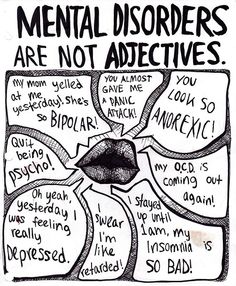
I catch myself using this strange new vocabulary quite a bit. There is a tendency to make adjectives where there should be nouns. There is an ‘in exactness’ in our thinking and speech.

Now we’re not the ‘policemen’ of other people’s grammar. We just should be aware of becoming too casual with mental disorders that can be quite debilitating to quite a few people. Do I ‘joke about’ having OCD when I try to do something precisely? (Sometimes.) Can I make light of being rather ‘retarded’ by some bone-head action I do? (More often than I’d like.)

I find I use terminology like this to explain ‘actions’ to give them a legitimacy as well as a medical reason to a situation. But when I do so, I can demean other people who actually are going through them for real. I also can label myself when I use these adjectives this way.

We really must be careful. We can use our language in such way that reveals our ignorance of the medical and psychological status of disorders. When we use words casually we start to ‘dilute’ them. They can describe a ‘reality’ of things that don’t really exist; we then end up speaking falsely and minimize the severity of a disorder.

“The true test of a man’s spirituality is not his ability to speak, as we are apt to think, but rather his ability to bridle his tongue.”

R. Kent Hughes

As a Christian believer, I also suffer from Bipolar disorder with delusions and anxiety. And yet, the Word tells me to always “speak the truth in love.” (Eph. 4:15). Listen to yourself, and let the Holy Spirit guard your words.

“Set a guard over my mouth, Lord;
    keep watch over the door of my lips.”

Psalm 141:3

bry-signat (1)

cropped-christiangraffiti1.jpg

Hope for the Hopeless [Joy]

Titanic-Hitting-The-Icebery

12 Rejoice in hope, be patient in tribulation, be constant in prayer.”

Romans 12:12

Three things are critical for the New Testament believer:

  1. To rejoice out of a real hope,
  2. a deliberate endurance,
  3. and a prayer life that is unceasing.

These three are vital for us if we want to be authentic saints. These three aspects must become foremost in our discipleship.

Of the three, the first is to rejoice out of a real hope is the most important. It seems like I take the most “hits” over this one. There is a constant erosion  over my joy and my hope. I encounter the false belief that I will be one of the damned. A variation is that I’m ‘cursed’ by God and my life from this point is always going to be hellish and miserable. Frozen like a mosquito in ancient amber.

For me, my mental illness is a sin– the sin of despair. I don’t insist on the right terminology or of definitions. Some believe these issues are demonic. Some wonder about the use of meds, or the value of seeing a psychiatrist or going into therapy. These are all valid, but it seems like polishing the brass rails as the Titanic is seeking.

I won’t try to give answers, because there isn’t a single one to be found. There’s a complexity about the human heart, and God’s sovereign plan that I can’t venture anything. I will only suggest we give room for our own misunderstandings. Perhaps it’s the presence of Jesus we can agree on.

Rejoice in hope,” goes a long ways to combat the enemy, our own fallenness and our own sin of despair. A ‘song to the Lord’ breaks our souls free and is the brokenbelievers true hope is the best antidepressant. But I vote we keep singing out of our cells (Acts 16:25).

bry-signat (1)

cropped-christiangraffiti1.jpg