Love Wears Work Gloves

 “But if anyone has the world’s goods and sees his brother in need, yet closes his heart against him, how does God’s love abide in him?”

“Little children, let us not love in words or talk but in deeds and in truth.”

1 John 3:17-18, ESV

Love is a noble idea, it’s admired and extolled by practically everyone–we see it in our music and poetry, ethics and religion. For the most part it’s a word for something decent and virtuous and honorable. It’s a good thing, but I’m afraid it’s not always scriptural.

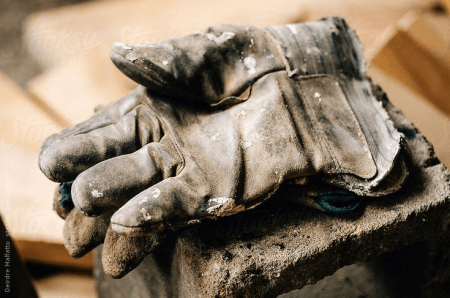
You see, Bible love wears work gloves.

It labors and sweats and works. Bible love has chores to do, and it actively looks and sees what needs to be done. 1 John 3 tells us that we shouldn’t deceive ourselves and only see the world’s definition. That love a believer has is to be different.

Love, in John’s eyes, is most assuredly “doing.” It burns spiritual calories as it labors to serve our brothers and sisters. Love finds things it can do–it doesn’t just talk but it gets busy. Love sees the need and then gets down to serve.

“You must show sincere love to each other as brothers and sisters. Love each other deeply with all your heart.”

1 Peter 1:22

Working (serving) has nothing to do with our salvation, that is a free gift. We’re saved by grace through the blood of Jesus–that’s a given. But this love isn’t  drudgery, as a matter of fact, working and serving each other is a joy. The deepest kind of joy there is.

Our words, although important, are really an insufficient way of proving our authenticity.  The love we serve another with isn’t “pretty poetry” kind of love. It’s so easy to just shout out truth and never ever show a working, serving kind of love. That sort of love is impressive, and can’t ever be duplicated.

That disconnect is a bit disturbing.

But when do we start to realize that this love is really a verb?

Our prayer and intercession really begins when we go to work for someone else. (Our lunch box is our Bible.) We read it and it energizes us to work for one  another. When we pray we truly are loving another brother or sister. It’s work that they can’t or won’t do for themselves. At least not yet. So we pray.

John is calling believers to a more real kind of love. His love is a love that sweats.

“The church is made up of individuals. It can do nothing except as its members work, and work together.”

     James H. Aughey

Dear reader–I really do pray for you. Your love impacts so many.


Protecting Others

“Those who carried burdens were loaded in such a way that each labored on the work with one hand and held his weapon with the other. 18 And each of the builders had his sword strapped at his side while he built. The man who sounded the trumpet was beside me.”

Nehemiah 4:17-18, ESV

Nehemiah was supervising the rebuilding of Jerusalem’s walls. He gathered the men and assigned them to various parts of this. His focus was on building as fast as possible.

But there was enemies who threatened to disrupt the work. There was a conspiracy that directly threatened the work that was taking place.

Nehemiah had to act. He prayed and then posted protection among the men in strategic places, These stood guard to defend the workers. Nehemiah then ordered those who labored to wear swords while they worked.

We who are building God’s kingdom need to arm themselves against our spiritual enemies. We are called to give diligent attention to this, and defend God’s people.

“Take… the sword of the Spirit, which is the word of God.”

Ephesians 6:17

Furthermore we are “may be able to stand against the schemes of the devil” (Eph. 6:11). We’re not working against “flesh and blood.” but the “spiritual forces in the high places.” This is an unseen war that really does exist.

God’s Word is our powerful defense. We’re called to handle it skillfully. This is a mark of maturity. The sword must be engaged to help those who aren’t really aware of this present darkness.

Nehemiah understood. He was diligent and very aware of the evil that swirled around him and his people. He wouldn’t minimize this problem, but met it head on.

We must be like him. We are to be aggressive defenders of our brothers and sisters in Christ. We cannot afford to look away or pretend the enemy is not resisting us. We see his work daily.

“Father, thank you for the Bible. The Word is alive and active as we yield it. Teach us to overcome the enemy as we protect our selves and our loved ones with it. In Jesus’ name, Amen.

1brobry-sig4 (2)


cropped-christiangraffiti1-3-1

The Weakest Link is Us

power-and-weakness

“Now when they saw the boldness of Peter and John, and perceived that they were uneducated, common men, they were astonished. And they recognized that they had been with Jesus.”

Acts 4:13

“God created the world out of nothing, and so long as we are nothing, He can make something out of us.”  

Martin Luther

Consider this: the jawbone of a donkey, a sling shot. and barley loaves, a woman’s tears, a young boy’s lunch, a young colt, and a talking donkey, they all suggest that God touches the common and the insignificant. He uses what we consider of minor importance.

We often turn to the talented and gifted far too readily.

Peter and John are being seen by the Sanhedrin (the Jewish “Supreme Court”). They are to give account of themselves before the highest court of the land. There had been a healing, and there was the matter of preaching as well. Both Peter and John exude a confidence that these religious leaders couldn’t deny. Their perception was that they were ignorant men. Uneducated and common. But, they also knew they had been with Jesus.

However, in the minds of the leadership, they were nothing more than religious white trash.

God loves to use what we consider common. His revealed history has been to take anything at His disposal and utilize it to redeem lost souls. A staff or a sling-shot are used with an adroitness that seems extraordinary among men. The things we think are simple and common are used to further God’s work among mankind.

But the message always returns back to the preachers. The Sanhedrin knew of the disciples preaching. They had absorbed the fact of a miracle; a crippled man had just been healed. (This they couldn’t deny.) But they were troubled. And they didn’t really know what to do.

What more could this be, but a direct intervention of God? And yet, God is working through extremely “common people.” Then let’s look…

“…if we are being examined today concerning a good deed done to a crippled man, by what means this man has been healed,”

Acts 4:9

Within this preaching was woven this healing. The Holy Spirit was ‘rocking their  world.’ The people who came in contact with these disciples would never be the same. Paul tells the Corinthian church that:

“Instead, God chose things the world considers foolish in order to shame those who think they are wise. And he chose things that are powerless to shame those who are powerful.”

1 Corinthians 1:27, NLT

If God has a specialty it would be this. He desires all the glory. He goes out of the way to use the broken and weak. He shows His strength through insignificant and minor things and people. This is His heart given to nobodies.

“We are all wounded. But wounds are necessary for his healing light to enter into our beings. Without wounds and failure and frustrations and defeats, there will be no opening for his brilliance to trickle in and invade our lives.”
“Failures in life are courses with very high tuition fees, so I don’t cut classes and miss my lessons: on humility, on patience, on hope, on asking others for help, on listening to God, on trying again and again and again.”

Bo Sanchez


Nothing But Leaves

“Seeing at a distance a fig tree in leaf, He went to see if perhaps He would find anything on it; and when He came to it, He found nothing but leaves, for it was not the season for figs.”

Mark 11:13, NASB

Perplexing isn’t it?  I personally have had a certain amount of ambiguity with this passage.  I have questions that I’ve swept under the rug.  Why did that poor tree get cursed?  It wasn’t the trees fault, after all.  And didn’t Jesus realize this?  So why go through the theatrics?

I don’t know if this is the case with anyone else. 

I hesitate to ask around.  But recently have come to a better place about this entire event.  The traditional view is that it comes immediately after “the cleansing of the temple” and that explains a lot.  The fig tree is always emblematic of Israel.  (The Old Testament is well populated with these references.) The disciple Mark adroitly organized his Gospel in order to connect both events.

I assure you, Jesus has no issues or vendettas against trees.  😁

But He does take an issue with things that claim fruit, but really have nothing.  There’s nothing but leaves. I’ve been told that the figs do grow, almost as fast as leaves.  The lush greenness is the prime indicator of the succulent fruit. At least, in theory, it has the potential.

Luke 12:7-9,

Look, for three years now I have come seeking fruit on this fig tree, and I find none. Cut it down. Why should it use up the ground?’ And he answered him, ‘Sir, let it alone this year also, until I dig around it and put on manure. Then if it should bear fruit next year, well and good; but if not, you can cut it down.’”


The beautiful leaves declare its fruitfulness.  This tree was loaded, but had nothing to show but leaves.  Within God’s plan for Israel was for fruit.  Enough to feed the nations that would stream to Jerusalem.  Instead, it was worthless.  There was nothing to be had.  Loads of leaves, and the promise of an incredible harvest, but zilch, zero, nothing.

Hypocrisy is a deadening experience, with a definite sterility.

Israel was finding this out, and Jesus is now declaring it to the nation.  A corrupt temple, and a fruitless tree; this were all indicators of hypocrisy and showiness.  The luxuriant leaves loaded the tree, but ‘where’s the fruit?!’

Sometimes we declare that we are fruitful, on the mere basis of our lovely leaves. 

At times maybe even green?  Leaves are pretty much all we can do.  And we do it quite well. But the fruit is from the Holy Spirit, (Galatians 5:22.)

Israel failed God.  They became religious and neglected mercy, and justice.  Humility and graciousness.  The widow and the orphan were not part of their personal equation.  They produced leaves by the wheelbarrow load, but were missing out on the authenticity to what was true, and what really mattered.

Pharisees will do this all the time.

They turn into hypocrites who do not possess what they profess. A hypocrite values true godliness, but he personally falls short of all those things he admires. But he will never, ever admit it to anyone.  And even we who struggle so, must continually admit that we stumble and falter as we try to follow.

The terrible temptation of this time is to look good without being good.

It’s the awful curse of legalistic religion, and it runs rampant in our nation today, even in our government. The Lord absolutely detests it. God help us understand, and repent from what He shows us.

Personally, I may be a ‘screwy’ excuse of being a disciple, but I have decided I don’t want to deceive people anymore. 

God, help me.

“This year, or this month, or, more likely, this very day, we have failed to practice ourselves the kind of behavior we expect from other people.”  

C.S. Lewis


1brobry-sig4

cropped-christiangraffiti1 (1)