Bethesda, 31 A.D.

healing-the-lame

“Afterward Jesus returned to Jerusalem for one of the Jewish holy days. Inside the city, near the Sheep Gate, was the pool of Bethesda, with five covered porches. Crowds of sick people—blind, lame, or paralyzed—lay on the porches.One of the men lying there had been sick for thirty-eight years. When Jesus saw him and knew he had been ill for a long time, he asked him,“Would you like to get well?”

“I can’t, sir,” the sick man said, “for I have no one to put me into the pool when the water bubbles up. Someone else always gets there ahead of me.”

Jesus told him, “Stand up, pick up your mat, and walk!”

Instantly, the man was healed! He rolled up his sleeping mat and began walking! But this miracle happened on the Sabbath,

John 5:1-9, NLT

We were following Jesus and He led us to the pool of Bethesda. A crowd gathered quickly, but I jostled myself right up front. We stood waiting, we pretty much knew something big was going to happen. And it did. I can never be the same, after what I saw. This is my simple story.

So much was happening, and as I watched I realized that so much escapes me. I can’t take it all in. But when I decide to watch Jesus, I quickly become aware of what is important, what is real. It starts to make sense. The chaos of the moment becomes calm. At least it does when He takes charge.

There were hundreds of sick people camped out. They are laying under the roofs, with their thin mats. The smell alone was really bad, all were unwashed and some with putrid and festering sores. Dirty bandages are used over and over, and shared with all.

Finally, all are watching Jesus, they become quiet wondering what He will say. We’re all pretty curious. We see Jesus as He walks directly into this ugly field of suffering people. He doesn’t hesitate or flinch.

It is almost like He is at home in this dreadful place.

Just to have a religious teacher visit Bethesda is rare. They never come. And today is the Sabbath (and a special feast day at that) and that alone makes it impossible. And yet Jesus is here, and that somehow is wonderful.

Jesus stops to talk with a man who is an ‘old-timer’ here in this horrible place of pain. This man had been sitting here for almost 40 years, and that is a long, long time. Jesus speaks. “Do you want to get well?” Jesus waits quietly.

“Sir, when the water is stirred, I don’t have anybody to put me in the pool. By the time I get there, somebody else is already in.” The man explains. He has an excuse that seems like a reason. Nothing has ever gone right– ‘I always miss out, and I can’t find anyone to help me.’ And I suppose that this is the world of the blind, the crippled, the paralyzed in Israel. They are confined to Bethesda, with the weak hope of finally being healed. I don’t think that this is how it was meant to work.

This man was horribly discouraged.  It was then Jesus said, “Get up, take your bedroll, start walking.” And this very crippled man was healed on the spot. No ‘hocus-pocus’, no incantations, no magic dust or rubbing of sacred bones. Nothing.

He was healed by a few spoken words.

I cannot emphasize my own astonishment enough. It shook all of us to the core. We were all stunned, and undone. The crowds, and all the sick and the paralyzed just stopped and stared. There are so few moments in life, just like this. We just looked at each other sort of stunned.

The ramifications of what we all had witnessed were staggering. Shocked, we turned to each other, and a great fear fell on us like a heavy blanket. The crowd did not disperse, we were completely shocked, and pretty much speechless.

For years that sense of awe has never left me.

I don’t really listen to the scorners anymore– they simply have no idea. It completely changed my life. I was never the same after that.

“For the Son of Man came to seek and save those who are lost.”

Luke 19:10

Kyrie elesion,  (Lord, have mercy on us.)

Bryan

 cropped-christiangraffiti1 (1)
 

Rembrandt’s Prodigal Son

Rembrandt-The_return_of_the_prodigal_son
Rembrandt, “The Return of the Prodigal Son,” c. 1661

17 “But when he came to himself, he said, ‘How many of my father’s hired servants have more than enough bread, but I perish here with hunger! 18 I will arise and go to my father, and I will say to him, “Father, I have sinned against heaven and before you. 19 I am no longer worthy to be called your son. Treat me as one of your hired servants.”’ 20 And he arose and came to his father. But while he was still a long way off, his father saw him and felt compassion, and ran and embraced him and kissed him. 21 And the son said to him, ‘Father, I have sinned against heaven and before you. I am no longer worthy to be called your son.’ 22 But the father said to his servants, ‘Bring quickly the best robe, and put it on him, and put a ring on his hand, and shoes on his feet. 23 And bring the fattened calf and kill it, and let us eat and celebrate. 24 For this my son was dead, and is alive again; he was lost, and is found.’ And they began to celebrate.

Luke 15:17-24, ESV

Two hundred and eighty-nine words– these describe the life of every man, woman, and child who has ever lived. These 289 words reveal to us a God who loves far too much, way too easy. Perhaps we sort of expect that he will ‘appropriately’ punish his son– at least put him on probation at least. It only makes sense. But we find that is legalism talking.

“Every saint has a past, and every sinner has a future.” 

Many of us have lived as prodigals, and we have spent our inheritance like ‘drunken sailors.’ We really have nothing at all to show for it. The prodigal, completely destitute, takes the only work he can find. (Imagine a good Jewish boy feeding hogs.)

He is so far gone that he starts inspecting the filthy slop buckets for something to eat.

Many of us will understand his despair. Often there comes to us a crystalline moment of simple awareness. The prodigal, sin-crusted and impoverished, still has a lingering memory of the Father’s house.

The servants there had far more than him right now. Sometimes I wonder if in our captivity, we instinctively want to go home, if only in our minds, to be a servant there.

The Father has dreamed of this precise moment.

The parable says, “He saw him–felt compassion–ran out to him–embraced him–and kissed him.” The Father is a whirlwind of agape love. I’ve read the Parable of the Prodigal Son a hundred times or more. It never loses its punch. I simply want to bring some observations: 

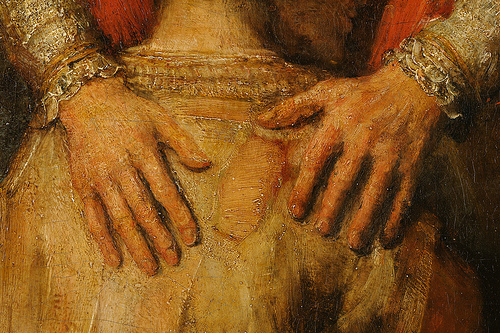
  • We see that his father receives him with a tender gesture. His hands seem to suggest mothering and fathering at once; the left appears larger and more masculine, set on the son’s shoulder, while the right is softer and more receptive in gesture.
  • The son’s head is downy, almost like a newborn’s. We must enter the kingdom like little children. 
  • The Prodigal Son seems to be protected by his father. He snuggles near the Father’s breast. It’s love that holds him there.
  • Consider his sandals. It has taken a long time for him to come home. 
  • Standing at the right is the prodigal son’s older brother, who crosses his hands in stoic judgment; we read in the parable that he objects to the father’s compassion for his brother.
  • We see his mother in the background in the painting, and a seated steward or counselor. One stands in profound joy, the other in sits in stunned perplexity.

But Rembrandt had painted the Prodigal once before, when he was considerably younger. And it is a very good painting. The prodigal is happy and gay; there is absolutely no indication of the consequences of sin.

The Prodigal Son in the Brothel, 1635

He’s a charming young man at the height of his popularity, and we see him at a happy party. He is spending the inheritance of his father.

But Rembrandt chooses at the very end of his life to re-paint it to reflect reality.

This is one of the last paintings he will do, and it is the Prodigal Son–destitute and repenting. I can only imagine; the years have taken a toll and he doesn’t really feel his first painting is enough. He wants to paint what is true.

He now is painting our spiritual condition.

We are given a work that some critics call as the greatest painting ever completed. The painting is now in St. Petersburg, Russia. It is seldom seen by visitors. It is a clear echo of the grace of God for fallen men and women. Like the father in the painting, He’s ready to forgive every sin saturated son and daughter.

The Father’s Prodigal

bry-signat (1)


Little Sin, Little Love— Much Sin, Much Love


She was forgiven many, many sins, and so she is very, very grateful. If the forgiveness is minimal, the gratitude is minimal.”

Luke 7:47, Message

I have been a disciple of Jesus for over 40 years.  But it seems that I really haven’t been a desperate lover of Jesus until recently.

I have seen a lot of stuff, so I made a quick list–

  • the charismatic movement
  • the Imperials
  • New Wine Magazine
  • “I Found It”
  • Larry Lea‘s Prayer Program
  • the PTL Club
  • the Shack
  • preaching on the streets of San Francisco
  • Jesus’ festivals, Festival of the Son
  • Promise Keepers
  • Anita Bryant
  • the Living Bible, youth edition
  • YWAM teams, the Candle– SF
  • Four Spiritual Laws
  • ’88 Reasons Why
  • “Honk if You Love Jesus”
  • preaching on death row
  • Don Francisco
  • carrying the cross, Arthur Blessit
  • the Hiding Place
  • Watchman Nee
  • Outdoor baptisms in city parks

I’ve been exposed to a lot of winds blowing through, and moving on.  You learn to separate the chaff from the grain.  Much of my life has been spent winnowing out to get to the good stuff.  God, through his word describes a coming “trial by fire” over each person’s works.  Romans 14:12 says,

“Yes, each of us will give a personal account to God.” 

One time I walked as a backslidden Christian. I remember once waking up from a drunken stupor with my t-shirt soaked in blood. That blood was someone elses.  I sobered up really quick.  I had this shadowy awareness of beating someone almost to death.  I still catch myself wondering what exactly happened.  There is so much stuff that will be revealed, and I have done many despicable things.

The judgment seat of Christ, therefore, involves believers giving an account of their lives to Christ. The judgment seat of Christ does not determine salvation; that was determined by Christ’s sacrifice on our behalf and our faith in Him. All of our sins are forgiven, and we will never be condemned for them.

We should not look at the judgment seat of Christ not as condemnation but as love, but rather as the Lord speaking into our lives. Yes, as the Bible says, we will have to give an account of ourselves. Part of this is surely answering for the sins we committed.   

But the One who will judge me is also my Savior. That comforts me.

The Greek word for the judgement of Christians is “bema seat.” It was where the judge sat during athletic contests.  Think of the high chair on which a court official sits during a tennis match.  

The issue will not be our salvation, but our faithfulness.    

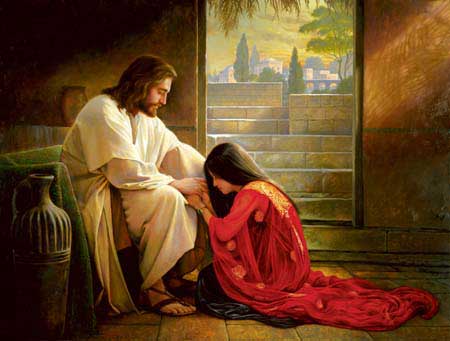
Loving Jesus must become your critical objective for the rest of your days, 1 Peter 4:8, “Love covers a multitude of sins.”  We also read of the sinful woman who washed Jesus feet, “therefore I tell you, her sins, which are many, are forgiven—for she loved much. But he who is forgiven little, loves little.” (Luke 7:47)

Dear one, practice loving him– starting today.  Many are the doers, few be the lovers.  The demanding weight of evangelism and world missions has quadrupled in the last 10 years.  Now is our time!  We love much!  Time is getting very short.


A Believer in Pain

by Joni Eareckson Tada

My chronic pain makes my quadriplegia feel like a walk in the park.

People often ask how I manage my pain. Well, when its fangs sink deep into my hips and back, that’s my signal. I begin deep breathing, slow and steady. And when fiery pain threatens to overtake me—just as the flames threatened to consume Shadrach, Meshach, and Abednego in that fiery furnace found in the book of Daniel—I have a conversation with it.

I don’t say, “I can’t stand this; it’s killing me,” because words like that are fraught with anxiety. Fear only makes things worse. Instead, I calmly ask Jesus to meet me in my pain, to not let it crush me. And the Son of God never fails to meet me, just as he met those three Hebrews in that hot furnace of fire.

And what does Jesus say to me in that agonizing place of pain?

He comforts me with his own words. He will say something like, “Joni, my Spirit inspired 2 Corinthians 4:8 for a good reason. For although you are ‘hard pressed on every side,’ you will not be crushed.”

Oh, what a promise! Pain may tighten its vice grip, but it cannot crush me. As I cling to God’s promises, my pain pushes me further into Jesus’s heart. There is nothing sweeter than finding my Savior in the middle of my hellish circumstances. It helps deflect the pain and helps me to suffer well. Jesus helps me be in that unhappy place well.

All the years I’ve lived in my wheelchair, I never got delivered from pain. But I met my Deliverer in it. I didn’t get healed, but I found intimate fellowship with the Healer.

Friend, pain does not have to crush you.

As you courageously look at the stern countenance of pain and enter unafraid into its recesses, you will defang it of its terror. You’ll see that the Lord is in your pain, having transfigured it to become a place of union with him. Jesus conquered the insidious ways of pain and because of that, he is your best prescription for pain—whether it’s in your hip, your head, or your heart.

And remember, there is a glorious day coming when it says, “He will wipe every tear from their eyes. There will be no more death or mourning or crying or pain, for the old order of things has passed away.” (Revelation 21:4). Until then, when pain encroaches, start deep breathing and cling to a Bible promise. There are thousands to hold onto.

Perhaps my favorite is this one uttered by almighty God to you and me, promising, “I have made you and I will carry you; I will sustain you and I will rescue you” (Isaiah 46:4b).

And he will. He promised.

Joni Eareckson Tada