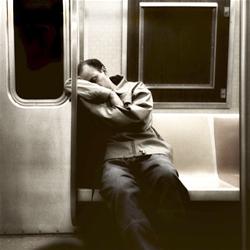
Often there is so much of ‘life’ that we must try to handle. There’s far too many things that confuse us. Faced with many issues beyond our control, we seldom seek the best answer. We are hoping just to survive reasonably unscathed through the latest intense conflict.
Mental illness has its unique trials. Those of us afflicted know the instability it brings us. We go from crisis-to-collapse everyday, (and sometimes even before lunch-time!) Some people have no concept of how much energy it takes just trying to appear ‘normal.’
Sometimes sadness is the best we can do. Trying to find a positive note seems empty and futile. I know a woman who must battle with pain every day. She has to manage every minute of every day with her handicap. She is a wonderful Christian, and she still exudes a gentle faith in her Savior.
We may seem cursed in this life. But Jesus died for this. His love for you is constant and sure.
Sometimes however the only way out is through. We simply must go through the many issues that face us. We must plow through such darkness, that has no precedent. We are the rescued ones, but only because he has made us so. The lost are now found. And we were really, really lost.
We go through, but not without grace. We may step through, but not without pain. So much of our confusion rides on a fascination with the ways of sin and darkness. The ways of the “dark one” may enchant us, but never fulfill us.
We can rest in that we are our Father’s foremost concern.
“He guides me in the paths of righteousness for His name’s sake”
We can puncture the surrounding evil by a simple decision to be faithful to Jesus.Darkness may pursue us, but it will never defeat us. We advance through this pain to the glory of God. He alone can make us triumph. Only Him.
“For I am confident of this very thing, that He who began a good work in you will perfect it until the day of Christ Jesus”
Philippians 1:6
“I do not understand the mystery of grace — only that it meets us where we are and does not leave us where it found us.”
Rarely sits still. He’s always running, climbing, or fidgeting.
Diet:
Having tried – and firmly rejected – honey, haycorns and thistles, Tigger settles on extract of malt as his food of choice. While this particular substance is unlikely to exacerbate his condition, a more balanced diet would almost certainly benefit him and perhaps contribute to an improvement in his behaviour.
Family background:
No information is available on Tigger’s life before his arrival at Pooh’s house. Nothing is known of his previous address or his family of origin, although it has been said that he is the only Tigger.
Patient notes:
Tigger’s arrival at Pooh’s house in the middle of the night is evidence of his inability to control his impulses. A less disordered individual would have known that it is more appropriate to visit people during the day, especially when dropping in on someone one scarcely knows or has never met.
Impulsive behaviour, interrupting and intruding are at the heart of Tigger’s problems. Soon after their first meeting, for example, Tigger suddenly interrupted Pooh, climbed on to the table, wrapped himself in his host’s tablecloth and brought everything crashing to the floor.
When questioned by Pooh about his behavior, rather than accepting responsibility for his actions, Tigger accused the tablecloth of trying to bite him. Tigger makes bold statements, such as declaring that he is only bouncy before breakfast. He proclaims impulsively that whatever food he is offered is what Tiggers like best, then gulps down large mouthfuls of the food in question, only to find he dislikes it very much.
More evidence of Tigger’s recklessness and poor impulse control is displayed by his belief that he can do anything. He has no sense of fear or responsibility. This was apparent when he climbed up a high tree with Roo on his back before he had ascertained whether he was able to climb a tree in the first place. Inevitably, they then got stuck when he realised he had no idea of how to get down.
On one occasion, Tigger grabbed Roo’s medicine from Kanga, which he proceeded to swallow, almost devouring the spoon as well. Obviously the medicine might have proved dangerous to him. Tigger never learns from his mishaps, bouncing back almost immediately after a frightening and potentially hazardous incident. As a result, Tigger’s behaviour causes concern to those around him.
——————————————-
Living with someone suffering from ADHD can be trying. Perhaps this is why Rabbit suggested the rather extreme measure of taking Tigger into the forest and losing him in the mist. Rabbit and his friends believed the shock of being lost might cause Tigger to calm down a little on his return, a strategy that backfired…
“ADHD is a disorder that makes it difficult for a person to pay attention and control impulsive behaviors. He or she may also be restless and almost constantly active.” –National Institute of Mental Health
By Mark Earley, Christian Post Guest Columnist, Wed, Aug. 08, 2007
The least of these is my brother
In the 16th century, London’s mentally ill were often kept at Bethlem Royal Hospital. The conditions inside the hospital were notoriously poor. Patients were often chained to the floor and the noise was so great that Bethlem was more likely to drive a man crazy than to cure him. The conditions were so infamous that the nickname locals gave the hospital—Bedlam—has come to mean any scene of great confusion.
Unfortunately five hundred years later, we’re still treating the mentally ill more like prisoners than patients. Fifty years ago, more than 550 thousand people were institutionalized in public mental hospitals. Today, only between 60 and 70 thousand are, despite a two-thirds increase in the country’s population.
Since there’s no evidence that the incidence of mental illness has dropped precipitously, the mentally ill who previously had been institutionalized had to have gone somewhere. While some are being treated successfully in their communities, at homes and groups homes, but for many that “somewhere” is behind bars. This last part shouldn’t come as a surprise.
Five years ago, the Washington Post told the story of “Leon,” a one-time honor student, who had 17 years in and out of jail on various drug-related charges. It was only after several suicide attempts, including drinking a “bleach-and-Ajax cocktail,” that Leon was diagnosed with bipolar disorder. Leon’s story was a microcosm of a larger problem: “Prisons and jails are increasingly substituting as mental hospitals.”
As one advocate for the mentally ill told the Post, “a lot of people with mental illness are charged with minor crimes as a way to get them off the streets.” In effect, they are behind bars for “being sick.” Fast forward five years and little, if anything, has changed. A few weeks ago, another piece in the Post discussed the same problem.
Psychiatrist Marcia Kraft Goin told readers something that should shock and outrage them: “The Los Angeles County Jail houses the largest psychiatric population in the country.” As with the earlier Post piece, the conclusion was inescapable: “People with [untreated] mental illnesses often end up with symptoms and behaviors that result in jail time.” You don’t have to be a “bleeding heart” to understand that this is an injustice—any kind of heart will do.
Not only are the mentally ill not getting the help they need, they are as lambs to the slaughter in our crowded and violent prisons. They are being victimized twice over. They’re not the only ones being victimized.
At a time when most state prisons are unlawfully overcrowded, there are better uses for prison beds than as makeshift mental hospitals. As Goin wrote, “treating” mental illness as a criminal justice problem costs “more than treating patients appropriately in their community.”
As part of its ministry to prisoners and their families, Prison Fellowship supports community-based alternatives to incarceration. Not only because it makes “financial sense” but because it’s what Christ would have done. In Matthew 25 he called the ill and the prisoner his “brothers” and he expects us to offer them something more than bedlam.
“There but for the Grace of God go I…”–Bryan
__________________________________
From BreakPoint®, August 6, 2007, Copyright 2007, Prison Fellowship Ministries. Reprinted with the permission of Prison Fellowship Ministries. All rights reserved. “BreakPoint®” and “Prison Fellowship Ministries®” are registered trademarks of Prison Fellowship.
There may not ever be a last episode, but there are ways to fend off and mitigate the next one.
By Jodi Helmer
Doctors never talked to Elly L. about RELAPSE.
Although she was hospitalized during a manic episode and diagnosed with bipolar disorder, doctors never mentioned that it could happen again. Instead, Elly was stabilized, handed a prescription for mood stabilizers and discharged. She had no idea that she’d be battling mania and depression for the rest of her life.
“I was told that as long as I took my medications, I’d be okay,” recalls Elly, a mental health coach in Toronto, Ontario.
Elly experienced at least eight relapses between her diagnosis in 1978 and 1991. Each time, she was hospitalized, often placed in restraints and taken to the psychiatric ward in a police car or ambulance. Upon discharge, Elly always promised herself it would be her last hospital admission-but she had no idea how to stave off future relapses.
In bipolar disorder, relapse is defined as the return of depression or a manic or hypomanic episode after a period of wellness. According to a 1999 study published in the American Journal of Psychiatry, 73 percent of those diagnosed with bipolar disorder experienced at least one relapse over a five-year period; of those who relapsed, two-thirds had multiple relapses.
“You can never say that someone with bipolar disorder has had their last episode; relapse is part of the illness,” explains Alan C. Swann, MD, professor and vice chair for research in the Department of Psychiatry and Behavioral Sciences at The University of Texas Medical School at Houston and director of research for the University of Texas Harris County Psychiatric Center. “Relapse is self-perpetuating; once it happens, the more likely it is to happen again.”
Searching for Answers
It’s possible to do all of the right things- follow a proper medication regimen, eat well, exercise, minimize stress and get enough sleep-and still experience relapse. Unfortunately, there is no clear understanding of why this happens.
“There may be changes in the cellular level that cause cycling but their cause is unknown,” says Joseph R. Calabrese, MD, director of the Mood Disorders Program at the Case Western Reserve University School of Medicine in Cleveland, Ohio.
While the neurological causes of relapse are unknown, a few things are certain: Those who are diagnosed with bipolar II are more likely to relapse than those with bipolar I. Their episodes of depression, mania or hypomania are often shorter than the episodes experienced by those with bipolar I but tend to return more often, according to Calabrese. It’s also far more common to relapse into depression than into mania or hypomania. Calabrese estimates that in bipolar II, there is a 40-to-1 ratio of depression to mania; the ratio of depression to mania drops to 3-to-1 in bipolar I.
“The key to recovery is a low tolerance for relapse,” says Calabrese.
In fact, Dr. Roger S. McIntyre, MD, associate professor of psychiatry and pharmacology at the University of Toronto and head of the Mood Disorders Psychopharmacology Unit at the University Health Network, believes that even the mildest symptoms of depression and mania should be treated as potentially hazardous.
“The takeaway message is that we need to seek complete elimination of symptoms as our treatment objective,” he says…
Click here to read the full article, “A Bumpy Road: Dealing with Relapse”
“bp Magazine” is a wonderful “shot in the arm.” I would suggest that you get a subscription, and for a friend as well.
Join NAMI today!
When you become a member of NAMI, you become part of America’s largest grassroots organization dedicated to improving the lives of persons living with serious mental illness. And now you can join online.