When Faith Doesn’t Seem to Work

by Terry Powell

I am not a Christian because my faith “works” for me. Talk to a devout Mormon, Muslim, or Buddhist and he’ll extol the here-and-now benefits of his faith. He’ll cite a serenity of spirit, or a sense of order that believing brings to his life. Yet his belief system contradicts mine, so logically these various faiths cannot all be true!

If I were a Christian just because faith has utility for me, because my days are more likely to unfold in a smooth, trouble-free manner, I’d be a pragmatist, pure and simple. And I’d be prone to shuck my commitment to Christ the moment a different philosophy or religion appeared to offer me more.

Don’t get me wrong. Following Christ is not without rewards in the present. My faith often sustains me, provides perspective for decision-making, and injects happiness rooted in a biblical worldview.

But not all the time.

There’s the inevitable warfare with the world, the flesh, and the devil to contend with. And in my case, either chronic depression or other weaknesses of temperament sometime get the best of me. I’ll keep praying for relief and I’ll strive for sound mental health, yet I don’t want to be among the growing number of Christians who expect God to give them on earth what He only promised for heaven.

From a theological perspective, I’m a Christian because God chose me and initiated a relationship with me (Eph. 2:1-10). From a human perspective, my faith is in Christ not because it works, but because I believe Christianity is true. And truth is objective reality, not a subjective experience. No matter how I feel, or how my day goes, truth doesn’t change. Truth just is. I wrote this poem to convey this point.

Nature of Truth

When all hope yields to despair

and I doubt that God is there;

when my heart is cold, unfeeling,

and my prayers bounce off the ceiling;

when depression takes its toll

and winter winds assault my soul;

when the race seems all uphill

and dying grows in its appeal;

when things don’t go as expected—

still, God’s Truth is unaffected.

In the long run, faith works in the sense that I’ll enjoy eternity with my Savior (thanks to His works, not mine). But being a Christian doesn’t shield me from affliction in the here and now. It does assure me of God’s compassion and healing presence: “He heals the brokenhearted, and binds up their wounds” (Ps. 147:3).

Love, Terry


Terry teaches in the areas of Church Ministry and Ministry Leadership at Columbia International University in South Carolina. He has served as a Christian Education staff member for three  churches, and he’s a licensed preacher in the Presbyterian Church of America.  His current books in print are Serve Strong:  Biblical Encouragement to Sustain God’s Servants, and  Now That’s Good A Question!  How To Lead Quality Bible Discussions. Terry has been married for 46 years, and has two sons, a daughter-in-law, one grandson, and a dachshund.  His constant prayer is, “Lord, make me half the man my dog thinks I am!”

Check out his blog at https://penetratingthedarkness.com/. His ministry is focused on Christians experiencing clinical  depression and other mental issues.


Oh God, Why is This Happening to Me?

book_of_Job-570x377
“Why have you made me your target?…Why do you hide your face?…Why should I struggle in vain?…Why does the Almighty not set times for judgment?…Why then did you bring me out of the womb?”

Job 7:20, 13:24, 9:29, 24:1, 10:18

Didn’t Job get “hammered?” His monumental suffering is unparalleled in history. He is essentially a godly man who loses everything (except his faith). Job must pick up the pieces after “catastrophic ” sudden pain and total loss.

Job is being tested with the ultimate horrors. Will he “curse God and die” as his wife suggests? Will he cave in to the final four (his friends) and agree to their twisted theology? (You have to read chapters 38-39 to find out).

The Book of Job has been regarded as inaccessible and archaic by many.

Unfortunately many believe this assessment and look elsewhere for comfort. I would agree that Job is a challenging book, but so is Macbeth or Plato. (I guess you should find an easier translation).

Job is less an explanation and more a revelation of suffering. “Why” questions go unanswered. “Who” questions matter. I suppose this seems unfair. It certainly seems so, but straight answers in a fallen world won’t get any mileage at all.

One more thing. The Book of Job is about “twisted” theology. Job’s friends “toe-the-party-line” of theology that is logical. But don’t be mislead by their pronouncements, for they seem reasonable but they are flawed. It is a doctrine without love.

“If I have the gift of prophecy and can fathom all mysteries and all knowledge, and if I have a faith that can move mountains, but do not have love, I am nothing.”

1 Cor. 13:2

You can’t split your theology from love and get away with it.

When you read “Job’s friends” you must remember that. These are lessons it takes a long time to learn.

The broken believer, hobbled by chronic illness, has much to learn from Job. He is like “the poster child” for those afflicted. My mental illness is an issue (of course) but God is fully in control. He brings beauty out of the ashes.

“To bestow on them a crown of beauty
    instead of ashes,
the oil of joy
    instead of mourning,
and a garment of praise
    instead of a spirit of despair.
They will be called oaks of righteousness,
    a planting of the Lord
    for the display of his splendor.”

Isaiah 61:3


Pushing Through

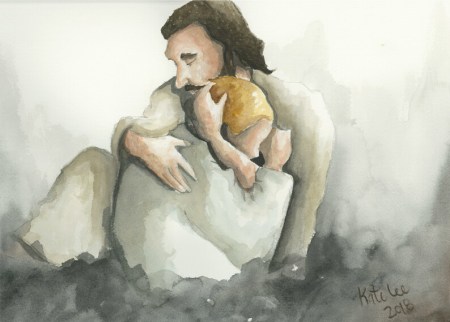
“Snuggle in God’s arms. When you are hurting, when you feel lonely, left out. let Him cradle you, comfort you, reassure you of His all-sufficient power and love.”

     Kay Arthur

There is a lifeline if you are:

  • A weary leader, caregiver, or simply a burned-out believer.
  • Navigating the heavy fog of grief, anxiety, or emotional numbness.
  • Quietly asking yourself, “Why do I still feel so empty?”
  • Aching to feel close to Jesus again.

You don’t have to fix yourself to be found. You’re not too broken—you are already being held.

Are You Sick and Tired Yet?

Matthew 11:28-30, ESV

Weariness and burdens are our common plight. We all have them. They are shared as sort of common identity, like eye color or hair color. We all have them, and wish we didn’t. Sometimes we feel like shutting down, it seems too much to endure.

Weariness, that bone-tiredness that sleep doesn’t seem to help.

We seem to be chronically fatigued by life and what it brings us. We have heavy burdens, we carry a load that only gets heavier (and never lighter.) I suppose we adapt, and simply learn to carry it. But that wears thin, and weariness always breaks through.

Money problems, bills that are past due, marriages, straying children, cars that need fixing, family problems, job hassles, health problems… the list goes on ad nauseam. There are far too many issues, too many problems. Perhaps boredom and tedium are added to the list. They only intensify the hopelessness. (Its own special kind of suffering.)

Some will choose to ‘self medicate’ with alcohol or drugs.

They want something more, and find they only create more burdens (not less). Some will become hopelessly addicted, never finding relief from their burdens, but only increasing them. Suicide very often is seen as the only way out. It seems that it’s an option.

But Jesus will never condemn (leave that to the Pharisees) but instead offers a sort of amnesty to the burnt-out and the burdened. Come to me, all of you who are weary and carry heavy burdens, and I will give you rest.” Jesus did not say, “Get away from me, I am holy and you are not.” Rather, He makes himself to be the solution to all those whose life has overwhelmed.

He desperately wants our burdens and absorbs all our weariness. He wants us. He wants to give us peace and rest. Often Jesus offers but we’ll refuse.

An easy trade, especially since we are so desperate. Some have evaluated Jesus’ offer and made the transaction–piling up our burdens at His feet. We might be a little hesitant about the “my yoke” part, but will quickly find that discipleship can’t be compared to the weight we once carried for so long.

Biblical discipleship is relatively easy. It only asks that we surrender–For my yoke is easy to bear, and the burden I give you is light.” Following Jesus becomes the best way to live. We seem to understand, but unless we commit we will just carry our weight. (But it only gets heavier.)

Here’s a few verses from Isaiah that might help you sort this out:

29 He gives power to the weak
    and strength to the powerless.
30 Even youths will become weak and tired,
    and young men will fall in exhaustion.
31 But those who trust in the Lord will find new strength.
    They will soar high on wings like eagles.
They will run and not grow weary.
    They will walk and not faint.

Isaiah 40:29-31

But you need to deliberately choose. You must decide for yourself–what will you commit to? Will you continue to carry your burden, or will you turn to Jesus?