Healing the Wound of Rejection — by Jonathan Coe


When a child is born into the world, often the first face they see is a doctor or nurse followed by their mother and father. Then in their early years and all the years before they leave home, they will see their parents’ faces probably more than anyone else. Single–parent homes will add a different dynamic to this experience.

Over the years their parents’ faces will communicate different emotions to them. In an emotionally healthy family, lots of love, acceptance, sense of belonging, respect, and appreciation will be communicated. In an unhealthy family, just the opposite, or a confusing mixture of false and true messages, will be communicated and will leave the child with the wound of rejection.

The wound of rejection has to be one of the most difficult wounds to heal. It occurs not only in parent–child relationships, but also in husband–wife, sibling, peer, employer–employee, and  priest/pastor–flock relationships. It cuts deep because it communicates to the person not that they are doing something wrong, but that there is something wrong with them.

The face they see in their mind’s eye tells them that they are defective, second-rate, not good enough, and unlovable. For many this face, and its false messages will plague them the rest of their lives.

It would be foolish for me to try to pretend to solve a complex problem like this in one blog post. However, it is not foolish for someone like me, who has also felt the sting of rejection, to try to provide a helpful beginning.

For starters, one thing that helped me was to realize that the person(s) who rejected me didn’t reject me because I was inherently unlovable; they rejected me because they didn’t have the wherewithal, inner resources, or ability to love me like I needed to be loved. It wasn’t about me; it was about them. Embracing this truth, for many people, can be the beginning of healing.

Another thing that helped me was contemplative prayer. Now when many people hear the words “contemplative prayer,” they feel intimidated and think that such a thing must be reserved only for mystics, monks, and very holy people. That’s not true. Contemplative prayer is for everybody.

When St. John Vianney entered his church and found an old farmer praying, he asked him what he was doing and the peasant told him, “I look at him and he looks at me.” That’s contemplative prayer. St. Teresa of Avila said that “Contemplative prayer, in my opinion, is nothing else than a close sharing between friends.”

We see the face of Jesus and he sees us and there is an intimate exchange. Contemplative prayer is helpful for the person who is wounded by rejection because they replace the face of the person(s) who has/have wounded them and  their false messages with the face of Christ and his true messages about you. So the main question for us as we read this is “Whose face are we looking at?” 

I hope that it’s the face that I see in Zephaniah 3:16 and 17. Please remember that what is said in this passage to Israel under the old covenant is even more true to us today under a better covenant and one greater than Moses (Jesus):

“On that day they will say to Jerusalem, ‘Do not fear, O Zion; do not let your hands hang limp. The Lord your God is with you, he is mighty to save. He will take great delight in you, he will quiet you with his love, he will rejoice over you with singing.'”

God is singing. Why? Because he is rejoicing and delighting over us with an overflowing, super–abundant love. This is the face of Christ that should replace the other faces that we constantly see that have given us the wound of rejection.

Additional to this, it’s also important to have friends and family that become the face of Christ to us or what a psychologist friend of mine called “Jesus with skin on.” With all these things in place we can truly shout from the rooftops, “Let the healing begin!”

ybic, Jonathan


If you like this post from Jonathan Coe, you may also like his new book, Letters from Fawn Creek, that now can be purchased at this link:

https://www.tatepublishing.com/bookstore/book.php?w=9781628542035

Letters from Fawn Creek

cover art/photo: http://www.adventistonline.com
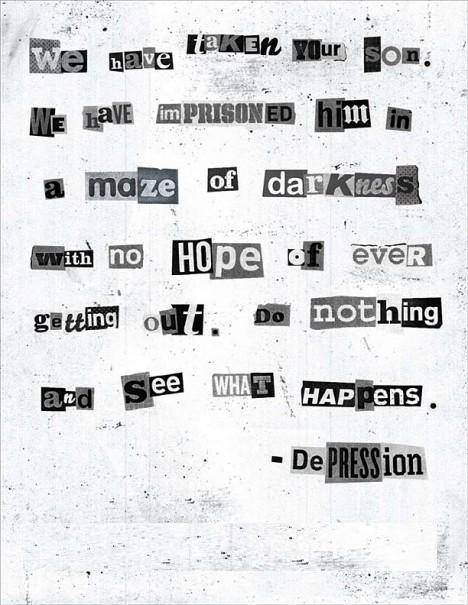
The Ransom Note

depression-note

“We collapse in the dust,
    lying face down in the dirt.
26 Rise up! Help us!
    Ransom us because of your unfailing love.”

Psalm 44:25-26, NLT

“For even the Son of Man came not to be served but to serve others and to give his life as a ransom for many.”

Mark 10:45

“God chose him as your ransom long before the world began, but he has now revealed him to you in these last days.”

1 Peter 1:20

I think that God has more or less ransacked the human language in His effort to get through to us the critical nature of what exactly has been done just for us. When it comes to our salvation and what that means to the universe, the word, “ransom” is used.

The connection for us, as we consider the implications, has mainly a connection with the crime of “kidnapping.” This is when someone is captured by other men, and held in captivity until certain terms are met. When the kidnapper feels his needs are fully met, then the hostage is released.

In the Bible sense, we should work through several verses. There are at least three Hebrew words. In the N.T. Greek just a single word to explain “ransom” is seen. And yet we can say, each word is linked back to the idea of being “helpless.” And helpless is far more than a definition, rather it is a description of a “state of being.”

We come to understand that helplessness is the natural state of human beings. We each have been captured, taken away and are being held, until terms are met for our release. I suppose that some see this helplessness easier than others. (And I’m sure a few will never acknowledge it at all). But nevertheless, it is real and it describes every single person that has ever lived.

Being completely helpless is hardly a situation we would ever choose. Having ransom demands being made to set us free is mostly awkward. And it’s an affront. Perhaps, we feel we are worth more? But the issues here are eternal, and currency concepts are never the consideration.

But there is a present need, to purchase back those who are being held as captives. The absolute clear position is that the Lord Jesus Christ, died in our place. Choosing to die for us, he was essentially tortured before his cruel death. In this decision, he himself paid my ransom. In doing this, I was set free and fully able to return home.

There are many who have been free. But there is a thing called “the Stockholm Syndrome.” This refers to those in captivity who somehow “connect” with their kidnappers through a prolonged captivity. This is to the point where they begin to act less than the victims, and more like the captor. It is confusing. They seem to go out of their way to act “pro-kidnapper”. This can get very disturbing.

We must look to our children, and closest family and our friends. They are toiling for Satan, the captor of our souls (past-tense). Many different tactics are being used– depression, addictions, lust, greed, anger, gluttony, pride, guilt and many other deceitful things. They are being held, until faith (the key) “springs” them out of their prison.

Thank you Jesus, for coming to free us. Thank you for forgiving us. We have been released, and now walk away free. You died, so we might live. We desperately want to see the others we love set free.

*

ybic, Bryan


cropped-christiangraffiti1 (3)

*

Epileptic Christians Rule

Epilepsy understood
Epilepsy understood

“My health may fail, and my spirit may grow weak,
    but God remains the strength of my heart;
    he is mine forever.”

Psalm 73:26, NLT

I think it’s time for me to talk openly about this.

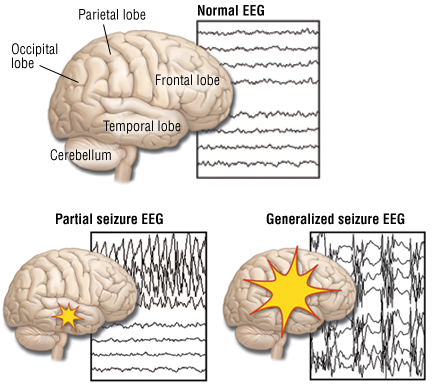
For several months I have been experiencing absent seizures. These are moments when I just ‘check out’ and stare at something–actually at anything, but bright and flashy will almost always draws me in. These are not the ‘grand mal seizures’ with the jerking and shaking and rolling around (but I’ve been told that these can happen to me.) I have the ‘petit mal’ variety. Many times they go undetected and unnoticed by others. They seem like a long pause of thoughtfulness. But it isn’t. I’m having a seizure.

It seems just what I needed, “another kick-in-the-head.” The thought has been brewing lately that I’ve been mistreated by God again. Why? (Why do I always get the hammer? I wonder if heaven has a Complaint Department?)

My medical history would rival the classic, “Moby Dick” in terms of sheer mass and requiring “heavy lifting.” Hepatitis C, Manic depression, Brain tumor surgery and all the after effects–and now this. Perhaps, I need to spend some quality time with my Father?  I like this verse a lot.

“O Lord, if you heal me, I will be truly healed;
    if you save me, I will be truly saved.
    My praises are for you alone!”

Jeremiah 17:14, NLT

I have worked hard to eradicate self-pity over the years (or I think I have). I’ve had so many medical issues and I don’t ever want to add “hypochondriac” to this list.  I heard this joke about a young boy who was so caught up with his illness that he started to take his M&Ms one by one with a glass of water, like a pill.

The jolt is becoming real now. They want to take my driver’s license away. (What next–will I be mandated to hear a protective helmet?) All of this is so wrong, it seems to me. (“Can I get an ‘amen’ here?”) The last few days I’ve taken a new med, a proven anti-convulsive. I have never ever wanted a drug to work more then this one. Unfortunately, I am experiencing some side effects. I covet your prayers now, more than ever, especially for my wife, Lynn and my kids.

flourish1

“I will trust Him. Whatever, wherever I am, I can never be thrown away. If I am in sickness, my sickness may serve Him; in perplexity, my perplexity may serve Him; if I am in sorrow, my sorrow may serve Him. My sickness, or perplexity, or sorrow may be necessary causes of some great end, which is quite beyond us. He does nothing in vain.”

    John Henry Newman

Some links I have discovered to be interesting, and maybe even helpful.

http://epilepsyfoundation.ning.com/group/christianswithepilepsy

http://www.squidoo.com/ahealthyresponsetoseizuresversusdemons

http://morethanstone.blogsome.com/2007/02/27/epilepsy-and-spiritual-warfare/

&

ybic, Bryan


cropped-christiangraffiti1 (3)

(L

A Holy Troublemaker

Christians were never meant to be normal. We’ve always been holy troublemakers, we’ve always been creators of uncertainty, agents of dimension that’s incompatible with the status quo; we do not accept the world as it is, but we insist on the world becoming the way that God wants it to be. And the Kingdom of God is different from the patterns of this world.”

Jacques Ellul

I was living in the gritty Mission district in San Francisco, I remember sitting in my favorite coffee shop at the corner of Clarion Alley and Mission reading Ellul’s “Meaning of the City.” I have to admit, I was profoundly undone.  Here I sat with my ‘latte,’ in the presence of a “genius,” reading a man who was describing the city that I was living in.  It was a bit much. It devastated me, but in a very good way.

Jacques Ellul describes the condition of city-darkness.  His contention was that there are people who are actively, (but often passively,) in a rebellious opposition to whatever God is doing.  There is an “organization of unbelief” that always resists the Holy Spirit, and it has become especially embedded into places we call the City.

Ellul recognized that there is an opposition force.  There are now those who have been drastically connected to the radical presence of God. There can’t ever be real normalcy here.  We are saints, (whether we like it or not.)  We are solidly “light.”  And then we start reflecting that into a profound darkness, which cares for nothing at all– even hating the grace of God– things can get vicious.

We stand in an awesome place (whether we understand or not.)  We are in the truest sense revolutionaries.  We stand by grace in this place.  The light is always breaking holy-troublemakersinto the lives of those who are living against Him.  This is most uncomfortable– like falling into a raspberry patch naked, with all its stickers and scratches. Hardly pleasant.

We are “the troublemakers.”  What we believe turns the world upside down (really, upside right.)  We have become obstacles to those in darkness. We are altered, and as believers the change is dramatically authentic.  There is simply nothing outside of His power that can do this.

Jesus answered, “I tell you the truth, unless you are born again, you cannot be in God’s kingdom.”   John 3:3, NCV

This critical thought describes the essential work that must happen before we can enter into it.  God’s kingdom is now our dream and our destiny.  It fuels us, and energizes us far beyond any work we can do.  We are now living people, residing in the “land of the dead.”  We must expect problems, but exult in a real existence.

U

ybic, Bryan


cropped-christiangraffiti1-2