“Bearing with one another and, if one has a complaint against another, forgiving each other; as the Lord has forgiven you, so you also must forgive.”
Colossians 3:13, ESV
Since this blog originates in Alaska, and since winter is upon us, this post seems fitting. It’s cold. And, well, I’ve been thinking about things that have happened to me recently.
We have a sinful tendency to “freeze” people that offend us.
We do it with our words, attitudes, actions. It is called unforgiveness, or stigma, or just plain contempt. It locks another person in a place were they will stay forever, and you won’t ever have to deal with them.
We glaciate others with extraordinary ease.
Someone offends me, or irritates me and I blast them. In my mind I solidify them into one spot, and there they are locked. Sealed away, and out of my thinking. I sometimes call it “discernment.” And then I can avoid those pesky urges to humble myself.
I have been frozen by others, and to be quite honest, I have been the ‘freezer’ as well.
The sad part is that we ourselves are so far from perfect. When we zap someone we will never, ever ‘receive’ from that person. We can even preclude them as outside of the grace of God. (And usually that’s what happens.)
“You offend me, and I will never forget it, and you will never be more than an evil miscreant to me.” My rationale is “life is too short for hassling with jerks like you.” But yet I can’t fully accept that idea. That is not God’s will for me, and I know it.
We end up debasing ourselves by our own unforgiveness.
We restrict others from the Holy Spirit’s transforming ability. In our mind’s eye, the wicked person will never be able to offer up anything of value. We freeze–locking them into a place. And a vast amount comes from an unforgiveness that is ‘fallen,’ and an unbelief in God’s grace and power.
Furthermore, any use of our ‘freeze gun’ freezes us as well. Unforgiveness turns on us (which we didn’t count on) and the effect is cumulative. We can only absorb so much an we get hard and cold.
One more thing. We do this to whole groups of people. The alcoholics, the mentally ill, other races. This can be called prejudice or stigma. Ask yourself this–have you ever been stigmatized or demonized? You will usually know it. But we cannot afford to be controlled by our unforgiveness.
There is far too much at stake.
“And whenever you stand praying, if you have anything against anyone, forgivehimand let it drop (leave it, let it go), in order that your Father Who is in heaven may also forgiveyou your [own] failings and shortcomings and let them drop.”
“So then, since we have a great High Priest who has entered heaven, Jesus the Son of God, let us hold firmly to what we believe. This High Priest of ours understands our weaknesses, for he faced all of the same testings we do, yet he did not sin. So let us come boldly to the throne of our gracious God. There we will receive his mercy, and we will find grace to help us when we need it most.“
Hebrews 4:14-16
These two verses out of Hebrews 4 establish three things.
We are “criminals” and in need of representation.
Jesus Christ stands ready, and able to help us before both this world and to the one to come.
Jesus still has a present day ministry as our priest and provider.
And he is busy! He did not ascend to heaven to wait around for his second coming. He is active, and we are being acted upon.
Saving you, and watching over you, is the present work of heaven.
But there is more, let’s look at the story of Paul’s voyage to Rome in Acts 27. He is a prisoner being escorted to stand before Caesar. He has a guard who is watching him as he travels by ship across much of the Mediterranean.
Because of the time of the year, the trip will be hard. The weather is very iffy, and awful storms could pummel a ship at times. No matter what, it will be a hard journey. Sometimes that happens.
“When a light wind began blowing from the south, the sailors thought they could make it. So they pulled up anchor and sailed close to the shore of Crete. 14 But the weather changed abruptly, and a wind of typhoon strength (called a “northeaster”) burst across the island and blew us out to sea. 15 The sailors couldn’t turn the ship into the wind, so they gave up and let it run before the gale.”
16 “We sailed along the sheltered side of a small island named Cauda, where with great difficulty we hoisted aboard the lifeboat being towed behind us. 17 Then the sailors bound ropes around the hull of the ship to strengthen it. They were afraid of being driven across to the sandbars of Syrtis off the African coast, so they lowered the sea anchor to slow the ship and were driven before the wind.”
Acts 27:13-17, NLT
The storm is probably a once in a lifetime experience. It seems everyone is problem-solving trying to keep the ship from “breaking up.” They are fighting for their lives. After tossing over the cargo, and the ships tackle, they would have cut down the mast. Leaving it up would only weaken the ship’s hull, which reduces their chances.
They then did something called “frapping.”
It involved wrapping ropes or cables around the hull in a criss-cross manner. This outside strengthening would have been “levered” to increase tightness. It could be an effective way of surviving the unsurvivable.
There is a specific Greek word to describe this frapping. It is used in only one other place in the entire Bible. In Hebrews 4:16 we read–
“So let us come boldly to the throne of our gracious God. There we will receive his mercy,and we will find grace to help us when we need it most.“
Can you see the connection? In these desperate times when the storm is ripping up everything, attempting to destroy us– our families, our friends and neighbors. Just survival seems a long stretch. It is then that Jesus fraps (or wraps) us tightly.
But many of us go through typhoons with the cables coiled up on deck. We seem oblivious and ignorant of its availability. We really don’t see the “present tense’ ministry of Jesus standing to intercede. We merit nothing– but He promises us everything. We are on the knife’s edge of falling apart, but perhaps it’s our own fault?
I believe this message has not come to you by accident. You are either in the storm, or know someone who is there. The name of this post is, “Jesus Actively Helps Me.” I hope you will see it, you will need it.
“Jesus Christ carries on intercession for us in heaven; the Holy Ghost carries on intercession in us on earth; and we the saints have to carry on intercession for all men.”
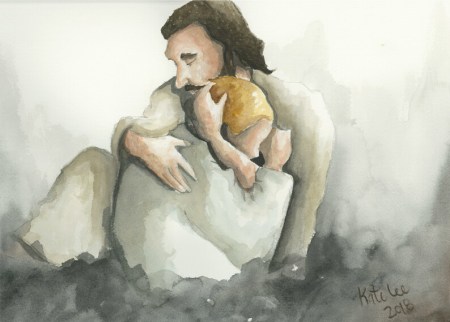
“Snuggle in God’s arms. When you are hurting, when you feel lonely, left out. let Him cradle you, comfort you, reassure you of His all-sufficient power and love.”
This should give direction and dialogue on the issues faced by every church member. It is a great opportunity we have been given— to minister to every person in the Body of Christ. —Bryan
by Ken Camp, Associated Baptist Press —
Living with depression — or any other form of mental illness — is like viewing life “through a glass darkly,” according to Jessy Grondin, a student in Vanderbilt University’s Divinity School. “It distorts how you see things.”
Like one in four Americans, (25%), wrestles significantly with a mental illness.
Depression is one of the most common types of mental illness, along with bipolar disorder, another mood-altering malady. Other forms of mental illness include schizophrenia and disorders related to anxiety, eating, substance abuse and attention deficit/hyperactivity.
Like many Americans with mental illness, Grondin and her family looked to the church for help. And she found the response generally less-than-helpful. “When I was in the ninth grade and hospitalized for depression, only a couple of people even visited me, and that was kind of awkward. I guess they didn’t know what to say,” said Grondin, who grew up in a Southern Baptist church in Alabama.
Generally, most Christians she knew dealt with her mood disorder by ignoring it, she said. “It was just nonexistent, like it never happened,” she said. “They never acknowledged it.” When she was an adolescent, many church members just thought of her as a troublemaker, not a person dealing with an illness, she recalled.
Mental Illness that affects believers must be accepted by the Church.
A few who acknowledged her diagnosed mood disorder responded with comments Grondin still finds hurtful. “When dealing with people in the church … some see mental illness as a weakness — a sign you don’t have enough faith,” she said. “They said: ‘It’s a problem of the heart. You need to straighten things out with God.’ They make depression out to be a sin, because you don’t have the joy in your life a Christian is supposed to have.”
A Baylor University study revealed that among Christians who approached their local church for help in response to a personal or family member’s diagnosed mental illness, more than 30 percent were told by a minister that they or their loved one did not really have a mental illness. And 57 percent of the Christians who were told by a minister that they were not mentally ill quit taking their medication.
It’s not a sin to be sick.
That troubles neuroscientist Matthew Stanford. “It’s not a sin to be sick,” he insists. Stanford, professor of psychology and neuroscience and director of the doctoral program in psychology at Baylor, acknowledges religion’s longstanding tense relationship with behavioral science. And he believes that conflict destroys lives. “Men and women with diagnosed mental illness are told they need to pray more and turn from their sin. Mental illness is equated with demon possession, weak faith and generational sin,”
Stanford writes in his recently released book, Grace for the Afflicted. “The underlying cause of this stain on the church is a lack of knowledge, both of basic brain function and of scriptural truth.” As an evangelical Christian who attends Antioch Community Church in Waco, Texas, Stanford understands underlying reasons why many Christians view psychology and psychiatry with suspicion. “When it comes to the behavioral sciences, many of the early fathers were no friends of religion. That’s certainly true of Freud and Jung,” he noted in an interview.
Often sin is not the main issue.
Many conservative Christians also believe the behavioral sciences tend to justify sin, he added, pointing particularly to homosexual behavior. In 1973, the American Psychiatric Association famously removed homosexuality from its revised edition of its Diagnostic and Statistical Manual of Mental Disorders. As a theologically conservative Christian, Stanford stressed that scripture, not the Diagnostic and Statistical Manual, constitutes the highest authority.
But that doesn’t mean the Bible is an encyclopedia of knowledge in all areas, and all people benefit from scientific insights into brain chemistry and the interplay of biological and environmental factors that shape personality. Furthermore, while he does not presume to diagnose with certainty cases of mental illness millennia after the fact, Stanford believes biblical figures — Job, King Saul of Israel and King Nebuchadnezzar of Babylon, among others — demonstrated symptoms of some types of mental illness. “Mental disorders do not discriminate according to faith,” he said.
Regardless of their feelings about some psychological or psychiatric approaches, Christians need to recognize mental illnesses are genuine disorders that originate in faulty biological processes, Stanford insisted. “It’s appropriate for Christians to be careful about approaches to treatment, but they need to understand these are real people dealing with real suffering,” he said. Richard Brake, director of counseling and psychological services for Texas Baptist Child & Family Services, agrees. “The personal connection is important. Church leaders need to be open to the idea that there are some real mental-health issues in their congregation,” Brake said.
Pastors much carefully reach out to the mentally ill.
Ministers often have training in pastoral counseling to help people successfully work through normal grief after a loss, but may lack the expertise to recognize persistent mental-health problems stemming from deeper life issues or biochemical imbalances, he noted. Internet resources are available through national mental-health organizations and associations of Christian mental-health providers. But the best way to learn about available mental health treatment — and to determine whether ministers would be comfortable referring people to them — is through personal contact, Brake and Stanford agreed. “Get to know counselors in the community,” Brake suggested. “Find out how they work, what their belief systems are and how they integrate them into their practices.”
Mental-health providers include school counselors and case managers with state agencies, as well as psychiatrists and psychologists in private practice or associated with secular or faith-related treatment facilities, he noted. Stanford and Brake emphasized the vital importance of making referrals to qualified mental-health professionals, but they also stressed the role of churches in creating a supportive and spiritually nurturing environment for people with mental-health disorders. Mental illness does not illustrate lack of faith, but it does have spiritual effects, they agreed. “Research indicates people with an active faith life who are involved in congregational life get through these problems more smoothly,” Brake said.
You can’t fix the issues, but you can love them.
Churches cannot “fix” people with mental illness, but they can offer support to help them cope. “The church has a tremendous role to play. Research shows the benefits of a religious social support system,” Stanford said. They stressed the importance of creating a climate of unconditional love and acceptance for mentally ill people in church — a need Grondin echoed. “There needs to be an unconditional sense of community and relationships,” she said. She emphasized the importance of establishing relationships that may not be reciprocally satisfying all the time.
People with mental-health issues may not be as responsive or appreciative as some Christians would like them to be, she noted. “Others need to take the initiative and keep the relationship established. People don’t realize how hard it can be (for a person with a mood disorder) to summon the courage just to get out of bed,” Grondin said. Christians who seek to reach out to people with mental illness need to recognize “they are not able to see things clearly, and it’s not their fault,” Grondin added.
Mostly, Christians need to offer acceptance to people with mental illness — even if they don’t fully understand, she insisted. “Just be present. Offer support and love,” Grondin concluded. “You won’t always know what to say. Just speak words of support into a life of serious struggles. That means more than anything.”
(EDITOR’S NOTE — Camp is managing editor of the Texas Baptist Standard.)
A great book:
“Grace for the Afflicted: A Clinical and Biblical Perspective on Mental Illness” [Paperback] can be found at www.Amazon.com, by Matthew S. Stanford Ph.D
*******
For more information: National Alliance on Mental Illness (800) 950-6264 Anxiety Disorders Association of America (240) 485-1001 Depression & Bipolar Support Alliance (800) 826-3632 American Association of Christian Counselors (800) 526-8673 Stephen Ministries (314) 428-2600



 Furthermore, any use of our ‘freeze gun’ freezes us as well. Unforgiveness turns on us (which we didn’t count on) and the effect is cumulative. We can only absorb so much an we get hard and cold.
 Related articles:


 Broken Believers