He Wears the Crown

He Wears the Crown

“A Christian is not a person who believes in his head the teachings of the Bible. Satan believes in his head the teachings of the Bible! A Christian is a person who has died with Christ, whose stiff neck has been broken, whose brazen forehead has been shattered, whose stony heart has been crushed, whose pride has been slain, and whose life is now mastered by Jesus Christ.”

John Piper

No longer do I call you servants, for a servant does not know what his master is doing; but I have called you friends, for all things that I heard from My Father I have made known to you.”

John 15:15

It seems that the purpose of life is not to find our freedom,  it is really meant to find our Master.

The idea of being a slave to anyone is repugnant–a blow to our pride. We chafe at this, and yet man was never meant to be separated from the Lordship of Jesus. We’re instructed repeatedly with the New Testament idea that “our life is not our own”  Over and over God proclaims Himself as the King.

That really can trouble us somewhat.

Not so much when life is fairly good, granted, but in those hard moments when a decision must be made between enjoying the titillating “lusts of the flesh,” or accepting the fruits of the Spirit. This is one of those “lordship moments.” They come and go, and they show us exactly who we are. We cannot escape this–it’s part of our faith.

If you’re really going to be authentic–that is to be a legitimate and real disciple, then you must determine who is going to be in charge, and this isn’t one of those casual decisions. Your decision must become a settled issue.

You must fix your decision in your heart.

The thief on the cross knew salvation, he was promised an eternity with God simply by faith. But I submit to you that he had put himself under the Lordship of Jesus, simply by recognizing the sign, “the King of the Jews.” I believe he saw and understood its implications. Jesus was King! He knew and understood.

This is a very hard word for some, but so many of our personal issues hinge on this

I know this first-hand. It’s a monumental struggle. You must admit to not only having Jesus as your Savior, but you also must put your life under His total Lordship.  You need to pick up your cross daily in order to follow.  You need to learn how to kneel in total surrender to  Him.

I’ve chosen a crown to open up this post–it’s done on purpose.  I simply want you to understand the supreme call He has on your life.

You must learn here and now how to kneel before the Sovereign King

Your resistance to His lordship will end up bringing total pain. You MUST bow and accept Jesus’ crown– to recognize His lordship over every area of your life.

 If you look up into His face and say, “Yes, Lord, whatever it costs,” at that moment He’ll flood your Life with His presence and power.

     Alan Redpath

This image has an empty alt attribute; its file name is bryan-refuge.jpg

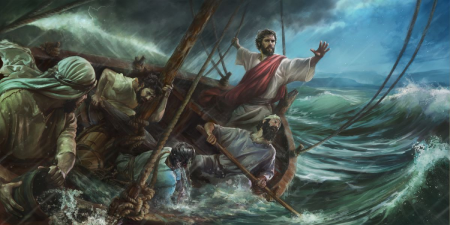
The Sea of Galilee ‘Crash’ Course, 101

A Crash Course in Trust

When Jesus woke up, he rebuked the wind and said to the waves, “Silence! Be still!” Suddenly the wind stopped, and there was a great calm. 40 Then he asked them, “Why are you afraid? Do you still have no faith?”

(Mark 4:39-40, NLT)

There He is, sleeping on a pillow, seemingly unaware of the danger that the disciples were facing. They’re suddenly in the middle of a cyclonic fury–a ‘bomb’ of wind and waves that is bursting into their tiny little boat. The twelve had never seen waves so high, or a storm rise up so fast.. At least four were seasoned fisherman, and they knew how to handle a boat. But this storm was way beyond anything they’ve ever faced before.

Maybe it was over crowded; the dimensions of the boat would’ve been around 25-30 feet long, and maybe 7-8 feet wide, more or less, and a single mast. The twelve crowded in, while the four fisherman handled the sail and the rudders. Jesus found His place in the stern. It had been a long full day, and everyone expected a restful crossing. The break would be welcomed.

Why do we doubt? Being unsure and uncertain is a very human quality, especially when everything has gone haywire. Things have turned out really rotten, and now the situation is starting to look even more grim. Our response varies–from mild concern to outright panic. We honestly never know what to expect or how to react. Small things look big. Big things look small.

To put it mildly, the disciples in the storm are scared out of their wits. They’re completely overwhelmed by the possibility of drowning. They are now fighting to stay alive. The waves are getting higher and higher, and the boat ‘groans’ like it wants to fall apart. They pitch up and down, twisting like some wacky ‘roller-coaster’ ride!

“As evening came, Jesus said to his disciples, “Let’s cross to the other side of the lake.” 

(Mark 4:35)

Never do they think that Jesus had declared that their destination was across the lake, and certainly not beneath it! But now where is Jesus? Twenty-eight eyes look to the very back of the boat. “Wake Him up, we’re all going to drown.” Funny how we are sometimes. Things are going nuts and we’re starting to come apart. Yet we wait to the last possible moment and seldom consider that Jesus has been in our “boat” all along.

Important idea: When Jesus stands up, and speaks to the wind and waves, He will use the same word as when He freed the demoniac, just a few verses later!

“Teach these new disciples to obey all the commands I have given you. And be sure of this: I am with you always, even to the end of the age.”

(Matthew 28:20)

I am with you always” is the promise given to each believer. Consider dear one, Jesus has chosen to stay with us and bring His supernatural touch directly into our storm. He will always make an appearance to all who are His. He is “responsible” for you. His intention is to bring you to the other side. His very honor is at stake! (Phil. 1:6). He fully believes He can grow your faith. (Heb. 11:6).

Life can fall apart on us very fast, I know first-hand. And it seems like it’s ‘doubly dangerous’ for those struggling with depression or disability. It’s like we have extra weights put on us, and when you’re barely “treading water,” that really isn’t good. Not only do we have these heavy burdens on us, but we must survive this horrendous storm. (The waves can get massive, and our boat is very small.)

“While I was with them, I protected them and kept them safe by that name you gave me. None has been lost.”

(John 17:12) 

The disciples called out to Jesus, and that is all they had to do. The rest belonged to their Lord. Obviously the disciples had zero ability to ‘halt’ their storm. But when they finally summoned Jesus, they became mere ‘spectators.’ All they did was watch as God move, and they simply sat still in amazement. (1 Samuel 12:16). He did all of the ‘work.’

What is going on in your life? Storms will always come, one way or another. These five should help:

  • He has promised to bring us to the other side, no debate here
  • He is in our boat, and superintends every storm we face
  • He understands our limitations, our weaknesses, our griefs, what saddens us
  • He has all authority and power, He does what He wants, whenever He wants
  • He teaches us to be faithful disciples, and it seems we understand our ‘voyage’ better

We maybe the broken, but perhaps that makes it easier to understand?

With Jesus in my boat,

Bryan

commentsbb@yahoo.com

Little Pieces of Obedience

abraham_isaac_1

“It was by faith that Abraham offered Isaac as a sacrifice when God was testing him. Abraham, who had received God’s promises, was ready to sacrifice his only son, Isaac, 18 even though God had told him, “Isaac is the son through whom your descendants will be counted.”19 Abraham reasoned that if Isaac died, God was able to bring him back to life again. And in a sense, Abraham did receive his son back from the dead.”

Hebrews 11:17-19, NLT

The faith of Abraham is understood by believers everywhere. This simple man followed God to a obscure mountain in Judea. He came fervently, and yet logically to the command of the Lord. Abraham’s confident assurance would carry him to Mt. Moriah were he would sacrifice his son. He would prefigure God’s own sacrifice of Jesus Christ, His only Son.

There were many steps Abraham had to take: the knife, the rope, the firewood, the donkey. There was a dozen details to arrange. Abraham would have had to plan ahead of time to prepare. I’m relatively certain he had ample time to consider what he was doing. The enormity of it all would’ve been staggering.

Hebrews reveals that ‘faith’ was what enabled Abraham. It was faith followed by a dozen little obediences that strengthened him to follow God’s instructions. Abraham would obey God, through faith, by doing many little things. All would lead up to the ‘big thing,’ the offering up of his only son.

I believe that no act is too small. Heavy doors swing on small hinges. Tiny obediences make for big ones. And sometimes we can’t tell them apart. It seems that several times during our daily grind we face little choices that often determine a far greater meaning. I’ve been told that there are flowers in alpine valleys that no man will ever see. Their sole beauty is visible only to God. Obedience is often like this. But the Lord knows.

God meets every act of obedience to Him with a smiling grace.

Hebrews 11 is known as the believer’s ‘hall of fame’. In its verses we’re pounded by the idea that the faith is visible only through obedience. What we do is as significant as what we believe. It has always been so.

“…but the people who know their God shall be strong, and carry out great exploits.”

Daniel 11:32, NKJV

Little obediences prepare us for big ones. If we won’t obey in the small ones, how will we in the big ones? The prophet Daniel spoke of a remnant that would do astonishing things, and that the core of their fame would come from knowing God. This is faith made visible. The ‘great exploits’ spring out of a faith in a strong God. To be regarded in this way would be wonderful, but faith needs those little obediences to be able to do the great ones. 

We must reclaim the reality that the details of our lives are not trivial.

bry-signat (1)


cropped-christiangraffiti1.jpg

When Rags Became Grace

ebedmelech

“Ebedmelech from Ethiopia was an official at the palace, and he heard what they had done to me. So he went to speak with King Zedekiah, who was holding court at Benjamin Gate. Ebedmelech said, “Your Majesty, Jeremiah is a prophet, and those men were wrong to throw him into a well. And when Jerusalem runs out of food, Jeremiah will starve to death down there.” 10 Zedekiah answered, “Take thirty of my soldiers and pull Jeremiah out before he dies.”

11 Ebedmelech and the soldiers went to the palace and got some rags from the room under the treasury. He used ropes to lower them into the well. 1Then he said, “Put these rags under your arms so the ropes won’t hurt you.” After I did, 13the men pulled me out. And from then on, I was kept in the courtyard of the palace guard.

Jeremiah 38:8-13, CEV

At the very last, there was just one remaining.  A single man, Ebedmelech.  He was a Ethiopian; made a eunuch by the will of the king.  The situation in Jerusalem has gotten very difficult.  In an action of revenge and reprisal, certain men intend to kill the prophet Jeremiah.  They take a certain satisfaction in this, and Jeremiah is thrown into a very deep cistern.  They intend for him to starve to death, which is a terrible way to die.

The king in these last pathetic days is being manipulated by the surviving leadership of the city.  Zedekiah gives tacit approval for the destruction of Jeremiah.  He just lets it happen without a good reason.  The prophet is lowered in the muddy cistern.  Without food, he will soon starve.  In the minds of this evil mob, they have taken care of the any last vestiges of a godly ‘righteousness.’

But there is one, he is a wild card.  And no man would have guessed it.  Ebedmelech, the Ethiopian eunuch steps forward and decides to change history.  Not only his ethnicity, but his state as a castrated man are definite issues.  This mob never recognized him as someone who would intervene.  He was a non-entity, a non-factor. He was black, and a eunuch, and a nobody.

But Ebedmelech is intervening, in the face of terrible risk, he steps out boldly to make an intercession.  He doesn’t appear to be intimidated, and makes a cry for the truth.  He becomes an intense and strong advocate for the release of Jeremiah from the deep mud.

Ebedmelech is given the ‘green-light’ by king Zedekiah. Ebedmelech rounds up thirty men to assist him as he delivers the prophet.  Ropes are brought out, and out comes Ebedmelech with a big armload of rags.  They shout down to Jeremiah.  The instructions are called down to him of what needs to take place for the extraction.

It’s interesting, but the rags are the most interesting. 

They are really an extra touch, not a necessity.  The rags become essentially, a form of grace.  They would pad the ropes, providing a degree of comfort as the prophet is pulled up out of the mud.  Ebedmelech showed the heart of God in what he did.  There was his desire to somehow make the prophet comfortable.  In doing so he communicated a kindness and concern that was saturated with God’s own enveloping presence.

Our illnesses– physical or mental, have moved us to a lonely place on the edge. 

We are those on the so-called ‘margins.’ Ebedmelech has now become a carrier of God’s grace.  Jeremiah could have been lifted up by just the ropes.  It would’ve been more difficult, granted.  But the rags sent down by Ebedmelech provided the prophet an extra gentleness.  And I am certain it did not pass by without notice.  Their mention in this Book of Jeremiah is significant, and shows Jeremiah’s deep appreciation of kindness.

We can gather up much from what has been written.  We will sometimes find ourselves in parallel situations.  But our kindness and concern can make the difference.  Admittedly, they are quite insignificant–quite minor. Call it ‘icing on the cake.’ But when you show the kindness of our Father, you will infuse the situation with love, and grace.  

So be an  Ebedmelech,—  an outcast perhaps– but in a position of kindness.


bry-signat (1)

cropped-christiangraffiti1.jpg