“As soon as he had finished speaking to Saul, the soul of Jonathan was knit to the soul of David, and Jonathan loved him as his own soul.”
1 Samuel 18:1
“But Ruth said, “Do not urge me to leave you or to return from following you. For where you go I will go, and where you lodge I will lodge. Your people shall be my people, and your God my God.”
Ruth 1:16
The quality of our lives can be measured by our friends. It takes some of us a very long time to understand this. Often we have this mistaken belief that other things are immensely important, and we strive to make these qualities relevant and significant. But the Spirit of God is on a whole different board, and He is wondering why we aren’t there with Him. It’s time to catch-up!
To be a friend– a companion, is a significant undertaking. It involves channeling ones love and commitment to someone other than family. If we have become someone’s friend, our dedication to that person can be measured. (Not everything is intangible). So what will friendship require? My answer is simply this: All that is needful for the present moment.
Something ‘clicked’ inside of Jonathan when he talked with David. There was something of understanding and an affinity that was created between them. As I read this account I realize that this friendship was what was exactly needed for David to survive the conflicts he was coming into. Now it certainly wasn’t the full answer, but friendship would certainly help lift him above the fray.
Ruth had this exceptional relationship with Naomi. Ruth was locked on and quite intensely has made a strong verbal and volitional commitment to Naomi. She is so sincere here as she makes a vow to follow and to serve. She ‘shuts down’ her agenda and goals in order to live life through Naomi’s experience. What a generous humility and gentleness!
“Don’t forget your friend or your parent’s friend.”
Proverbs 27:10
Both Jonathan and Ruth embraced their new calling. Friendship is a cavern chiseled out to be an amphitheater. It is a whole bigger and more expansive than we ever thought possible. Its borders and boundaries go far beyond than a Wednesday night poker game with your buddies.
Recovering this new understanding of biblical friendship can be revitalizing. When we see the fruits we wonder how we will ever transverse the path of discipleship without companionship. It is noteworthy to point out that Jesus sent out His disciples ‘two by two’. Sometimes, it will involve a radical (extreme) shift in thinking. However, there can be an incredible boost coming from this relationship.
“Walking with a friend in the dark is better than walking alone in the light.”
When clinical depression is “on-the-clock” it can be sheer agony. It resists and lingers, sometimes for days and days. (It can last for months if untreated.) But it seems that it is these “hours” that are scarcely endurable. It’s truly all this “wasted” time that can seem most unbearable to the afflicted.
“I was mute and silent, I refrained even from good, And my sorrow grew worse.”
–Psalm 39:2, NASB
Depressed people tend to suffer in silence and isolate themselves from the outside world. When you’re depressed, you feel less motivated to go out, make contact, socialize or participate in activities, or doing anything at all. It’s all you can do just to get out of bed.
Days, even weeks can go by without wanting to see anyone or talk to anyone. This aggravates feelings of isolation. Often depressed people do not want to talk about their problem or simply feel misunderstood.
Similarly, prolonged and intense feelings of depression can lead to loneliness. Treating the symptoms of depression may help resolve the problem but it isn’t a sure thing. Finding good relationships can push you out of a depression. Loneliness often fuels my depression. Find understanding friends that you can talk with.
Beating depression or loneliness does not start with having more friends, or a relationship, although it can help. It really starts from within and is a process that takes time and care. We can be tempted to scrap friendships because they’re a lot of work. But they maybe one of the keys to healing. Experience has taught me that humans go through life in patterns. (We ‘ll do the same thing over and over again.) Even in different situations, these patterns will be repeated and simply generate the same results. A friend can be a new and strategic solution to breaking free.
It is a good thing to know that Jesus Christ sees and understands.
But it’s also good to have someone with “skin on.” Someone you can see and touch. That’s precisely why we have the Church. People who believe and touch each other deeply, helping each other up. Depression does not do very well in the true Body of Christ.
“Brethren, even if anyone is caught in any trespass, you who are spiritual, restore such a one in a spirit of gentleness; each one looking to yourself, so that you too will not be tempted. Bear one another’s burdens, and thereby fulfill the law of Christ.”
Galatians 6:1-2
Dear broken believer, take solace in the people in the church. Learn to confide with those who understand. Sometimes I wonder if God has arranged my mental illness so that I will reach out to others. Perhaps He allows it to bless His Church?
“The church is not a select circle of the immaculate, but a home where the outcast may come in. It is not a palace with gate attendants and challenging sentinels along the entrance-ways holding off at arm’s-length the stranger, but rather a hospital where the broken-hearted may be healed, and where all the weary and troubled may find rest and take counsel together.”
Didn’t really sleep last night but an interesting day. Hope it continues to develop in that direction. I really need a good day to come along right now.
Been thinking about paranoia. It comes loaded up with delusions. They are separate words, but when they make that toxic combination it gets strange. Are people out to get me? Probably not. People are by far and away more apt to dismiss me then to plot against me.
Paranoia is the belief in a hidden order behind the visible.
Delusions are a strong belief in something despite superior evidence to the contrary.
I don’t know why this is such a hard concept to hold on. Paranoia is intensely self-absorbed and egocentric. Everything is conspiring to destroy me is a very foolish way to live. In a culture already overheated by egomania, to offend me becomes a declaration of war. My paranoia makes you a mortal enemy. But to act from that destroys me. I only take it deeper and make it easier to slide into the next time.
Paranoia is not rational. You can not reason with it. (You certainly have my permission.) For me, I win the battle over paranoia and delusions by “displacement”, pushing it out by adding in the presence of Jesus. The Holy Spirit fills us and flushes out the bad. At least that is what it feels like.
When I recognize Him to be the good shepherd, He watches over my thoughts like sheep. He protects me from paranoia’s snares and thorns. I experience peace when He is present. I find Jesus actively helps me in this.
There are times I hear the voices, and “see” the monstrous faces leering out of the wallpaper. But more often I concoct delusions about people who I feel have slighted me. Paranoia provides plenty of grist for me to grind. I’m learning how to recognize the lies, and the liar who speaks them to me.
“For God did not give us a spirit of timidity (of cowardice, of craven and cringing and fawning fear), but [He has given us a spirit] of power and of love and of calm and well-balanced mind and discipline and self-control.”
2 Timothy 1:7, AMP
Often I hear what seems like a telegraph, a varying ‘dot-dash-dot.’ It is very loud and obtrusive, but I know now it’s not real. I read a cool quote, that made me laugh, “I was walking home one night and a guy hammering on a roof called me a paranoid little weirdo. In morse code.” -Emo Phillips
How many families in your church have a loved one who struggles with mental health problems? That’s kind of a trick question. People don’t talk about mental health problems. You’re more likely to hear them describe their child’s condition as “something like autism,” as the elder of one church we know says.
Or they might cover up entirely, as does an elder’s wife in another congregation. When her bipolar disorder swung into mania after childbirth, her family, already managing the added responsibilities of a newborn, had to manage her condition as well. But because her condition is a secret, they did so without any support beyond the usual “new baby” dinners.
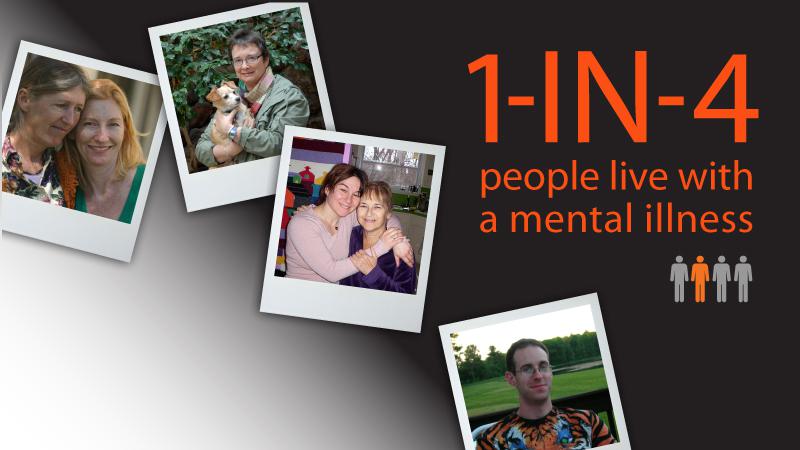
The answer to the question is, if your congregation is representative of the U.S. population, one in four households will struggle with someone’s mental health problems over their lifetime. That’s schizophrenia, bipolar disorder, obsessive compulsive disorder, disabling chronic depression, and various anxiety disorders. Look at the faces seated around you this Sunday. Someone is probably hurting. And they’re probably afraid to tell you.
The least acceptable disability
Out of Control
A study where people ranked disabilities by their “acceptability” returned these results, in order–most acceptable: obvious physical disabilities, blindness, deafness, a jail record, learning disabilities, and alcoholism.
Least acceptable: mental health problems. People with mental health problems frighten us because when people become mental ill, they become someone we don’t know. A bright boy who was his family’s bright hope may find he just can’t cut it anymore as schizophrenia turns him paranoid, disoriented, unmotivated in the extreme, and overwhelmed by delusional voices that tell him, over and over, how worthless he is.
Or, in the case of bipolar disorder, a girl who was a well-liked and active member of her Teen Challenge group may suddenly turn promiscuous, run away from home, and make a new home in the streets of a strange city. Laziness. Promiscuity. Violence. Sin. That’s what many people see when they look at those with mental health problems. It’s hard to believe that people may behave in such unacceptable ways and not be in control of their behavior.
Having a mental health problem is a lot like being on alcohol or drugs, without being able to stop. Medications “work” for about two-thirds of us. That means that a third of us can’t ever get off the chemical ride that our brains produce.
For those of us who can use medications, the side effects can be daunting. I have lost about 20 percent of my small motor functionality as a result of one of the five medications I take for bipolar disorder. I prefer that to losing large motor control and having another auto accident, being so disoriented I can’t find my way home from the store, losing bowel control in a busy bookstore, gaining 45 pounds, or any of dozens of side effects I’ve experienced on other medications.
Many people become so frustrated with side effects that they stop taking medications. Only about half of us accept treatment. Even when we are treated, not everyone regains their status as a fully functioning adult. In our extended family, six people have diagnoses. Those with bipolar disorder and chronic depression are successfully medicated and work full-time. Those with panic disorder and schizophrenia are on permanent disability. Nothing has pulled them through.
What the Bible says
The Bible talks about mental illness, as well as physical illness.
It describes a king who was made mentally ill until he would recognize the sovereignty of God (Dan. 4:29-34).
It describes demonized men who lived among the tombs and terrorized everyone until Jesus set them free (Matt. 8:28-33).
It also describes as demonized a young boy that most scholars today say had epilepsy (Matt. 17:15-18). Jesus delivered him, too.
What was once believed
What does this tell us about illness?
First, that God is able to heal. Second, that some physical and mental illnesses are caused by demons. Third, that some mental illnesses are caused by sin. But are all mental illnesses caused by demons or sin, and is seeking God our sole resource for physical and mental healing?
Since the 1950s, we have usually sent church members with epilepsy to doctors for effective treatment with anti-convulsant drugs. In a similar way, we’ve learned that medicines can effectively treat many cases of mental illness. So if all mental illnesses were caused by demons and sin, medicine would be exorcising demons and turning hearts to repentance. That is certainly untrue, for those are the works of the Holy Spirit.
Instead, we now know that most if not all mental illnesses are biological in origin, with environmental factors possibly triggering an existing genetic predisposition to the illness. Mental illnesses, just like epilepsy, are biological disorders of the brain.
What can the church do?
Compassionate service is one of our core charges as Christians. We observe it almost daily in the experience of one man we know with schizophrenia. His life is confined almost entirely to his home due to the fear, indecision, and lethargy that have become the shape of the illness in his body. But neighbors bring him occasional meals. The secretary of his small church talks to him by telephone every weekday. Several other members take weekly calls at designated times to help break his isolation. If he doesn’t feel up to driving to his Bible study meeting or Sunday services, some member will give him a ride. Nearby relatives help him plan and manage his finances, and come by to clean occasionally and for DVD “movie nights.” Phone cards given as gifts allow him to call his mother nightly. There’s much more that could be done—more frequent house cleaning and more meals and more visits—but he enjoys far more contact with many more loving people than many shut-ins.
The challenging good news is that when people with mental illness turn to someone outside “the system” for help, the church is first to get the call 40 percent of the time. Is your church ready?
…………………..
Carlene Hill Byron is the former Director of Communications for Vision New England. Through NAMI—the Nation’s Voice on Mental Illness, she and her husband, James, train churches to effectively serve people within the congregation with mental health problems and also teach NAMI’s class for families of people with mental health problems. They are members of Asbury United Methodist Church in Raleigh, North Carolina, where James serves on staff. First published by Vision New England’s Ministries with the Disabled, Acton, Massachusetts.




 Beating depression or loneliness does not start with having more friends, or a relationship, although it can help. It really starts from within and is a process that takes time and care. We can be tempted to scrap friendships because they’re a lot of work. But they maybe one of the keys to healing. Experience has taught me that humans go through life in patterns. (We ‘ll do the same thing over and over again.) Even in different situations, these patterns will be repeated and simply generate the same results. A friend can be a new and strategic solution to breaking free.




 Broken Believers