Preaching (and Listening) to Yourself

By Terry Powell,

Have you ever “preached to yourself?” I’m referring to the act of fighting negative and unbiblical thought patterns with the Word of God. It’s also called “biblical self-talk,” reminding yourself of truth that counteracts Satan’s lies. In Future Grace, John Piper illustrates how the Psalmist battled despondency by preaching to himself:

In Psalm 73:26 the psalmist says, “My flesh and my heart may fail.” Literally the verb is simply “My flesh and my heart fail!” I am despondent! I am discouraged! But then immediately he fires a broadside against his despondency: “But God is the strength of my heart and my portion forever.” The psalmist does not yield. He battles unbelief with counterattack.

The poem that follows is a type of sermon delivered to myself. The stanzas are painfully realistic about the hopelessness that accompanies my depression. Yet the poem ends on a more positive note, citing another verse from the Psalms in which the author talks back to despair and exalts God as the object of hope. What makes preaching to myself effective is reminding myself of God: Who He is, what He has done and what He had pledged Himself to do.

Hopeless?

Fleeting, it’s like a bird in flight,

Or like a shooting star at night,

Or lightning that spans the sky—

Gone in the blink of an eye.

Elusive, like the fog that lifts

When morning sun sends its gifts;

Or the zigzagging butterfly

That you can’t catch. No use to try.

That’s my relationship to hope:

It’s like a wet bar of soap

That keeps giving me the slip.

Can’t keep it within my grip.

Hope that a blinding beam of light

Will penetrate my soul’s dark night.

Hope that it won’t seem so strange

That habits of the heart can change.

Can God plant hope within a heart

For peace of mind and a fresh start?

Though right now I am without it,

God shouts “Yes!” Should I doubt it?

“Why are you in despair, O my soul? And why have you become disturbed within me? Hope in God, for I shall yet praise Him, The help of my countenance, and my God.”

Psalm 42:11

When inward or outward trials come, what are some Bible truths or text that you “preach to yourself”?

ybic,

Terry


Terry teaches in the areas of Church Ministry and Ministry Leadership at Columbia International University in South Carolina. He has served as a Christian Education staff member for three  churches, and he’s a licensed preacher in the Presbyterian Church of America.  His current books in print are Serve Strong:  Biblical Encouragement to Sustain God’s Servants, and  Now That’s Good A Question!  How To Lead Quality Bible Discussions. Terry has been married for 46 years, and has two sons, a daughter-in-law, one grandson, and a dachshund.  His constant prayer is, “Lord, make me half the man my dog thinks I am!”

Check out his blog at https://penetratingthedarkness.com/. His ministry is focused on Christians experiencing clinical  depression and other mental issues.


Redeeming Pain

When history speaks, do we listen?

by Terry Powell

It’s one thing to say that God’s sovereignty redeems our pain or weakness for a greater purpose. It’s another thing altogether to see a vivid illustration of the truth.

David Brainerd (1718-1747) took the gospel of Christ to Indians in Massachusetts, Pennsylvania, and New Jersey, often living alone with sparse food rations and exposure to cold. Extremely melancholy in temperament, Brainerd endured long episodes of joylessness, often slinking into despair over awareness of his sin, or over an incapacity to feel more love for the people he was trying to reach. Physical frailty accompanied his psychological anguish. He died of tuberculosis before his thirtieth birthday.

A couple years after launching missionary work among the Indians, in 1845, God’s Spirit brought a spiritual awakening in New Jersey. Within a year, the church Brainerd started numbered 130.

Brainerd kept diaries in which he described bouts of despondency, disclosed his consciousness of sin in light of God’s holiness, and recounted efforts to evangelize the Indians. Their pages teem with honest self-disclosure as well as desperate dependence on God for physical and emotional sustenance.

Twenty-two places in his diaries he yearned for death as an escape from his misery. Yet he persisted in proclaiming Christ, even when his own temperamental makeup eclipsed his ability to experience the joy inherent in the gospel. One entry revealed his acceptance of weakness and deeply-entrenched desire to finish well: “Oh, for more of God in my soul! Oh, this pleasing pain! It makes my soul press after God… Oh, that I might never loiter on my heavenly journey.”

After his death, the fruit of Brainerd’s life multiplied exponentially. In 1749, Jonathan Edwards, in whose home Brainerd died, took the diaries and published them as a Life of Brainerd, a book that’s never been out of print. Renown missionaries and leaders galvanized by Brainerd’s story include John Wesley, Henry Martyn, William Carey, Robert McCheyne, David Livingstone, Andrew Murray, and Jim Elliot.

The borders of Brainerd’s impact weren’t expanded in spite of his emotional and physical afflictions, but because of them.

His story resonates with so many servants over the years because when push comes to shove, they, too, wrestle with sinful propensities, episodes of despondency, and physical frailties. They believe they are candidates for the same divine grace they observe in Brainerd’s life. John Piper, himself buoyed by Brainerd’s story, offers this apt summary statement: “Brainerd’s life is a vivid, powerful testimony to the truth that God can and does use weak, sick, discouraged, beat-down, lonely, struggling saints who cry to him day and night to accomplish amazing things for his glory.”

How can God use you despite physical or emotional frailty?

For biblical indicators that God uses weak, needy people, read these texts: 1 Corinthians 1:26-29; 2 Corinthians 4:7; 12:9-10. Resources quoted are The Life of David Brainerd, by Jonathan Edwards, and The Hidden Smile of God: The Fruit of Affliction on the Lives of John Bunyan, William Cowper, and David Brainerd, by John Piper.


Terry teaches in the areas of Church Ministry and Ministry Leadership at Columbia International University in South Carolina. He has served as a Christian Education staff member for three  churches, and he’s a licensed preacher in the Presbyterian Church of America.  His current books in print are Serve Strong:  Biblical Encouragement to Sustain God’s Servants, and  Now That’s Good A Question!  How To Lead Quality Bible Discussions. Terry has been married for 46 years, and has two sons, a daughter-in-law, one grandson, and a dachshund.  His constant prayer is, “Lord, make me half the man my dog thinks I am!”

Terry has a new blog at http://www.penetratingthedarkness.com. It deals with the believer’s depression and other mental issues. Please visit him and tell him “Hi” from me.

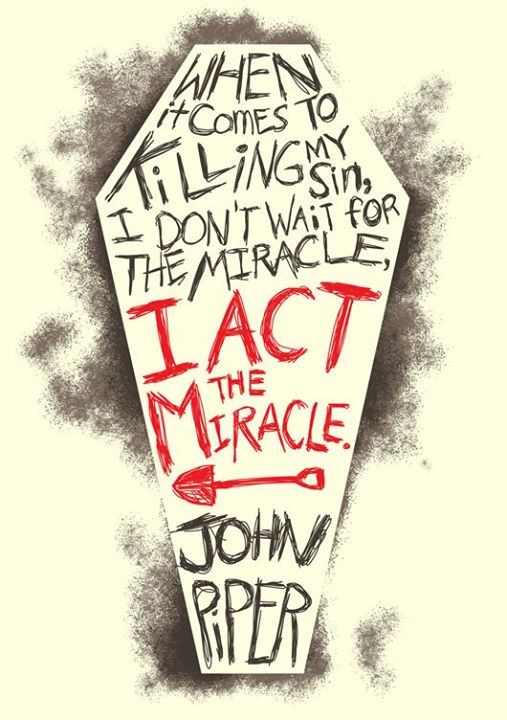
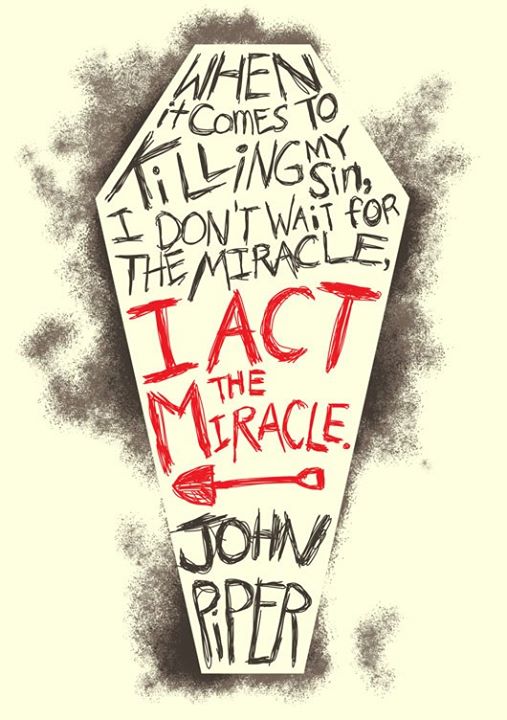
Killing My Sin, Before It Kills Me

killing-sin-act

We are for the most part anyway, eager to please God. We are Jesus’ people with the occasional brush with sin. But hey, who doesn’t? But that attitude must be questioned.

“My little children, these things I write to you, so that you may not sin.”

1 John 2:1

John hopes that his readers would make a choice— not to commit sin. After all, what soldier goes into battle with the intent of getting just a little wounded? Often we will sin just because it seems so inevitable, and we feel we can’t help ourselves. (But the reality is that we can.)

But the Holy Spirit now lives inside. Cooperation with Him is needed. Often we will work ourselves into a ‘no win scenario’ where we believe that sin rules. We can’t beat it, so we stop trying. That is common, and sad.

‘Passivity’ is defined as not participating readily or actively; inactive. When we are passive spiritually, we disengage ourselves from any effort of living holy and pure lives. Not being ‘hot’, but content to be lukewarm. At this point sin becomes, reluctantly, tolerated. “After all, I’m a sinner, what else can I do?”

Mentally ill people are often passive. We are told that we have an uncontrolled illness which dictates that we act ‘irresponsible.’ Our depression often escalates and we feel victimized by it. My experience has taught me that there are three kinds of depression:

  • organic depression, or the ‘biochemistry’ of the disease,
  • guilty depression, the kind that feels bad because of what we’ve done (or didn’t do),
  • reactionary depression, the type we feel when experiencing a loss, a loved one, or a job

Depression will almost always fall in these three categories. And passivity plays a part in all three. We  frequently feel victimized and ‘acted upon.’ When it comes to our discipleship we don’t act, we react. We are utterly convinced of the Bible— God’s truth, but we are so sporadic we can’t seem to get it to work for any length of time.

Yes, we are believers. And yes, we have issues. We’re waiting for a miracle, and hope we get a breakthrough soon.

At the base point of our lives, quite often, there is a passive attitude. Passivity aggravates our depression or mental illness. It deepens, spreading through our lives like a contagious illness. Our discipleship sputters and stalls. We no longer act on God’s Word, but we find ourselves fabricating a faith that makes allowances for our situation.

But we must ‘act the miracle.’ Everything God gives… everything… must be received by a convinced faith. We must be persuaded to give up our flawed ideas, and believe God for the real thing. I opened up this with 1 John 2:1. But there’s much more to this verse:

“My little children, these things I write to you, so that you may not sin.  And if anyone sins, we have an Advocate with the Father, Jesus Christ the righteous.”

I don’t want you to sin. Avoid sin. But even if you do— we have someone who will plead our case before God. He stands and argues our plight. He loves us that much.


bry-signat (2)

cropped-christiangraffiti1.jpg


Book Review: “When the Darkness Will Not Lift”

There are Christians for whom joy seems unattainable.

What will we tell them . . . “When the Darkness Will Not Lift?”

…………………………………………………………

“It is utterly crucial that in our darkness we affirm the wise, strong hand of God to hold us, even when we have no strength to hold him.”

–John Piper

The title of this reviewed book is terribly unyielding, but with a quick glimpse into its contents, and you realize what you hold in your hands is worth its weight in gold.  When the Darkness Will Not Lift: Doing What We Can While We Wait for God—And Joy,  John Piper gives guidance and hope to suffering believers and to those whom God has given to walk beside them.  The father of Christian hedonism reminds readers that joy is a duty even as he teaches them how to fight for it. At eighty pages, this slim volume commends itself to readers who, struggling under the weight of spiritual darkness, might be daunted by an exhaustive treatment of the subject.

Because the book starts from despair, it is a uniquely accessible tool for those who hurt. In the pastoral tone for which he is beloved, Piper shows that joy begins with despair in oneself. In “When the Darkness Will Not Lift”, Piper tackles difficult issues including:

• The physical nature of depression and the role of medication

• How to wait on the Lord through darkness

• The relationship between obedience and thanksgiving

• How unconfessed sin can clog our joy

Piper also provides insight for those who love depressed Christians—showing them how to exhort without crushing, and how they can help the struggling believer to distrust the “certainties of despair.”

PiperbookWhen the Darkness Will Not Lift: Doing What We Can While We Wait for God—And Joy Publisher Crossway Books, Author John Piper, ISBN 1581348762 Price $7.99, Released, January 2007

Available through your Bookstore, or just go to www.Amazon.com, like me.

John Piper’s website, http://www.desiringgod.org/

flourish15