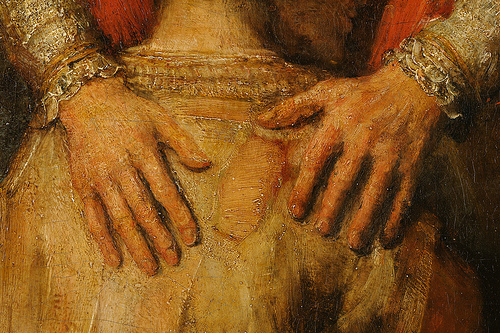
Deformed Hands

The Man with a Deformed Hand, Mark 3:1-5

Jesus went into the synagogue again and noticed a man with a deformed hand. 2 Since it was the Sabbath, Jesus’ enemies watched him closely. If he healed the man’s hand, they planned to accuse him of working on the Sabbath.
3 Jesus said to the man with the deformed hand, “Come and stand in front of everyone.” 4 Then he turned to his critics and asked, “Does the law permit good deeds on the Sabbath, or is it a day for doing evil? Is this a day to save life or to destroy it?” But they wouldn’t answer him.
5 He looked around at them angrily and was deeply saddened by their hard hearts. Then he said to the man, “Hold out your hand.”So the man held out his hand, and it was restored!
Mark 3:1-5

It was the Sabbath. I was led to the synagogue by a Pharisee who promised me money. I had no idea what was going to happen. This is my story,

I was born with a deformity in my hand. It was misshapened and more like a club than a hand. I had perfect use of the other and I learned to adapt. It seemed perfectly natural to me now. I suppose I just got used to it, but it would be nice to have a normal hand. The children in the streets would always made fun of me. I suppose I became the neighborhood outcast.

Life was never normal for me. I lived on handouts and spent my days sitting on the sidewalk out of the hot Judean sun. I suppose that there must been sin in my life for God to judge me so, that is what they told me anyway.

When the Pharisee approached me with the promise of money I jumped at the chance. “All you have to do is stand there and show off your hand.” That was easy enough. I could do that. Little did I know that I was just a pawn in the Pharisee’s plan to trap Jesus.

I entered the synagogue which was a new experience for me. I had never been inside but the Pharisee who was leading me said it was OK, that I was expected. I stood in the back trying not to be noticed. I held out my deformed just like they asked me to.

At one point Jesus noticed me. “Come up here,” he said, “Come up front.” I had no idea of what was going to happen, no way of anticipating what Jesus was going to do. Jesus challenged the Pharisees. “Is it part of the Law to do good on the Sabbath day. Should we not do what is right?” I was scared, I had no idea what I was mixed up in. The room was very quiet.

Jesus was angry and I was afraid. He looked around to see if anyone would answer him. No one did although the answer seemed plain enough, even for me. Yet I still had no idea what was going to happen next.

Jesus looked at me. I sensed his love and his peace in his gaze. “Hold out your hand,” he asked me. There were no theatrics. No hoopla, just a simple command. So I did exactly that, and in an instant I was completely healed.

What more could I say. My deformity was turned into a healthy hand. Bones and tendons and muscle instantly reorganized themselves and something normal appeared where their was once twistedness. I flexed new fingers and wondered exactly what had happened to me.

It took me years to realize that there was a deeper deformity in the Pharisees understanding that Jesus wanted to heal. It was an issue of grace and goodness over error and legalism. Yes, I was healed on the Sabbath, but that was what was supposed to happen. People were meant to be made whole on God’s special day of rest.

It is a tremendous thing to have two healthy and whole hands. I marvel at the goodness of God every time I think about it. The Lord has been gracious to me and I rejoice at that grace. He has made me a wonder.

Lord, at times I feel deformed. But please don’t forget me. I will always stumble if you’re not holding my hand, Remind that being religious is a poor substitute for your nearness. Amen.


He Gives Us More Grace

Titus 3:6, context 3:4-7

The Father is constantly drawing us to the place of blessing. All He wants is a humble heart that receives His grace daily. Your need is God’s focus, and He wants desperately to fill you with Himself. He calls us constantly to receive something new.

“You have poured over me fresh oil.”

Psalm 92:10

It’s interesting, the Jews had no word that corresponds to fresh. Their word (used here) was “green” and it was a way of describing a flourishing vine or fig tree. The sap that runs through the vine brings life to the fruit.

Yesterday’s oil is old. At best, I suppose it encourages us that the grace-filled Father will again bless us again. And honestly, tomorrow’s oil is in the future, and it’s hoped for. It’s the present day oil that must be sought.

Having grace for today is really what matters.

Check these verses out–

Joel 2:28

Psalm 23:5

Clearly God is not stingy when it comes to His grace.

He pours it out lavishly. He fills our cups generously, and I strongly suspect He wants to give more than we possibly can contain. He’s your Friend–your Savior–the One who sustains your life, and He loves you!

“Good measure, pressed down, shaken together, running over, will be put into your lap.”

Luke 6:38

Your spiritual food will come each morning as you look to Him. It should become a daily meeting; your spirit needs Him and His words. Yesterday’s time may have been good, but living in obedience demands a constant awareness of Him.

Charles Spurgeon

Are you broken? Flawed and stumbling?

Do you think that you are a poor example of a believer? I tell you, His love is not contingent on your outward behavior. You need Him. You need Him to be a fruitful believer.

God’s love is a Greek word, it is an “agape” love. Narrowly defined as an “unconditional love,” not related to what you deserve, earn, or warrant. It is a love given without an expectation of a corresponding love in return. This is His love, and it travels with grace.

The grace of God means He is holding you close, in a way seems to become overprotective of you.  Anyone who touches you, touches “the apple of His eye.” Let none question, you are His own.

Put yourself under His grace. Tune your heart to His. He is waiting for you.

Psalm 30:5


Are You Sick and Tired Yet?

Matthew 11:28-30, ESV

Weariness and burdens are our common plight. We all have them. They are shared as sort of common identity, like eye color or hair color. We all have them, and wish we didn’t. Sometimes we feel like shutting down, it seems too much to endure.

Weariness, that bone-tiredness that sleep doesn’t seem to help.

We seem to be chronically fatigued by life and what it brings us. We have heavy burdens, we carry a load that only gets heavier (and never lighter.) I suppose we adapt, and simply learn to carry it. But that wears thin, and weariness always breaks through.

Money problems, bills that are past due, marriages, straying children, cars that need fixing, family problems, job hassles, health problems… the list goes on ad nauseam. There are far too many issues, too many problems. Perhaps boredom and tedium are added to the list. They only intensify the hopelessness. (Its own special kind of suffering.)

Some will choose to ‘self medicate’ with alcohol or drugs.

They want something more, and find they only create more burdens (not less). Some will become hopelessly addicted, never finding relief from their burdens, but only increasing them. Suicide very often is seen as the only way out. It seems that it’s an option.

But Jesus will never condemn (leave that to the Pharisees) but instead offers a sort of amnesty to the burnt-out and the burdened. Come to me, all of you who are weary and carry heavy burdens, and I will give you rest.” Jesus did not say, “Get away from me, I am holy and you are not.” Rather, He makes himself to be the solution to all those whose life has overwhelmed.

He desperately wants our burdens and absorbs all our weariness. He wants us. He wants to give us peace and rest. Often Jesus offers but we’ll refuse.

An easy trade, especially since we are so desperate. Some have evaluated Jesus’ offer and made the transaction–piling up our burdens at His feet. We might be a little hesitant about the “my yoke” part, but will quickly find that discipleship can’t be compared to the weight we once carried for so long.

Biblical discipleship is relatively easy. It only asks that we surrender–For my yoke is easy to bear, and the burden I give you is light.” Following Jesus becomes the best way to live. We seem to understand, but unless we commit we will just carry our weight. (But it only gets heavier.)

Here’s a few verses from Isaiah that might help you sort this out:

29 He gives power to the weak
    and strength to the powerless.
30 Even youths will become weak and tired,
    and young men will fall in exhaustion.
31 But those who trust in the Lord will find new strength.
    They will soar high on wings like eagles.
They will run and not grow weary.
    They will walk and not faint.

Isaiah 40:29-31

But you need to deliberately choose. You must decide for yourself–what will you commit to? Will you continue to carry your burden, or will you turn to Jesus?

Depression: A Few Questions

Here are things I’ve heard over the years that we must take a second look at. Here are some possible answers.

“There must be something wrong with your spiritual life.”

Yes, depression CAN be a result of sin. BUT depression is NOT always a result of sin! If it is, God will tell you loud and clear what the problem is. This saying piles on the guilt for the depressed Christian. It’s unlikely that their depression has a spiritual cause, and this implies that they are not good enough spiritually.  

“Repent and ask forgiveness for your sin!”

Depression is a result of sin, in that if there was no sin in the world depression wouldn’t exist. But then, neither would diabetes, cancer, or any other illness… Sin caused the world to be not-perfect, therefore illness exists. It’s a sin to be depressed, any more than it is to have any other illness. Depression can be used by God to encourage repentance, but in that case, it will be crystal clear exactly what sin you should repent of. If you don’t know or have just a vague sense of guilt, your depression is not the result of sin. 

You need to have more faith.” or  “Have faith in God.”

Hebrews 11:1, “Now faith is the substance of things hoped for, the evidence of things not seen.” How much faith does it take to hold onto the Christian faith when emotions scream at you daily to give up, get out and turn against God? Very often a depressed Christian will be hanging onto faith by their fingernails in something that requires a ton of faith.  

“Taking antidepressants is playing God, He can heal you.”

Yes, God can heal. Sometimes he doesn’t just flick a switch to make the illness vanish, sometimes the healing comes through the conventional ways of doctors, psychiatrists, counselors, therapists, and medication. By persuading someone not to take their medicines in preference for a quick, supernatural healing that God may not have in store for them, the sufferer is being denied something that will help them, right now. 

“Scripture says everything that happens is for your own good!”

The actual verse found in Romans 8:28, “And we know that in all things God works for the good of those who love him, who have been called according to his purpose.” This verse in no way implies that the sufferer should sit back and accept the illness for the rest of their life. It also does not say that illnesses are not to be fought with the intention of a cure. While God may well have things to do with a depressed person, the illness is not a good thing itself, and it may take years before you see positive results from it.  

“You’ve been prayed for, why has nothing changed?”

This can be expressed in several ways and spoken by one of two different groups of people: either the person who asked for prayer or those who prayed for them. We’ll break the underlying situation into two areas: something definite was experienced in the prayer time: chains were obviously broken and new freedom gained, or, nothing apparently happened at all. That is, “I know God set you free,” why aren’t you free yet?

“Depression is a self-discipline problem.”

Self-discipline is important to a Christian. We have to be disciplined enough not to break the laws of the land, and to obey our God. But no amount of discipline will get rid of a medical problem. This statement implies that the sufferer is lazy and could become better by sheer force of will. This is not possible and causes a lot of guilt.

“You’re depressed because you choose to be.” 

Why would anyone choose depression? It is hell on earth. It destroys everything it touches. Families, marriages, jobs, churches, and ministries- faith, peace, hope, and love. Depression corrodes all that it touches.

Does a diabetic or cancer patient choose their disease? Does the blind or the deaf person wake up in the morning and decide they aren’t going to keep being handicapped? These are the questions I would ask.

This image has an empty alt attribute; its file name is image-12.png

“You just need to rebuke that spirit of depression and tell it to leave you. Don’t let Satan steal your joy.”

There are two problems with this statement. One problem is the assumption that depression is caused by demonic oppression. The other problem is the assumption that joy and happiness are the same things. Blaming a “spirit of depression” can be a wonderful cop-out. Just cast out the spirit and you’re cured! No need for long-term support, prayer, counseling, or anything at all! And with this statement comes the implicit assumption that once again it’s your fault you’re depressed, this time because you’re not “spiritual” enough to get rid of the troublesome spirit yourself.

Yes, it is possible that demonic oppression can cause depression. No, demons are not responsible for every case of depression. Imagine what would happen if this statement was directed at someone with cancer, hemophilia, or osteoporosis (“Just cast out that demon attacking your bones and be strong again! God wants to see you running marathons!”).

The second problem with this statement is that joy is equated with happiness. People with depression are not going to be the happiest souls in the church. I’ve heard it said that happiness depends on what happens, whereas joy can exist in very unhappy situations.

“There’s no such thing as mental illness, it’s all in your mind”

Saying this denies that there is anything actually wrong with the depressed person, and implies that they are just making it up. This piles on the guilt again! A mental illness can be defined as one that affects the mind; the brain is allowed to get ill, just as the liver and lungs are.

“It’s your own fault you’re depressed”

This is the kind of thing that Job’s “comforters” said, and it didn’t help then either. Bad things can happen to good people. Denying this hurts the sufferer.

“Pull yourself together”

If you’ve been trying, someone saying this to you comes across as “You haven’t been trying hard enough, do more, and more, and more until you get it right.” So back you go, pushing more and more, and still getting nowhere because you cannot pull yourself out of depression by your bootstraps, and you can’t fix a medical problem by force of will.

bry-signat-1