Devotions, [Eugene Peterson, Interview]

eugene-petersonInterview with Eugene Peterson

Why Can’t I Hear God? By Nancy Lovell

The musical group U2’s Bono quotes Eugene Peterson from the stage. Readers of the best selling Bible, ‘The Message,’ find themselves holding onto lines from his ‘fog-slicing’ Bible paraphrase, and many other works. For several years now, TheHighCalling.org has provided a daily prayer and reflection by Eugene Peterson. Recently, we asked the man himself: What are devotions and why do they matter in our daily work?

Why do so few people who believe in God bother to know Him?

The most obvious answer is that we’re in a hurry and not used to listening. We’re trained to use our minds to get information and complete assignments; but the God revealed to us in Jesus and our Scriptures is infinitely personal and relational. Unless we take the time to be quiet, in a listening way, in the presence of God, we never get to know him.

The same question is why so few married couples really know their spouses. People get divorced after 20 years of marriage, and the rejected spouse says, “I never knew this was coming. I thought everything was fine.” But there was not much listening in those 20 years. Devotions are the discipline of being quiet and listening for what we don’t hear in the streets, in the media, in the workplace.

What about people who sincerely set apart time, read the Bible, stay still, and hear nothing? They ask themselves whether God’s voice is anything more than their own thoughts.

We’re not good at this. We’ve had no practice doing it. No wonder we only hear our own thoughts. This is why the church is so insistent that we do this whether anything happens or not. Supported by 2000 years of history, we know that God does commune with us in our listening. But because we’re so unused to this way of communion, we don’t hear it. So it takes time.

How would you direct someone trying to start?

I would say: Get your Bible and find a place. If you can’t do this daily (some people can’t because of their life circumstances; mothers with young children are obvious instances), try for at least 20-30 minutes, two or three times a week, or four. Don’t make demands on yourself too high. Don’t ask questions about, “How long is this going to take?” Believe that something does happen in that silence—usually through Scripture, but not always—in prayerful, attentive listening, knowing that you’re in the presence of God.

I ask for a commitment of six months; so don’t come back in three weeks and say nothing’s happened. I’ve never had anyone who’s done this at least six months who came back to me and said, “I did it and nothing happened; I’m going on to something else.” Not many who give this a fair test ever say that nothing happens. Also, when I’ve asked people to do this as their pastor, I also ask them to worship regularly. This is a place where the whole community is gathered and listening and being in the presence of God.

Is that how you started?

I was lucky. In the family I grew up in, I started when I was about 14 …mostly with the Psalms, but all the Scriptures become part of it.

In your writing and speaking, you must have seen moments when a person realizes, “Yes, I want more and I want God.” What turns on the light for people?

Often the motivation is that people are tired of the way they’re living. They think there’s got to be more than just the motions they’re going through and the work they’re doing. There’s a craving and hunger that they identify with God. There’s enough pain or boredom or something to motivate them to do something that the culture’s not telling them to do. I got a letter recently from a friend of 40 years. She had been a parishioner of mine for a long time. Then she was ill, and divorced; and she quit, just gave up. She quit reading the Bible, quit going to church. Six months ago she wrote me a lovely letter that she was sitting with a group of friends and, in her words, “a rooster crowed”—it all came back and she was a Christian again and aware of the presence of God. Isn’t that a wonderful phrase? ‘A rooster crowed.’

Who knows what went into that statement of hers? Twenty years of unhappiness, pain, suffering, disillusionment …but still there was the need.She would have said during that time she didn’t believe in God. But the rooster crowed. That’s why we use the term the Holy Spirit to explain times like this. Given that it’s hard to discipline ourselves to silence, listening—and to daily time in quiet—tell us about your devotions on this website. I wrote those in the early morning for 20 years, maybe 25 years. And what I was trying to do was be present to the Scripture, listen to God, and to write as honestly as I could. I wasn’t thinking about anybody else but me.

It’s really hard to be honest as a writer. You get these wonderful ideas, and you love to manipulate words and see if you can make it sound good. It’s hard to be honest, especially working for God. That was the thing I was most aware of. “Eugene: Don’t say anything that is not relational, immediate, honest; stay present to the text and be honest before God.” I believed if I could be honest, I could draw some other people to honesty, too.

To read the rest of this interview, you will need to follow this link: http://www.christianitytoday.com/workplace/articles/interviews/eugenepeterson.html

 

cropped-christiangraffiti1-3

Of Adjectives and Disorders [Mental Illness]

4e327a2ad597c5b4d01de2a30649b04d

“Therefore each of you must put off falsehood and speak truthfully to your neighbor, for we are all members of one body.”

Ephesians 4:25, NIV

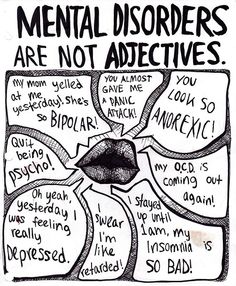
I catch myself using this strange new vocabulary quite a bit. There is a tendency to make adjectives where there should be nouns. There is an ‘in exactness’ in our thinking and speech.

Now we’re not the ‘policemen’ of other people’s grammar. We just should be aware of becoming too casual with mental disorders that can be quite debilitating to quite a few people. Do I ‘joke about’ having OCD when I try to do something precisely? (Sometimes.) Can I make light of being rather ‘retarded’ by some bone-head action I do? (More often than I’d like.)

I find I use terminology like this to explain ‘actions’ to give them a legitimacy as well as a medical reason to a situation. But when I do so, I can demean other people who actually are going through them for real. I also can label myself when I use these adjectives this way.

We really must be careful. We can use our language in such way that reveals our ignorance of the medical and psychological status of disorders. When we use words casually we start to ‘dilute’ them. They can describe a ‘reality’ of things that don’t really exist; we then end up speaking falsely and minimize the severity of a disorder.

“The true test of a man’s spirituality is not his ability to speak, as we are apt to think, but rather his ability to bridle his tongue.”

R. Kent Hughes

As a Christian believer, I also suffer from Bipolar disorder with delusions and anxiety. And yet, the Word tells me to always “speak the truth in love.” (Eph. 4:15). Listen to yourself, and let the Holy Spirit guard your words.

“Set a guard over my mouth, Lord;
    keep watch over the door of my lips.”

Psalm 141:3

bry-signat (1)

cropped-christiangraffiti1.jpg

Becoming Manic: What You Can Do

http://joemacgown.deviantart.com/

Top tips for coping

These are a list of things that people who have difficulties when they become high or manic have found helpful:

  • Try to get some sleep. Going without sleep has been shown to cause manic states and make them last longer.
  • Eat well. Don’t go without food or eat high energy food. Eat slowly.
  • Use relaxation techniques.  Quiet prayer works well right now.
  • Stay in bed even though you feel compelled to do lots of things.
  • Don’t act on your ideas. In a few days time you may see things completely differently.  Emailing friends now is dangerous. (I know).
  • Don’t buy anything expensive. Some people have found it helpful to give their credit cards/check book to friends.  (I tried to buy a 7 foot potted tree in London, UK once, because it was lonely.)
  • Use medication, herbal remedies, or other things that slow you down and/or help you sleep.  Think “speed bumps”.
  • Take relaxing (rather than high energy) exercise e.g. walking, swimming.  This is a must-do.
  • Make a plan for each day and keep to it. Don’t plan to do too much.
  • Try to do things slowly rather than quickly. Talk and walk consciously slower than you feel driven to.
  • Challenge any grandiose ideas you might have about yourself.  You must do this!
  • Reduce any pressures or stresses on you.
  • Cut out stimulants e.g. coffee, sugar, chocolate, fizzy drinks, alcohol. Some anti-depressants (e.g. the SSRIs like Prozac) can have stimulant-like effects – discuss this with your doctor and consider stopping them.

It may be helpful for you to make a plan about what to do before you get really elevated. You know yourself best, so build as many things into the plan that you feel will help you not do things you may later regret. It may be helpful to draw up a plan, and a list of ‘warning signs’, with a trusted friend or mental health professional at a time when you are not ‘high’, but that can be put into place as you or others notice your warning signs.

Some people believe that ‘getting manic’ is a response to not thinking about or facing things that might be quite frightening or depressing. It might be helpful to ‘get connected’ to such things, by talking and thinking about your life and some of the root causes of some unhappiness in your life. You could do this with a trusted friend or mental health professional.


cropped-christiangraffiti1 (3)

Epileptic Christians Rule

Epilepsy understood
Epilepsy understood

“My health may fail, and my spirit may grow weak,
    but God remains the strength of my heart;
    he is mine forever.”

Psalm 73:26, NLT

I think it’s time for me to talk openly about this.

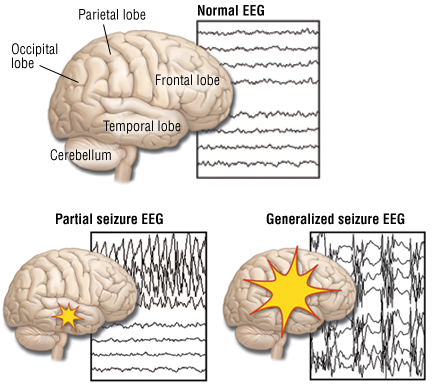
For several months I have been experiencing absent seizures. These are moments when I just ‘check out’ and stare at something–actually at anything, but bright and flashy will almost always draws me in. These are not the ‘grand mal seizures’ with the jerking and shaking and rolling around (but I’ve been told that these can happen to me.) I have the ‘petit mal’ variety. Many times they go undetected and unnoticed by others. They seem like a long pause of thoughtfulness. But it isn’t. I’m having a seizure.

It seems just what I needed, “another kick-in-the-head.” The thought has been brewing lately that I’ve been mistreated by God again. Why? (Why do I always get the hammer? I wonder if heaven has a Complaint Department?)

My medical history would rival the classic, “Moby Dick” in terms of sheer mass and requiring “heavy lifting.” Hepatitis C, Manic depression, Brain tumor surgery and all the after effects–and now this. Perhaps, I need to spend some quality time with my Father?  I like this verse a lot.

“O Lord, if you heal me, I will be truly healed;
    if you save me, I will be truly saved.
    My praises are for you alone!”

Jeremiah 17:14, NLT

I have worked hard to eradicate self-pity over the years (or I think I have). I’ve had so many medical issues and I don’t ever want to add “hypochondriac” to this list.  I heard this joke about a young boy who was so caught up with his illness that he started to take his M&Ms one by one with a glass of water, like a pill.

The jolt is becoming real now. They want to take my driver’s license away. (What next–will I be mandated to hear a protective helmet?) All of this is so wrong, it seems to me. (“Can I get an ‘amen’ here?”) The last few days I’ve taken a new med, a proven anti-convulsive. I have never ever wanted a drug to work more then this one. Unfortunately, I am experiencing some side effects. I covet your prayers now, more than ever, especially for my wife, Lynn and my kids.

flourish1

“I will trust Him. Whatever, wherever I am, I can never be thrown away. If I am in sickness, my sickness may serve Him; in perplexity, my perplexity may serve Him; if I am in sorrow, my sorrow may serve Him. My sickness, or perplexity, or sorrow may be necessary causes of some great end, which is quite beyond us. He does nothing in vain.”

    John Henry Newman

Some links I have discovered to be interesting, and maybe even helpful.

http://epilepsyfoundation.ning.com/group/christianswithepilepsy

http://www.squidoo.com/ahealthyresponsetoseizuresversusdemons

http://morethanstone.blogsome.com/2007/02/27/epilepsy-and-spiritual-warfare/

&

ybic, Bryan


cropped-christiangraffiti1 (3)

(L