Yield to God

 I read a story about a radio exchange that took place some time ago between a U.S. Navy ship and Canadian authorities off the coast of Newfoundland. The Canadians warned the Americans and the conversation went something like this: “Please divert your course 15 degrees to the south to avoid a collision.”

The Americans responded, “Recommend you divert your course 15 degrees to the north to avoid a collision.”

The Canadians said, “Negative. You will have to divert your course 15 degrees to the south to avoid a collision.”

The Americans: “This is the captain of a U.S. Navy Ship. I say again, divert your course.”

“No. I say again, you divert your course.”

“This is the aircraft carrier USS Lincoln, the second largest ship in the United States Atlantic fleet. We are accompanied by three destroyers, three cruisers, and numerous support vessels. I demand that you change your course 15 degrees north. I say again, that is 15 degrees north or countermeasures will be undertaken to assure the safety of our ship.”

After brief moment of silence, the Canadians responded: “This is a lighthouse. It is your call.”

Sometimes we don’t like what God wants us to do, and we want Him to change course when, in reality, it is us who ought to change course.

We need to understand that God’s plans are better than ours. Having said that, it does not mean that they are always the easiest or even the most appealing at the moment. There are times when we are going through life that we might not like the plan of God. But God’s plans are always better for us in the long run.

“My thoughts are nothing like your thoughts,” says the Lord.
    “And my ways are far beyond anything you could imagine.

Isaiah 55:8, NLT

Can you say, “Yes, Lord. I am Your servant. Take me, use me, spend me. Fulfill all Your holy, eternal purposes in and through my life, whatever the cost”?

That area you have insisted on controlling, that part of you you’ve just stubbornly refused to yield, where you have insisted on things being your way – it’s time to drop your sword and raise your white flag. It’s time to surrender.

Those of us with a chronic illness can find many of their issues can be resolved by this simple act of yielding to God. There will be aspects that linger, but much peace of heart and mind will can come through a quiet release of your will to Him.

 bry-signat (2)
flourish31

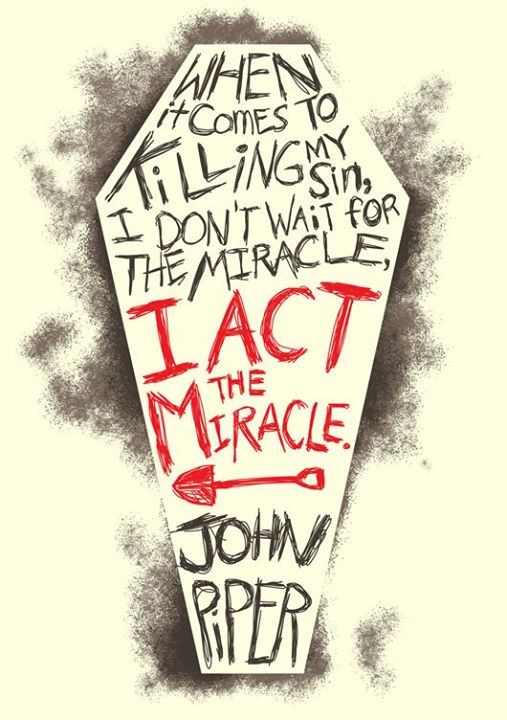
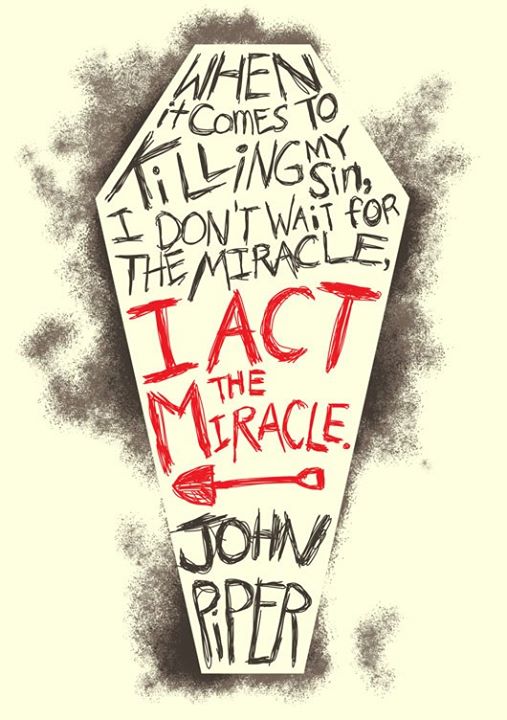
Killing My Sin, Before It Kills Me

killing-sin-act

We are for the most part anyway, eager to please God. We are Jesus’ people with the occasional brush with sin. But hey, who doesn’t? But that attitude must be questioned.

“My little children, these things I write to you, so that you may not sin.”

1 John 2:1

John hopes that his readers would make a choice— not to commit sin. After all, what soldier goes into battle with the intent of getting just a little wounded? Often we will sin just because it seems so inevitable, and we feel we can’t help ourselves. (But the reality is that we can.)

But the Holy Spirit now lives inside. Cooperation with Him is needed. Often we will work ourselves into a ‘no win scenario’ where we believe that sin rules. We can’t beat it, so we stop trying. That is common, and sad.

‘Passivity’ is defined as not participating readily or actively; inactive. When we are passive spiritually, we disengage ourselves from any effort of living holy and pure lives. Not being ‘hot’, but content to be lukewarm. At this point sin becomes, reluctantly, tolerated. “After all, I’m a sinner, what else can I do?”

Mentally ill people are often passive. We are told that we have an uncontrolled illness which dictates that we act ‘irresponsible.’ Our depression often escalates and we feel victimized by it. My experience has taught me that there are three kinds of depression:

  • organic depression, or the ‘biochemistry’ of the disease,
  • guilty depression, the kind that feels bad because of what we’ve done (or didn’t do),
  • reactionary depression, the type we feel when experiencing a loss, a loved one, or a job

Depression will almost always fall in these three categories. And passivity plays a part in all three. We  frequently feel victimized and ‘acted upon.’ When it comes to our discipleship we don’t act, we react. We are utterly convinced of the Bible— God’s truth, but we are so sporadic we can’t seem to get it to work for any length of time.

Yes, we are believers. And yes, we have issues. We’re waiting for a miracle, and hope we get a breakthrough soon.

At the base point of our lives, quite often, there is a passive attitude. Passivity aggravates our depression or mental illness. It deepens, spreading through our lives like a contagious illness. Our discipleship sputters and stalls. We no longer act on God’s Word, but we find ourselves fabricating a faith that makes allowances for our situation.

But we must ‘act the miracle.’ Everything God gives… everything… must be received by a convinced faith. We must be persuaded to give up our flawed ideas, and believe God for the real thing. I opened up this with 1 John 2:1. But there’s much more to this verse:

“My little children, these things I write to you, so that you may not sin.  And if anyone sins, we have an Advocate with the Father, Jesus Christ the righteous.”

I don’t want you to sin. Avoid sin. But even if you do— we have someone who will plead our case before God. He stands and argues our plight. He loves us that much.


bry-signat (2)

cropped-christiangraffiti1.jpg


Bridges to Burn

stevelaube.com
stevelaube.com

As a rambunctious kid I’d be told by my mom, “This is going on your permanent record!” At the time I didn’t know what that was, but it sounded really scary. I remember debating myself of whether or not such a record existed– and if it did, well, I was in deep trouble.

There is the adult version of this permanent record. It is called the conscience. And it can be a ‘hell on wheels.’ Each of us have:

  • murky attitudes
  • lousy circumstances
  • edgy emotions
  • broken reactions
  • screwy perceptions
  • subtle influences
  • sneaky prejudices

They don’t all have to be negative. As a matter of fact we have positive implications as well.

But like it or not, things get etched and colors become fast. Everything we are is a collection of past experiences. Some are godly, while others– not so much. Every decision you make determines your tomorrow. For some, this is a good thing, but a real terror for others.

“Come now, let us settle the matter,”
says the Lord.
“Though your sins are like scarlet,
they shall be as white as snow;
though they are red as crimson,
they shall be like wool.”

Isaiah 1:18

The consequences and implications are staggering. Few can live with this kind of truth. But many do come to God for forgiveness.

There is provision for our permanent record. The Word of God (the Bible) has a built-in filtering system that pulls out all the nasty stuff. Sin can build up, even in the blazing light of the Holy Spirit.

Another issue is having the guilt removed from your record by a sovereign act of God. The death of Jesus Christ wasn’t a noble act of a ‘religious teacher.’ Rather it was an atonement for our sin. At this point ‘amnesty’ is given to everyone who believes in Him.

Our permanent record has been expunged— erased, if you will. In a meaningful way, our record has been changed by God.

“If we confess our sins, he is faithful and just to forgive us our sins and to cleanse us from all unrighteousness.”

1 John 1:9

“Blessed is the one whose transgression is forgiven, whose sin is covered. Blessed is the man against whom the Lord counts no iniquity, and in whose spirit there is no deceit.”

Psalm 32:1-2

To have a clear record is a life-changing thing. To have the slate wiped clean is such a joy. God now shares His life with us, and enables us to redeem our yesterdays. Our past gets fixed by the only one who can fix it for us. Sin was never supposed to be permanent.

(Study scriptures: Ps. 32:5; 130:3-4; Acts 10:43; Eph. 2:8-9)

aabryplain


The Intensity of God’s Glory

When Moses went up on the mountain, the cloud covered it.16 The glory of the Lord came down on Mount Sinai, and the cloud covered it for six days. On the seventh day the Lord called to Moses from inside the cloud.17 To the Israelites the glory of the Lord looked like a fire burning on top of the mountain.18 Then Moses went into the cloud and went higher up the mountain. He was on the mountain for forty days and forty nights.

Exodus 24:15-18

flourish20

When we think real hard about ‘glory’ we end up gravitating to something that is invisible.  We work it out and it becomes something like honor, prestige, fame or respect.  This is a good start for us, and we do benefit from this sort of mental gymnastics.

Moses gets an invite from God to join Him on top of Sinai.  I can see Moses trembling with excitement as he climbs up into the Glory of God.  I’m willing to guess that the concept of just mere ‘invisible’ attributes was about to go through a major overhaul.  Moses entered the glory.  And nothing would ever be the same again.

Glory is a repeated experience that touched the children of Israel. 

  • First of all, during the Exodus they were led by a pillar of cloud and fire.  It protected and provided all that they needed.  All they had to do is look up.
  • Secondly, God’s glory took residence on Mt. Sinai.  There was much to do.  The Israelites commented that this glory altered the mountain top to ‘a consuming fire’.  I have been in a forest fire and it was quite intimidating; frightening is a very good description.
  • Thirdly, we see the glory of God is at the dedication of Solomon’s Temple.  We are told that the presence of God was so powerful that it temporary incapacitated the priests that were present.  It totally undid them and it laid them out on the floor (1 Kings 8:11).
  • The fourth time we see the Glory of God was at the Transfiguration in Luke 9:29-31.  Three disciples were present, and inexplicably Moses and Elijah.  But it was Jesus that took center-stage.  He seems to be the ‘focal point’ of lots and lots of glory.

I’m coming to see that glory is a whole lot more than esteem or honor.  Glory has a bolder and more intense quality about it.  Yes, it is respect and honor.  But it goes beyond this–it seems to be turbocharged with the supernatural.  I have been in revival meetings that were quite glorious. Perhaps we need to seriously look for or anticipate more of these “disturbances of glory.” (I’ve been saving this verse for the end.)

Our faces, then, are not covered. We all show the Lord’s glory, and we are being changed to be like him. This change in us brings ever greater glory, which comes from the Lord, who is the Spirit.

2 Cor. 3:18, NCV

We are simply ‘display cases’ that take in His glory and magnify it through our humanity.  It changes us to become more Christlike, and this verse seems to suggest that this keeps increasing, it doesn’t fizzle out.  And I’m thinking that this is tremendous!

aabryscript