Limits of Mental Illness

748

Mental illness is so limited,

It cannot cripple love, 

It cannot shatter hope.

It cannot corrode our faith.

It will never destroy peace.

It cannot.

It will never kill friendship, 

It cannot suppress memories. 

It cannot invade the soul.

It cannot steal eternal life.

It cannot conquer eternal life.

It cannot conquer your spirit.

Amen.

flourish2


 P.S. I have received some criticism over the contents of this post. The argument is that mental illness is very destructive, and that I’m misleading others by suggesting it isn’t. The thinking is that we dwell on the past and how it effects the present moment. I believe we have a mental illness. But I also believe more strongly so that Christ redeems us completely. “Because he lives,” goes the old hymn, “I can face tomorrow.”

In the “heat of the moment” the situation can seem overwhelming. Our illness can be completely devastating. However the Holy Spirit is yet to fully redeem us, yet we still must view this coming event as something triumphant and total. This life is not the end. What a relief to shed this mortal darkness!

“Behold, the dwelling place of God is with man. He will dwell with them, and they will be his people, and God himself will be with them as their God. He will wipe away every tear from their eyes, and death shall be no more, neither shall there be mourning, nor crying, nor pain anymore, for the former things have passed away.”

Revelation 21:3-4

1brobry-sig4


cropped-cropped-christiangraffiti1.jpg


Dismayed by My Own Fallenness

“As the Scriptures say,

“No one is righteous—
    not even one.
11 No one is truly wise;
    no one is seeking God.
12 All have turned away;
    all have become useless.
No one does good,
    not a single one.”

Romans 3:10-12

Scripture never, ever flatters the human ego.  It acts on us directly, “dividing the spirit from the soul.”  I find no glowing review of our “noble” humanity. The opposite is true.

At our deepest core, the Bible teaches that we are depraved—separated from truth and goodness.  In theology this is called, “original sin.”  (I don’t think there is really anything original about it.) There is also a concept called “contrition.”   It means, “having sorrow or sadness over sin involving making steps to amend your ways.”  Notice the definition instills a sense of action.  Perhaps the idea of penitence need a new emphasis?

Does your discipleship include the reality of you?

There are broad, generalized teachings that are woven into the Word— the iniquity and fallenness of men.  It consistently talks a seemless truth, without fail. ( That’s one of the reasons why I know the Bible is true.)  Yet the Father has made provision for our falseness and weakness, he sweeps nothing under a cosmic rug.  You might say the Scripture completely understands us, as us.  Our illusions and deceptions, blatant or subtle, do not confuse or mislead him.

Our discipleship must be “walked out” in brokenness. That is the only way it will work.

We have absolutely nothing to boast about.  I cannot point to this blog— or having been a missionary, a teacher and a pastor as my “good things.”  Today, I sat and became very aware of my inner wickedness. But because He directly intervenes in my life, I will not die in my sins like I deserve.

I am sad.  You see, I am fallen, a complete failure.  It’s easier to find water in the Sahara Desert than to find goodness in my heart.  As a matter of fact, I’ve taken evil to a new level.  I excel, and then I keep practicing it trying to squeeze out more and more power— pride— pleasure.

Those who mourn their contagiously evil hearts (Matthew 5:3-4) are the ones who God can comfort.  Our sadness over our sin (and the sin of the world)—is evidence of the Spirit’s action over our depravity. Look for it, and rest in the Spirit’s work.

“Original sin is in us, like the beard. We are shaved today and look clean, and have a smooth chin; tomorrow our beard has grown again, nor does it cease growing while we remain on earth. In like manner original sin cannot be extirpated [completely destroyed]  from us; it springs up in us as long as we live. Nevertheless we are bound to resist it to our utmost strength, and to cut it down unceasingly.” 

 ~Martin Luther

bry-signat (1)cropped-christiangraffiti1.jpg

Good Hygiene


bad_hygiene

”Wash yourselves; make yourselves clean; remove the evil of your deeds from before my eyes; cease to do evil,”

Isaiah 1:16, ESV

 ”Therefore, if anyone cleanses himself from what is dishonorable, he will be a vessel for honorable use, set apart as holy, useful to the master of the house, ready for every good work.”

2 Timothy 2:21

A Christian’s life should never be boring or mundane. For us who are disabled we are challenged in ways that others will never understand. As if normal life wasn’t enough, we’ve got issues that exceed the norms. Perhaps the most basic are areas of hygiene and cleanliness. I once went without a shower for five weeks when I was clinically depressed. (Somehow letting water pelt me seemed too violent of an ordeal.)

We are responsible for not only physical cleanliness but of a mental or an emotional one as well. I think we’d all agree on the essential need to maintain a certain level of physical health, but what can I do to stay mentally together? Are there standards there as well?

A soap dish can keep our hands clean after using the bathroom, but what of our hearts? It would seem to me that certain levels of being truly healthy apply to not just clean handsHygiene-Health but a healthy soul as well. Isaiah spoke to his generation and declared they needed a spiritual bath. The people needed to become clean again. ”Wash yourselves; make yourselves clean;”

This is a path of a ‘holy hygiene’ that we are all on. We are each responsible for keeping our hearts clean before the Lord. One of the principles of being  spiritual hygienic is that of separation from things that contaminate or defile. We are to be a distinct people. This is challenging.

Holiness is often misunderstood. It’s rare to find a believer who has something other than a legalistic idea of what it means to be holy. (This is a grievous thing.) We should be holy and loving at the same time. “A pharisee is hard on others and easy on himself, but a spiritual man is easy on others and hard on himself” (A.W. Tozer). It seems that holiness, like hygiene is not ever attained, but only maintained.

“Therefore go out from their midst, and be separate from them, says the Lord, and touch no unclean thing; then I will welcome you,”

2 Corinthians 6:17

Staying clean and becoming clean should be a realistic pursuit for the broken believer. We are to be sanitary people that can touch others without contaminating them with our personal sin. You were meant to instill holiness to others for God’s glory. The Holy Spirit can do this.

“Let it be your business every day, in the secrecy of the inner chamber, to meet the holy God. You will be repaid for the trouble it may cost you. The reward will be sure and rich.”

Andrew Murray

bry-signat (1)

cropped-christiangraffiti1.jpg

The Difference the Holy Spirit Makes

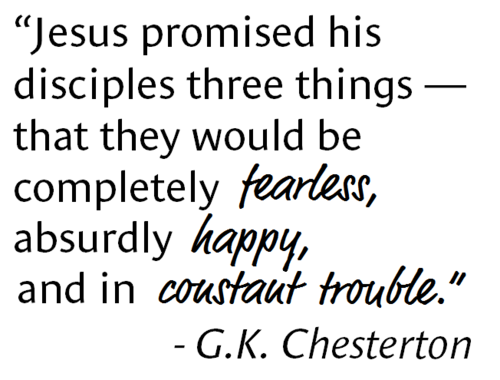
Chesterton-disciple

I like this quote. The early Church was all of these things: Fearless, happy, and very much in trouble. Luke wrote of the nascent exploits of this group of people in the Book of Acts, and while some believers will debate different aspects of theology, none can diminish the reality. These were human beings irrevocably touched by the Holy Spirit.

Some have even suggested that the title of the book be changed to “the Acts of the Holy Spirit.” (Instead of “Acts of the Apostles”).

When the fire of the Holy Spirit meets the dry tinder of the heart, it explodes into a conflagration that can’t be contained. It boils over and touches everyone around it. The disciples became fearless. Their boldness could not be diminished or diluted. They were so courageous (and contagious) that they preached to both kings and beggars.

They were “happy.” Once they had surrendered their personal ‘agendas’ they became immune to the negative issues of life. They soared with the eagles of contentment and joy. They no longer lived in the ‘mud’ of human life. They were ‘Teflon’ to that which can be so sticky. Happiness is the deep evidence of a personal contact with God’s own spirit.

But they ‘were in constant trouble.’ There may never been a people so maligned and persecuted. The apostle Paul faced daily obstacles. As the de facto leader of the church, he absorbed a lot of hatred and wrath that was focused on the early Church. Everywhere he went this darkness would descend, and each time God met him.

I suppose that we might ask ourselves, is this our experience? Am I fearless, and happy? Am I in ‘constant trouble” for the sake of the Gospel? (Do the police have my ‘mug shot?’)

Honest reflection is in order I think. We should really determine if we have the very same spirit that the early Church possessed. Whether or not, we should amend our relationship with the Spirit of God, and seek to be more tractable to His work. We start by believing the truth about our hearts and lives. The Truth is stronger than the lies.

This post was not intended to condemn. If you have read that into these words, I ask forgiveness. But reading this over, I will retract nothing. But I still ask that you ‘spiritually check’ each thought. Is it biblical, and does it glorify the Lord Jesus?

“I have told you all this so that you may have peace in me. Here on earth you will have many trials and sorrows. But take heart, because I have overcome the world.”

John 16:33, NLT


aabryscript


cropped-christiangraffiti1-3