OCD: Rituals and Obsession

“I couldn’t do anything without rituals. They invaded every aspect of my life. Counting really bogged me down. I would wash my hair three times as opposed to once because three was a good luck number and one wasn’t. It took me longer to read because I’d count the lines in a paragraph. When I set my alarm at night, I had to set it to a number that wouldn’t add up to a ’bad’ number.”

“I knew the rituals didn’t make sense, and I was deeply ashamed of them, but I couldn’t seem to overcome them until I had therapy.”

“Getting dressed in the morning was tough, because I had a routine, and if I didn’t follow the routine, I’d get anxious and would have to get dressed again. I always worried that if I didn’t do something, my parents were going to die. I’d have these terrible thoughts of harming my parents. That was completely irrational, but the thoughts triggered more anxiety and more senseless behavior. Because of the time I spent on rituals, I was unable to do a lot of things that were important to me.”

People with obsessive-compulsive disorder (OCD) have persistent, upsetting thoughts (obsessions) and use rituals (compulsions) to control the anxiety these thoughts produce. Most of the time, the rituals end up controlling them.

For example, if people are obsessed with germs or dirt, they may develop a compulsion to wash their hands over and over again. If they develop an obsession with intruders, they may lock and relock their doors many times before going to bed. Being afraid of social embarrassment may prompt people with OCD to comb their hair compulsively in front of a mirror-sometimes they get “caught” in the mirror and can’t move away from it. Performing such rituals is not pleasurable. At best, it produces temporary relief from the anxiety created by obsessive thoughts.

Other common rituals are a need to repeatedly check things, touch things (especially in a particular sequence), or count things. Some common obsessions include having frequent thoughts of violence and harming loved ones, persistently thinking about performing sexual acts the person dislikes, or having thoughts that are prohibited by religious beliefs. People with OCD may also be preoccupied with order and symmetry, have difficulty throwing things out (so they accumulate), or hoard unneeded items.

Healthy people also have rituals, such as checking to see if the stove is off several times before leaving the house. The difference is that people with OCD perform their rituals even though doing so interferes with daily life and they find the repetition distressing. Although most adults with OCD recognize that what they are doing is senseless, some adults and most children may not realize that their behavior is out of the ordinary.

OCD affects about 2.2 million American adults, and the problem can be accompanied by eating disorders, other anxiety disorders, or depression.  It strikes men and women in roughly equal numbers and usually appears in childhood, adolescence, or early adulthood. One-third of adults with OCD develop symptoms as children, and research indicates that OCD might run in families.

The course of the disease is quite varied. Symptoms may come and go, ease over time, or get worse. If OCD becomes severe, it can keep a person from working or carrying out normal responsibilities at home. People with OCD may try to help themselves by avoiding situations that trigger their obsessions, or they may use alcohol or drugs to calm themselves.

OCD usually responds well to treatment with certain medications and/or exposure-based psychotherapy, in which people face situations that cause fear or anxiety and become less sensitive (desensitized) to them.

Source: http://www.nimh.nih.gov/index.shtml

cropped-christiangraffiti1 (1)

Our View From the Tree

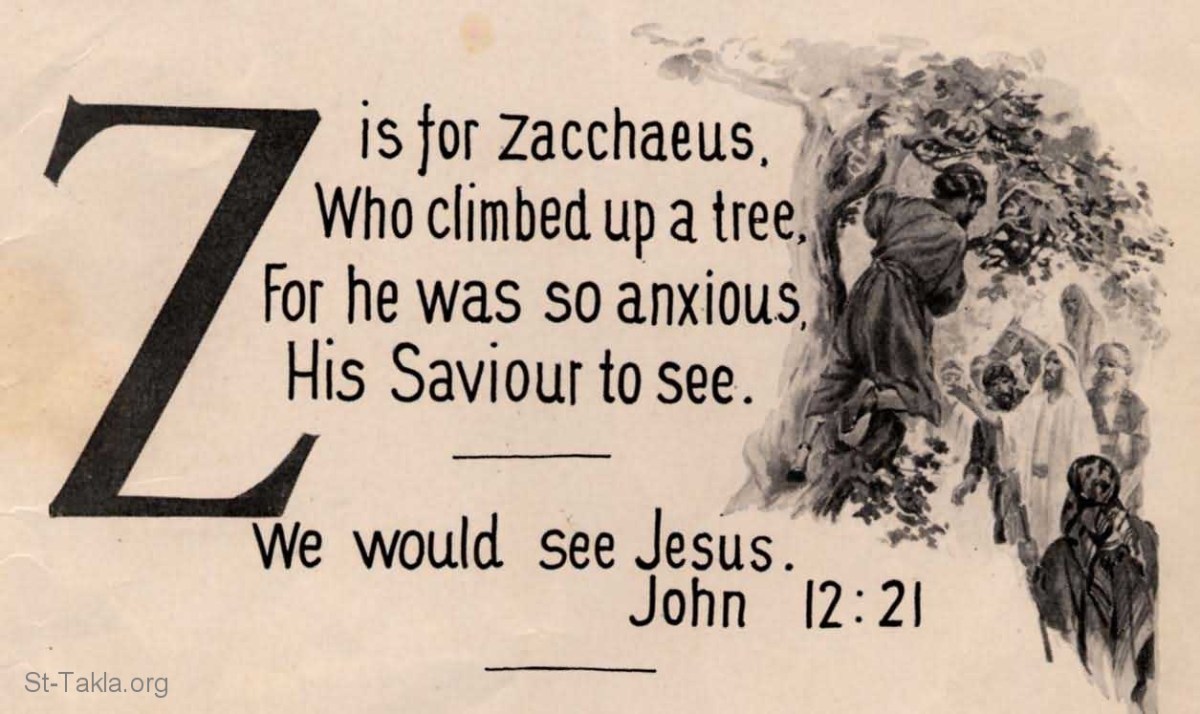
Jesus entered Jericho and was passing through. 2A man was there by the name of Zacchaeus; he was a chief tax collector and was wealthy.

3He wanted to see who Jesus was, but being a short man he could not, because of the crowd. 4So he ran ahead and climbed a sycamore-fig tree to see him, since Jesus was coming that way.

 5When Jesus reached the spot, he looked up and said to him, “Zacchaeus, come down immediately. I must stay at your house today.” 6So he came down at once and welcomed him gladly.

 7All the people saw this and began to mutter, “He has gone to be the guest of a ‘sinner.’ “

Luke 19:1-7

This particular story is one of my personal favorites.  Zacchaeus faced with the chance of missing Jesus shows his resourcefulness by running ahead.  He positions himself up in a tree that grew by a busy road.  Climbing up he placed himself where he could see Jesus.

I can see Jesus stopping under Zacchaeus’ tree, looks up and calls him to come down. “I must stay at your house today”, Jesus declares.  Now there is some serious protocol issues here.  A guest never invited himself to dinner, that just didn’t happen.  Also Jesus, as an esteemed religious teacher/prophet/messiah was supposed to set an example and not to associate with “sinners”. Rules are being broken.

There are many lessons here for the modern disciple.  We would do well to meditate on the many issues imbedded in the text.  The graciousness of Jesus is profound.  He is kind and yet assertive at the same time.

Imagine if this account was all  the New Testament we had, what would our mindset be like?  I think we’d all have to make some adjustments. To put it simply, Jesus is not normal.  He touches peoples hearts in unorthodox ways.

I think what blesses me the most is Zacchaeus’ decision to climb that tree.  He is a man who is “vertically challenged.” But basically he overcomes his liabilities when he commits to climb up into the branches.  He positions himself to see Jesus, and you can’t say a thing against that. Zacchaeus’ adventure is just now begun.

But isn’t that is what we do as Christians?  We put ourselves in a place where we can be close to him.  Think about the ‘disciplines’ of the Christian.  Disciplines like prayer, fasting, Bible study, tithing, baptism, serving and worship.  All of these are like branches on the Sycamore tree.  Ascending we put ourselves in place where Jesus is coming.  It is a way of seeing Jesus. But, that is surely enough.

When I pray, I do so in order to see Him more clearly.  

I can get it all confused and see it as an end in itself.  This is a common flaw in our thinking.  We forget that all these disciplines do is to help us see Jesus. Nothing more– just to see Jesus, and to be seen by Him.

Zacchaeus did not stay in the tree, you might say the tree accomplished its purpose when Jesus drew close.  Zacchaeus did not say, “Jesus, I have this wonderful spot, and it took ‘effort’ to get here. I think I will stay right here.” No, he didn’t just want to climb– he wanted to see Jesus.

“Sir, we want to see Jesus.”  John 12:21


bry-signat (1)
cropped-christiangraffiti1.jpg 

How Things Grow, [Work]

plow1930s

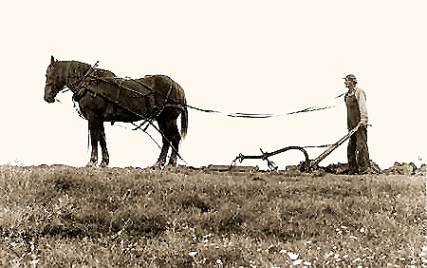
A farmer slowly walks behind his plow. The ground is hard and unyielding, but the steel cuts the heavy sod like a knife. He is preparing the soil for receiving the seed. He knows that what he is doing is imperative and he shouts out to encourage the horse. Its getting late and he wants to cut another furrow before night.

Plodding behind the plow he thinks many things. He can break up the ground, till and fertilize it, sow the seed— and then wait. He is powerless it get the seed to germinate and grow. He is limited to cultivating the soil and waiting. That is all he can really do, and he accepts this powerlessness. He can do everything right, and still not have a crop. All he can do is his part.

The farmer works in partnership with God. He is dependent on Him to grow the seed. The farmer must rely on the weather to meet and engage the planted seed. There are no shortcuts here. He does all he can, and then hopes that it is enough.

Farming is a joint endeavor between man and God. The man does what he has to do. God takes what the man has done and then finishes it. The crop will grow because He wills it. The farmer plays a part for sure, but ultimately God must become involved. Afterall, He makes the seed to sprout and grow.

We can say decisively that the pursuit of holiness in a Christian’s life is a joint endeavor between a believer and God.

Each have made the effort. The Christian does what is necessary, and then the seed is finally sown. It is then up to God to make the seed become the seedling. But each must work to finish the growth.

No one can attain holiness in their life apart from the work of preparation (it’s indeed work). The man must prepare the ground through plowing and cultivating. The farmer works the ground in order to make the ground ready. On the other hand, God provides both the environment and the growth needed to grow the seedling. Both the farmer and God must do their work.

A life of holiness is not automatic. It will never come at measured pace, trickling into our souls at a mechanized rate. (It would be nice if it would). Rather it wheat-field-landscape-picture_1920x1200_79595seems to come, in fits and spurts, sputtering rather than simply flowing.

Holiness is like a steamy Amazon jungle, vibrant and full of life. It is saturated with things living and green. It is not like an arid and sterile desert. Holiness is pulsating and powerful, full of lush growing things.

Becoming a person of holiness is the grandest adventure for the human soul. It defies our tendency to be rigid and legalistic. It is quite the opposite. It is tapping into life itself, and who is up to the task? Our morbid ideas of what holiness are not worthy of what really is.

Yes, to be holy is to work. Just as the farmer must prepare the soil for the seed, we too must guide our plows. God is ready to sow, and we should be ready to be ready. That is if we want to be fruitful and productive.

“Oh, the fullness, pleasure, sheer excitement of knowing God on earth!”

 Jim Elliot

bry-signat (1)

cropped-christiangraffiti1.jpg

Traveling Mercies, [The Journey]

Things can get pretty grim just living life.  But add a disability, and suddenly blam! It gets worse.  A mental illness intensifies life, and the weird concoction of symptoms and hospitals, therapists and medications and family/friends is a bit daunting for anyone. Imagine, that it’s a bit like running through the wilderness slathered in ‘bacon grease,’ trying to stay ahead from the bears (I’m writing this from Alaska, hence the bear imagery, lol.)

My walk with Jesus has extreme variations (at least, on my part.)  I’m up, and then I’m down.  I’m on fire and then I’m cold.  I struggle to attempt at least a modicum of consistency, wishing I could just put two ‘good days’ together.  I am ashamed by this volatility.  The apostle Peter, or David are probably the only guys in scripture I can really understand.

The impulsivity of my mental illness has driven me to turn my credit cards over to Lynn.  I try to avoid liquor stores, porn sites, and urges to strip off my clothes and run down Pioneer Avenue.  I definitely try to go to Church, read the Bible and pray.  But I have been known to hallucinate, I hear things, and get awfully paranoid.  I’m always, it seems just one step ahead of my psychiatrist in avoiding the hospital.  (And I want to keep it that way.) And suicidality is an almost real monster– always lurking for me under my bed.

But I have also learned many other things from being a mentally ill believer:

  • When its really dark, His love always comes through. He understands me. He intentionally ‘looks’ for me. He’ll never quit on me.
  • My discipleship is not about the externals of my theology, but it’s about romance from my heart.
  • In my pathetic brokenness, He is my strength and my shield. Always.
  • Worship and prayer are more like invasive “medical procedures” that keep me alive.
  • Love. I’m learning to be kinder and more aware of others then ever before.
  • I want to live in the Light and respond to others in Christlike way. Never out of my fallen sinfulness.

I suppose I could add more, if I thought about it.  Ultimately, it all comes down to the presence of Jesus Christ coming to meet me, to forgive me and to change me.  This simple blog is saturated with posts that other Brokenbelievers can wade through, and some just might help, lol.

The title of this post alludes to a quote I found. I’ve gently modified it. Not sure where I found it. But it gives the explanation for all that I’ve said:

“Life should NOT be a journey to heaven with the
intention of arriving safely in an attractive and well
preserved body, but rather to skid in sideways,
with bruises and band-aids, and some tears as well, body thoroughly used up, totally worn out and screaming… “WOO HOO what a ride!”

bry-signat (1)

cropped-christiangraffiti1.jpg