“Simon, Simon, Satan has asked to sift each of you like wheat. But I have pleaded in prayer for you, Simon, that your faith should not fail.”
“So when you have repented and turned to me again, strengthen your brothers.”
Luke 22:31-32
I’ve been thinking about failure; it is something that I am really, really good at. In my over 40 years of walking with Jesus, I realized that I’ve experienced more weak moments then strong. I have easily failed more than I have succeeded. I am embarrassed by this. I’ve sinned, and failed more as a Christian, than I ever did as a pagan sinner. And things sometimes show little sign of improving.
Simon Peter is about to undergo a trial so intense and difficult, that unless Jesus intervenes it will probably destroy Peter.
(The only other blatant attack where Satan seeks permission is in the life of Job. It is reasonable to believe that the forces of hell are concentrated on Peter.)
You and I undergo some of this onslaught ourselves. We go through periods of intense trial. Everything just falls apart, and we lose hope. I’ve had several periods like that, it’s like a tornado from hell bears down upon my life.
But there is something remarkably good in all of this.
First, Jesus is praying for me to endure. He is the faithful intercessor for my soul.
Second, He gives us a modicum of understanding by warning us of the approaching storm. Peter is told ahead of time of what was going to happen.
Third, the wheat will be sifted. Sifting or winnowing of the grain is necessary, it’s a good and godly work of the Holy Spirit. It is a good thing, as it builds your faith.
Four, you will survive to strengthen your brothers and sisters.
All pain and failure gives us a mandate to serve others. Our weakness gives us a spiritual license to become a shepherd of mercy and hope. (You could say that you are now a licensed minister.)
We can ask for nothing more; it is a good and profound work to serve others.
In love’s work, only sifted people can truly serve.
“While he was in one of the cities, there came a man full of leprosy. And when he saw Jesus, he fell on his face and begged him, “Lord, if you will, you can make me clean.”
Luke 5:12. ESV
The man is desperate. His leprosy has advanced; he is covered with it from ‘head-to-toe.’ He’s an outcast now, completely infected by something he never asked for; he is ‘unclean’ and completely without hope. There is no treatment, the doctors can do nothing. How bad can it get?
The leper knows that without the touch of Jesus, he will never be healed.
He knows it; he doesn’t need to be convinced by anyone over the hopelessness of his condition. But somehow he has heard that Jesus can do real miracles. Could it be that Jesus can heal his sickness?
The leper comes and falls on his knees before the Lord, with his face in the dirt. This man is completely broken; he has no hope, except for Jesus. What else can he do? He is with any real hope.
Our diseases differ, but our lives have been completely changed by our pain. We all have this in common.
Our pain and darkness vary. Some hurt more, some less. But we’ve all come to the place where we no longer have illusions of somehow being made whole. I sometimes think there should be a secret handshake or a password. We all share a comradeship– we’re all part of the same community.
We’re a broken club of tired and decidedly unclean misfits.
And we belong to the fellowship of pain.
Lying in the dirt, we’re starting to believe the unbelievable. Our faith doesn’t activate our healing, as much as it simply guides us to Jesus. We can kneel, and perhaps that’s all we need to do. His presence drives away the fear, the doubt, and the pain. He’s come, and somehow maybe, we begin to hope for mercy.
Only Jesus can carry us through this. Only He can do this.
I have struggled with deep dark depression. I’ve had to take meds. But when I come into Jesus’ presence, all my melancholy is driven out. He comes and I start to hope again. Am I a stellar example of perfect discipleship? I think not. But isn’t about us becoming “angels,” perhaps it’s more about us learning how to kneel, and to allow Jesus to touch our hearts.
You must do this. Repeatedly.
(Over and over and over again.)
“The power of the Church is not a parade of flawless people, but of a flawless Christ who embraces our flaws.”
“The Church is not made up of whole people, rather of the broken people who find wholeness in a Christ who was broken for us.”
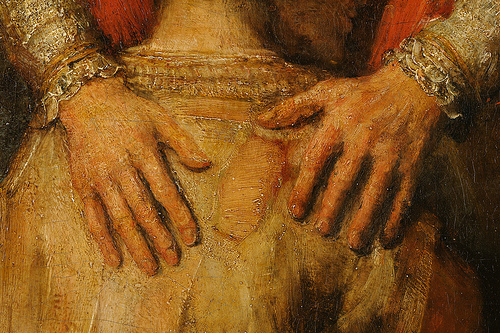
Rembrandt, “The Return of the Prodigal Son,” c. 1661
17 “But when he came to himself, he said, ‘How many of my father’s hired servants have more than enough bread, but I perish here with hunger! 18 I will arise and go to my father, and I will say to him, “Father, I have sinned against heaven and before you. 19 I am no longer worthy to be called your son. Treat me as one of your hired servants.”’ 20 And he arose and came to his father. But while he was still a long way off, his father saw him and felt compassion, and ran and embraced him and kissed him. 21 And the son said to him, ‘Father, I have sinned against heaven and before you. I am no longer worthy to be called your son.’ 22 But the father said to his servants, ‘Bring quickly the best robe, and put it on him, and put a ring on his hand, and shoes on his feet. 23 And bring the fattened calf and kill it, and let us eat and celebrate. 24 For this my son was dead, and is alive again; he was lost, and is found.’ And they began to celebrate.
Luke 15:17-24, ESV
Two hundred and eighty-nine words– these describe the life of every man, woman, and child who has ever lived. These 289 words reveal to us a God who loves far too much, way too easy. Perhaps we sort of expect that he will ‘appropriately’ punish his son– at least put him on probation at least. It only makes sense. But we find that is legalism talking.
“Every saint has a past, and every sinner has a future.”
Many of us have lived as prodigals, and we have spent our inheritance like ‘drunken sailors.’ We really have nothing at all to show for it. The prodigal, completely destitute, takes the only work he can find. (Imagine a good Jewish boy feeding hogs.)
He is so far gone that he starts inspecting the filthy slop buckets for something to eat.
Many of us will understand his despair. Often there comes to us a crystalline moment of simple awareness. The prodigal, sin-crusted and impoverished, still has a lingering memory of the Father’s house.
The servants there had far more than him right now. Sometimes I wonder if in our captivity, we instinctively want to go home, if only in our minds, to be a servant there.
The Father has dreamed of this precise moment.
The parable says, “He saw him–felt compassion–ran out to him–embraced him–and kissed him.” The Father is a whirlwind of agape love. I’ve read the Parable of the Prodigal Son a hundred times or more. It never loses its punch. I simply want to bring some observations:
We see that his father receives him with a tender gesture. His hands seem to suggest mothering and fathering at once; the left appears larger and more masculine, set on the son’s shoulder, while the right is softer and more receptive in gesture.
The son’s head is downy, almost like a newborn’s. We must enter the kingdom like little children.
The Prodigal Son seems to be protected by his father. He snuggles near the Father’s breast. It’s love that holds him there.
Consider his sandals. It has taken a long time for him to come home.
Standing at the right is the prodigal son’s older brother, who crosses his hands in stoic judgment; we read in the parable that he objects to the father’s compassion for his brother.
We see his mother in the background in the painting, and a seated steward or counselor. One stands in profound joy, the other in sits in stunned perplexity.
But Rembrandt had painted the Prodigal once before, when he was considerably younger. And it is a very good painting. The prodigal is happy and gay; there is absolutely no indication of the consequences of sin.
The Prodigal Son in the Brothel, 1635
He’s a charming young man at the height of his popularity, and we see him at a happy party. He is spending the inheritance of his father.
But Rembrandt chooses at the very end of his life to re-paint it to reflect reality.
This is one of the last paintings he will do, and it is the Prodigal Son–destitute and repenting. I can only imagine; the years have taken a toll and he doesn’t really feel his first painting is enough. He wants to paint what is true.
He now is painting our spiritual condition.
We are given a work that some critics call as the greatest painting ever completed. The painting is now in St. Petersburg, Russia. It is seldom seen by visitors. It is a clear echo of the grace of God for fallen men and women. Like the father in the painting, He’s ready to forgive every sin saturated son and daughter.
“I have refined you, but not as silver is refined. Rather, I have refined you in the furnace of suffering.“
Isaiah 48:10
“Once we have come through the ‘furnace of humiliation,’ desperately, fearfully clinging to Christ for all He is worth, then we are fully equipped to march into somebody else’s furnace.”
‘Blessed with Bipolar”
Becoming a real and authentic person starts with basic responses that we’ve made in the presence of Jesus. Amazingly, this simple faith becomes the prerequisite, granting us the right to enter. However, without faith in those promises, you won’t find anything real or true.
You will not be able to handle the Kingdom of God unless you’re walking out a life of brokenness and humility.
I believe that only the heat of the furnace can teach us these things.
There are furnace promises, but they, without truly understanding them will walk around in unreality. Often ‘they get religion.’ These are those who land on “the rocky soil.” They become ‘quasi-disciples’ who will do and say things that they really don’t really understand.
But furnace people have the connection to that which is honest and true. They rarely enter into anything false or manipulative. Their own hearts are transformed by the fire, and only then are qualified to minister God’s grace. Only furnace people can enter in. You will know them by their scars.
The Church has a tremendous need for those who have withstood the furnace of humiliation.
After we endure its ugliness and its great evil, we’ll discover that we’re in an altogether different place than when we first started. The Church is waiting for those who went in and then come out on the other side.
Furnace people have the ability to function gracefully at this particular stage.
Furnace people are brought to a place where they can minister the grace of God into desperate situations. We must convince ourselves, that furnace people have a gift. They have been through the worst. They may be battered and bruised. But they still stand.
Our brothers and sisters have carried the Word with wisdom and grace. They come to us, through the fire. But will we receive them?
My hope is that you would personally grasp what God has worked in you. That really is your truest calling. The things good or bad, that have happened to you are part of how you’ll understand grace. He waits for you to respond. Will you come to Him, through the grace you find in the flames?
The most gracious people you’ll ever meet are those who endured God’s furnace.
“The furnace of affliction is a good place for you, Christian; it benefits you; it helps you to become more like Christ, and it is fitting you for heaven.”