This poem was written for someone I love who struggles with bipolar disorder. Though I have suffered through depression, anxiety, and panic attacks, I can never truly understand her pain. I want to help but I am at a loss as to what to do.
I wanted to share this here so those who suffer from mental illness might know how your suffering breaks the hearts of those who love you but don’t know what to do.
A Broken Heart of Love
This searing pain in my heart I wish it would go away I pray for it to leave me But it is love I would be hollow without it
I watch you drowning in a sea of turmoil and fear I reach out my hand, the one connected to my broken heart “It’s okay, the sailing’s fine,” you say
I walk away, thinking perhaps my eyes deceive me and you are not drowning, or else why would you say otherwise? I know you would not lie
But still this pain deep down inside my aching heart reminds me that you are not fine, the sea is not calm
The storm rages but I cannot rescue you You cannot see my hand reaching through the darkness beckoning you to dry land
1. Do not expect too much from yourself too soon, as this will only accentuate feelings of failure. Avoid setting difficult goals or taking on ambitious new responsibilities until you’ve solidly begun a structured treatment process.
2. Break large tasks into small ones, set some priorities, and do what can be done, as it can be done.
3. Recognize patterns in your mood. Like many people with depression, the worst part of the day for you may be the morning. Try to arrange your schedule accordingly so that the demands are the least in the morning. For example, you may want to shift your meetings to midday or the afternoon.
4. Participate in activities that may make you feel better. Try exercising, going to a movie or a ball game, or participating in church or social activities. At a minimum, such activities may distract you from the way you feel and allow the day to pass more quickly.
5. You may feel like spending all day in bed, but do not. While a change in the duration, quality and timing of sleep is a core feature of depression, a reversal in sleep cycle (such as sleeping during daytime hours and staying awake at night) can prolong recovery. Give others permission to wake you up in the morning. Schedule “appointments” that force you to get out of the house before 11 a.m. Do this scheduling the night before; waiting until the morning to decide what you will be doing ensures you will do nothing.
6. Don’t get upset if your mood is not greatly improved right away. Feeling better takes time. Do not feel crushed if after you start getting better, you find yourself backsliding. Sometimes the road to recovery is like a roller coaster ride.
7. People around you may notice improvement in you before you do. You may still feel just as depressed inside, but some of the outward manifestations of depression may be receding.
8. Try not to make major life decisions (such as changing jobs or getting married or divorced) without consulting others who know you well and who have a more objective view of your situation.
9. Do not expect to snap out of your depression on your own by an exercise of will power. This rarely happens. Many churches and communities have depression support groups. Connect with people who understand depression and the recovery process.
10. Remind yourself that your negative thinking is part of the depression and will disappear as the depression responds to treatment.
Here are things I’ve heard over the years that we must take a second look at. Here are some possible answers.
“There must be something wrong with your spiritual life.”
Yes, depression CAN be a result of sin. BUT depression is NOT always a result of sin! If it is, God will tell you loud and clear what the problem is. This saying piles on the guilt for the depressed Christian. It’s unlikely that their depression has a spiritual cause, and this implies that they are not good enough spiritually.
“Repent and ask forgiveness for your sin!”
Depression is a result of sin, in that if there was no sin in the world depression wouldn’t exist. But then, neither would diabetes, cancer, or any other illness… Sin caused the world to be not-perfect, therefore illness exists. It’s a sin to be depressed, any more than it is to have any other illness. Depression can be used by God to encourage repentance, but in that case, it will be crystal clear exactly what sin you should repent of. If you don’t know or have just a vague sense of guilt, your depression is not the result of sin.
“You need to have more faith.” or “Have faith in God.”
Hebrews 11:1, “Now faith is the substance of things hoped for, the evidence of things not seen.” How much faith does it take to hold onto the Christian faith when emotions scream at you daily to give up, get out and turn against God? Very often a depressed Christian will be hanging onto faith by their fingernails in something that requires a ton of faith.
“Taking antidepressants is playing God, He can heal you.”
Yes, God can heal. Sometimes he doesn’t just flick a switch to make the illness vanish, sometimes the healing comes through the conventional ways of doctors, psychiatrists, counselors, therapists, and medication. By persuading someone not to take their medicines in preference for a quick, supernatural healing that God may not have in store for them, the sufferer is being denied something that will help them, right now.
“Scripture says everything that happens is for your own good!”
The actual verse found in Romans 8:28, “And we know that in all things God works for the good of those who love him, who have been called according to his purpose.” This verse in no way implies that the sufferer should sit back and accept the illness for the rest of their life. It also does not say that illnesses are not to be fought with the intention of a cure. While God may well have things to do with a depressed person, the illness is not a good thing itself, and it may take years before you see positive results from it.
“You’ve been prayed for, why has nothing changed?”
This can be expressed in several ways and spoken by one of two different groups of people: either the person who asked for prayer or those who prayed for them. We’ll break the underlying situation into two areas: something definite was experienced in the prayer time: chains were obviously broken and new freedom gained, or, nothing apparently happened at all. That is, “I know God set you free,” why aren’t you free yet?
“Depression is a self-discipline problem.”
Self-discipline is important to a Christian. We have to be disciplined enough not to break the laws of the land, and to obey our God. But no amount of discipline will get rid of a medical problem. This statement implies that the sufferer is lazy and could become better by sheer force of will. This is not possible and causes a lot of guilt.
“You’re depressed because you choose to be.”
Why would anyone choose depression? It is hell on earth. It destroys everything it touches. Families, marriages, jobs, churches, and ministries- faith, peace, hope, and love. Depression corrodes all that it touches.
Does a diabetic or cancer patient choose their disease? Does the blind or the deaf person wake up in the morning and decide they aren’t going to keep being handicapped? These are the questions I would ask.
“You just need to rebuke that spirit of depression and tell it to leave you. Don’t let Satan steal your joy.”
There are two problems with this statement. One problem is the assumption that depression is caused by demonic oppression. The other problem is the assumption that joy and happiness are the same things. Blaming a “spirit of depression” can be a wonderful cop-out. Just cast out the spirit and you’re cured! No need for long-term support, prayer, counseling, or anything at all! And with this statement comes the implicit assumption that once again it’s your fault you’re depressed, this time because you’re not “spiritual” enough to get rid of the troublesome spirit yourself.
Yes, it is possible that demonic oppression can cause depression. No, demons are not responsible for every case of depression. Imagine what would happen if this statement was directed at someone with cancer, hemophilia, or osteoporosis (“Just cast out that demon attacking your bones and be strong again! God wants to see you running marathons!”).
The second problem with this statement is that joy is equated with happiness. People with depression are not going to be the happiest souls in the church. I’ve heard it said that happiness depends on what happens, whereas joy can exist in very unhappy situations.
“There’s no such thing as mental illness, it’s all in your mind”
Saying this denies that there is anything actually wrong with the depressed person, and implies that they are just making it up. This piles on the guilt again! A mental illness can be defined as one that affects the mind; the brain is allowed to get ill, just as the liver and lungs are.
“It’s your own fault you’re depressed”
This is the kind of thing that Job’s “comforters” said, and it didn’t help then either. Bad things can happen to good people. Denying this hurts the sufferer.
“Pull yourself together”
If you’ve been trying, someone saying this to you comes across as “You haven’t been trying hard enough, do more, and more, and more until you get it right.” So back you go, pushing more and more, and still getting nowhere because you cannot pull yourself out of depression by your bootstraps, and you can’t fix a medical problem by force of will.
Difficulty and pain sometimes come from others, and challenges to the Lordship of Jesus often come from our unique circumstances.
But what if it was something we’ve done?
I remember the classic picture of a Buddhist monk who sat in the middle of a street. He was serene as he soaked himself with gasoline, and lit himself on fire as a protest against a war he believed was wrong and evil. He burned himself in front of the cameras.
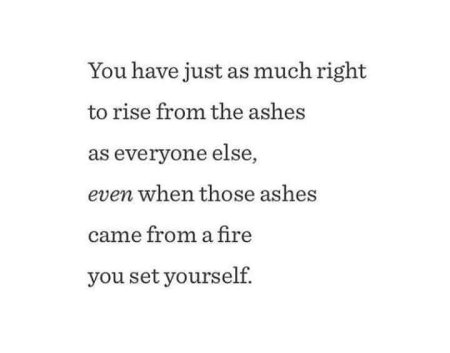
All too often we’re pretty much responsible for our own self-immolation. It is we (and we alone) that set ourselves ablaze. Sin affects our minds and hearts. We set ourselves on fire.
When we sin– when we walk in ‘known’ disobedience we always put ourselves in an awful place. We love it but learn to hate it too. But we continue to do it regardless of the awful death that ensues.
God promises to forgive us. Out of our ashes, He keeps bringing us life and hope.
You can be forgiven. You can find life again, even if you’re fully responsible for the evil we’ve done to yourself. Yes, we all sin, and yes we walk in our own personal rebellion. But Jesus knows it all. These awful things we’ve all done can be forgiven.
As a man and a preacher of the Gospel, I realize that I often choose to sin. In spite of all I know and teach I realize that I can live in the ashes of my own making. As one who also struggles with bipolar, I understand that I’m even more susceptible to doing awful things. I understand that I choose darkness even though others will call me “a man of God.”
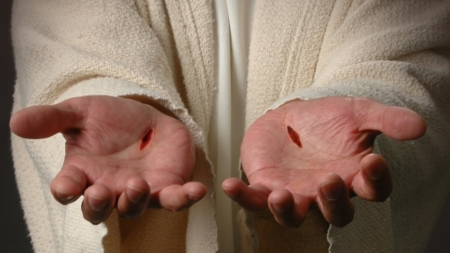
As you read this I’m praying that you find His forgiveness and mercy. You’ve come a long way it seems, but you must see His blood that was ‘released’ from His veins and arteries for you.
He desperately loves you–even if you’ve set yourself on fire, and sit in the ashes of your doing.
“To appoint unto them that mourn in Zion, to give unto them beauty for ashes, the oil of joy for mourning, the garment of praise for the spirit of heaviness; that they might be called trees of righteousness, the planting of the Lord, that he might be glorified.“









 Broken Believers