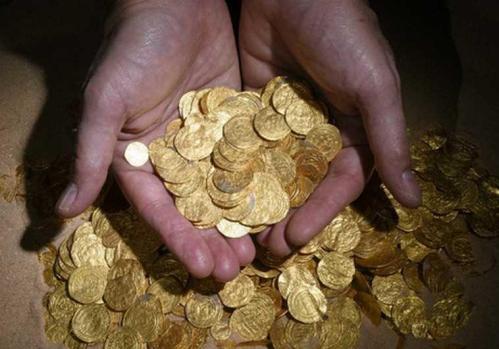
The Treasure Hidden Inside the Church

treasure-found

As Christians, often our Church and our theology tell us that mental illness, depression, and bipolar disorder have no place in a believer’s life.

As a result, we end up hiding and sneaking  into sessions with our therapists, and direct the conversation to minimize our exposure to any direct questions. In one way, we are the new “lepers of the Church.”   But I would like to suggest to you that it is we who may be closest to the Kingdom of God.

From a certain viewpoint, it is easier for us to approach the Father– in our brokenness, humility, and lostness.  And yes we have needs– a sound mind, a healthy body and we know it. But we have no illusions of wellness– nothing can convince us that we are well.  We know we are not.  We know we are broken and only our loving creator can mend us.  

You should think and say that the Church needs us.  An Archbishop was given an ultimatum by the Huns who surrounded his cathedral. “You have 24 hours to bring your wealth to these steps”, the war-leader declared.   The next morning the Archbishop came out leading the poor, the blind, the lame, and the lunatics.  “Where is your treasure?  Why have you brought out these, people?”  The Archbishop said this, “These are the treasures of the Church, these who are weak are our valuables.  They make us rich.”

I’m afraid the the Western Church no longer sees its “treasures” or wealth like it should.  We have let the ‘government’ pick-up the burdens of health care.  We have tried to operate our churches like successful businesses and definitely have no room for the desperately weak. The mind-set is routine and predictable–that “they only take, and never give.”

But the handicapped have much to teach the Church.

We the weak are ‘sprinkled’ by the Lord into each local church (each church has one or two.)  We are not victims of our illness or addiction.  We admit we are the ones so broken that everyone has given up on us. But we have reached out, and touched the hem of His garment. “And in love’s service, only the wounded can serve.”

 My plea is directed to the local churches, and their leadership. You must decide what you are going to do with us, the handicapped. Will you accept us– and we are many? But we do admit and insist that we should not trivialized or diminished. We often have discovered grace in a way you haven’t, we have been loved in a way that you can only dream.

“It’s not about perfection; it’s about our intimacy with God, or our connection, our relationship with God. Once we get through that, once we realize that we can be imperfect, flawed, broken; those kinds of things are the ingredients of spirituality.”

–Mike Yaconelli
cropped-christiangraffiti1-2

*

“Without Your Wound, Where Would Your Power Be?”

The subject of “the pool at Bethesda” alludes to the following excerpt from the Thorton Wilder play “The Angel that Troubled the Waters”. The play is based on the biblical verses of John 5:1-4, but it changes the end of the parable.

I first encountered this excerpt within the book “Abba’s Child: The Cry of the Heart for Intimate Belonging“, by Brennan Manning.

The play tells of a physician who comes periodically to the pool of Bethesda, hoping to be the first in the water and healed of his melancholy when the angel appears and troubles the water. Everybody at the pool also hopes to be the first in the water and thereby healed of his malady. The angel appears but blocks the physician at the moment he is ready to step into the pool and be healed.

Angel: “Draw back, physician, this moment is not for you.”

Physician: “Angelic visitor, I pray thee, listen to my prayer.

Angel: “Healing is not for you.”

Physician: “Surely, surely, the angels are wise. Surely, O Prince, you are not deceived by my apparent wholeness. Your eyes can see the nets in which my wings are caught; the sin into which all my endeavors sink half-performed cannot be concealed from you.”

Angel: “I know.”

……………… A long pause

Physician: “Oh, in such an hour was I born, and doubly fearful to me is the flaw in my heart. Must I drag my shame, Prince and Singer, all my days more bowed than my neighbor?”

Angel: “Without your wound where would your power be? It is your very sadness that makes your low voice tremble into the hearts of men. The very angels themselves cannot persuade the wretched and blundering children on earth as can one human being broken on the wheels of living. In Love’s service only the wounded soldiers can serve. Draw back.”

Later, the person who enters the pool first and was healed rejoices in his good fortune then turns to the physician before leaving and said:

“But come with me first, an hour only, to my home. My son is lost in dark thoughts. I — I do not understand him, and only you have ever lifted his mood. Only an hour . . . my daughter, since her child has died, sits in the shadow. She will not listen to us but she will listen to you.”

………………………………………

For me, this story is quite exceptional, probably because the message of this excerpt—“Without your wound where would your power be?“—carries so much meaning for me, as this has taught me that through my weakness I can see others.  I believe that for us,  it should be our whole philosophy of ministry.

The depressed physician ministered out of his brokenness.  He parallels the way the Apostle Paul did his work “out of much suffering.”  Just something to think about.

This is a Broken Believers classic post.  It is shared again with the steady hope that it will encourage you and strengthen you in your walk with Him.

*******

ybic, Bryan

cropped-christiangraffiti1 (1)


Yield to God

 I read a story about a radio exchange that took place some time ago between a U.S. Navy ship and Canadian authorities off the coast of Newfoundland. The Canadians warned the Americans and the conversation went something like this: “Please divert your course 15 degrees to the south to avoid a collision.”

The Americans responded, “Recommend you divert your course 15 degrees to the north to avoid a collision.”

The Canadians said, “Negative. You will have to divert your course 15 degrees to the south to avoid a collision.”

The Americans: “This is the captain of a U.S. Navy Ship. I say again, divert your course.”

“No. I say again, you divert your course.”

“This is the aircraft carrier USS Lincoln, the second largest ship in the United States Atlantic fleet. We are accompanied by three destroyers, three cruisers, and numerous support vessels. I demand that you change your course 15 degrees north. I say again, that is 15 degrees north or countermeasures will be undertaken to assure the safety of our ship.”

After brief moment of silence, the Canadians responded: “This is a lighthouse. It is your call.”

Sometimes we don’t like what God wants us to do, and we want Him to change course when, in reality, it is us who ought to change course.

We need to understand that God’s plans are better than ours. Having said that, it does not mean that they are always the easiest or even the most appealing at the moment. There are times when we are going through life that we might not like the plan of God. But God’s plans are always better for us in the long run.

“My thoughts are nothing like your thoughts,” says the Lord.
    “And my ways are far beyond anything you could imagine.

Isaiah 55:8, NLT

Can you say, “Yes, Lord. I am Your servant. Take me, use me, spend me. Fulfill all Your holy, eternal purposes in and through my life, whatever the cost”?

That area you have insisted on controlling, that part of you you’ve just stubbornly refused to yield, where you have insisted on things being your way – it’s time to drop your sword and raise your white flag. It’s time to surrender.

Those of us with a chronic illness can find many of their issues can be resolved by this simple act of yielding to God. There will be aspects that linger, but much peace of heart and mind will can come through a quiet release of your will to Him.

 bry-signat (2)
flourish31

Righteousness: His, Yours? (or Ours?)

“All of us are dirty with sin.
All the right things we have done are like filthy pieces of cloth.
All of us are like dead leaves,
and our sins, like the wind, have carried us away. “ 

Isaiah 64:6, NCV

________________

I have this reoccurring nightmare. I jump out of a plane.  I deploy my parachute, and it opens.  But it is completely full of holes!  Yikes!  I wake up before I splat. And then I think in a spiritual sense— what a relief it is to have a holiness that is given, or imputed.  If somehow you could turn off the spigot of the holiness he gives, and then run on your own merits; how far would you go?

Among good Christian people, there is an occupational hazard of sorts, and that is to “advance” in our thinking to that place where we are doing fine on our own.  We very much appreciated Jesus’ help– but now, at this moment, I must figure it out by myself.  This line of thinking, is called “self-righteousness.”

“Many have passed the rocks of gross sins – who have suffered shipwreck upon the sands of self-righteousness.” 

William Secker:’The Consistent Christian,’ 1660

We begin to travel in our sense of ourselves, away from a desperate, clinging to a trust in his mercy that is moving to a place of a confident, strutting awareness of having put ourselves back together again.  This is the ‘evil ones’ work– to steer you into self-righteousness.  Once you get there, he can just release you and let you ‘stew in your own juices,’ while he rules over your soul.

Becoming self-righteous should scare us to death.  It will damn our souls just as quick as adultery, or murder.  It is evil, and it sedates us to the place where it can work, unhindered and unchallenged.  I’ve read that some predators inject first an anesthetic to soothe their prey. This enables them to take their time, as they slaughter them.

I have had several bouts with self-righteousness.  (And I bet I’ll have several more.)  It is sin that will give you a wonderful back massage, just before it reaches for the knife that will cut your throat.  Somehow, we are lulled into this and my! I’m such a good person (even after such a dark and evil start.)

“Self-righteousness is the largest idol of the human heart – the idol which man loves most and God hates most. Dearly beloved, you will always be going back to this idol. You are always trying to be something in yourself, to gain God’s favour by thinking little of your sin, or by looking to your repentance, tears, prayers ; or by looking to your religious exercises, your frames, etc; or by looking to your graces, the Spirit’s work in your heart.”  

–Robert Murray McCheyne

 Jesus was, and is, and will be all my “righteousness.” 

We must cling to these hand-holds of grace.  The waves are substantial, and we most certainly would be swept out to sea.  But we grab and hold on to him.  And he holds on to us!  The fantasy of having enough of my own created righteousness to please God is simply a crock.  Jesus was, and is, and will be all my “righteousness.”  I have nothing– nothing else.

 bry-signat (1)

cropped-christiangraffiti1.jpg