Don’t Waste Your Sorrows


062_dont_waste_your_sorrows

These little troubles are getting us ready for an eternal glory that will make all our troubles seem like nothing.”

2 Cor. 4:17, CEV

“Before God could bring me to this place He has broken me a thousand times.”                                   

Smith Wigglesworth


As we move toward maturity, over time and through circumstance, we will start to develop exciting new ways of thinking.  We engage the Word and combined with our relationships with people we start the work of God.  We soon learn that the Kingdom of God flows through relationships, almost exclusively.

Pain and sorrow are some of the more intense ways the Lord reaches down and into our lives.

Rick Warren has written, “God intentionally allows you to go through painful experiences to equip you for ministry to others.” 


I think that as we dwell on this we will start to see the hand of God, moving things around in our complicated lives.  As we attend class in this school of the Spirit, we learn things that will change our life and ministry.

But we must consider that we can waste our pain and sorrows by not engaging the issues properly.  Will I submit, or will I grow sullen and cynical? Will I worship through my tears?  Surrendering to Christ is not a once-in-a-lifetime event.  It is a daily, and even hourly process.  I regard any kind of cynicism though, as a hungry predator who is hunting me.  Very dangerous, and I am highly suspectable.

Pain is the way the Father reaches me, he isn’t too concerned about our comfort (it isn’t the real issue, after all.)  When I hurt, I invaribly look for Jesus.  And that cannot be all bad.  Through the trials and pain I begin to reconnect with my Father.  Without the trials, I doubt we would ever call out for His help.

“Don’t waste your sorrows.”  It is easily said but seldom done.  We start to stagger by the weight of our personal issues.  Overwhelmed by the pain we start to panic and grab things, and throw them overboard, to lighten the load.  We can be confused, and will do whatever we must do to stay afloat.  But unless we take these sorrows well, we are just short-circuiting God’s intentions.

C.S. Lewis once commented on our issues,

“Experience: that most brutal of teachers. But you learn—my God do you learn.”

The darkness intends to absorb us.  Satan uses our own bitterness and frustration to do this.  Our discipleship is no longer valid if we commence doing our own will and desires.  Even though we get “flaky” the Father will always love us. But we dare not waste our pain, it comes at too big of a price.

bry-signat (1)

cropped-christiangraffiti1.jpg


Jesus Is Light in My Darkness

LightinMyDarknessI have been so blessed to have Bryan Lowe allow me to share my thoughts and poetry here at Broken Believers. It’s a blessing I never would have known if not for the many years I spent suffering from major clinical depression. I love how God uses our suffering to shower us with blessings.

But I know that when in the midst of suffering that truth is difficult, if not impossible, to see. I believe that is why He has inspired me to write the poetry I have written and to publish it in a book called Light in My Darkness: Poems of Hope for the Brokenhearted. This book is now available at Amazon.com and you can even “Look Inside”

I am especially excited about this book because my son created the cover for me with original art. I shared with him my idea for the cover, read him a few of the poems, and he took it from there.

I also want to take a moment to thank Bryan for writing the foreword and to share here what he wrote:

“Never underestimate the sheer power of poetry. It is formidable. Linda knows this, and she has compiled this book from direct experience. And that is remarkable. I hope you’ll read this with an inquisitive heart and an eager mind. Good poetry should carry a weight of truth wherever it might lead. All that it requires is all of you. Poetry requires your full attention, at least to appreciate it fully.

Linda honors God in what she has written. I know her intention is to bring Him glory, and she does it fearlessly. What you read here comes from life’s furnace— things will be imparted through these poems. I pray the Lord’s blessing on this little book.

Read this book. Squeeze out the truth each poem has. I know that the author would appreciate it immensely.”

And he’s right—I would appreciate it. But even more importantly, I would love to know that those who read my poetry are blessed to find God’s Light in their darkness.


aasignLinda

You can find Linda’s website at http://lindakruschke.wordpress.com/


cropped-christiangraffiti1.jpg

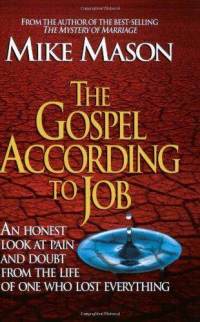
The Gospel According to Job

Today, I want to bring out this book, out into the spotlight.  It is a tremendous devotional that makes its way through the book of Job.  I have leaned on it, and it has held me nicely.  I challlenge you to get a copy of this, and to let it work in the confines of your spirit and mind. ––Bryan

A

Excerpt from “The Gospel According to Job,” by Mike Mason


“An Honest Look at Pain and Doubt from the Life of One who Lost Everything”

_______________________

A“Once I met a man who, like Abraham, had moved his entire household halfway around the world on the strength of a vision from God. When I asked him to tell me the story, he answered that there were three versions of that story, and which one did I want to hear? First, there was the version of the story that he told to Christians. Then there was the version he told to non-Christians. Finally, there was the truth. Job is a book that tells things from the third point of view. Probably, along with Ecclesiastes, it does this better than any other book in the Bible.

Not that the other Scriptures do not tell the truth. But Job tells the truth in a way that makes it almost impossible to pervert the truth into pious pabulum. A few years ago I went through a difficult time. Never mind what the problem was. It was nothing compared to the trials of Job. In fact, it was nothing at all compared to the sufferings of many of my neighbors right there on the quiet street where I lived.

But pain is pain, and suffice it to say that my pain was enough to drive me to my knees, totally defeated, half-crazy at times, and crying out for relief. Month after month the battles raged on, thick, dark, agonizing. I prayed, but somehow prayer did not ‘work.’ Usually nothing at all worked, except lying low and gritting my teeth until, for reasons entirely obscure to me, the straightjacket of oppression began to loosen a little––at least enough for me to get on with my life for another day or so before the screws tightened again. What else could I do? How was I to fight this?

In retrospect I can see that a large part of my anguish was rooted in the fact that there really was nothing I could do to control what was happening to me. I was absolutely helpless, and it is this, perhaps, that is the soul of suffering, this terrifying impotence. It is a little taste of the final and most terrifying impotence of all, which is death.

We Christians do not like to think about being absolutely helpless in the hands of our God. With all of our faith, and with all of His grace, we still prefer to maintain some semblance of control over our lives. When difficulties arise, we like to think that there are certain steps we can take, or attitudes we can adopt, to alleviate our anguish and be happy. Sometimes there are. But anyone who has truly suffered will know that when it comes to the real thing there is no help for it, no human help whatsoever.

Simply put, when we are in a deep dark hole we cannot think our way out; neither can we hope, sing, pray, or even love our way out. In fact there is absolutely nothing either we or anyone else can do to better our situation. We can have faith, yes; but in itself faith will not change anything. Neither faith, nor any other good thing that a person might have or do, can actually lift the cloud, move the mountain, or bring about an end to the problem.

Only the Lord Himself can do that, and when He does, as Exodus 6:6 puts it, “Then you will know that I am the Lord your God, who brought you out from under the yoke.” How will we know? Simply because nothing and no one else could possibly have done it. In this kind of crucible, therefore, we come to a new understanding of what it means to be saved, what it means to be snatched away from the brink of destruction.

Here we get down to the bedrock of the gospel. During my night of anguish, I turned to the book of Job, and there I began to make contact with the gospel in a way that somehow I never had in studying the New Testament. Reading Job, I found myself experiencing in new and astonishing depth the reality of Jesus’ promise in John 8:32,

 “You will know the truth, and the truth will set you free.”


cropped-christiangraffiti1.jpg

“Without Your Wound, Where Would Your Power Be?”

The subject of “the pool at Bethesda” alludes to the following excerpt from the Thorton Wilder play “The Angel that Troubled the Waters”. The play is based on the biblical verses of John 5:1-4, but it changes the end of the parable.

I first encountered this excerpt within the book “Abba’s Child: The Cry of the Heart for Intimate Belonging“, by Brennan Manning.

The play tells of a physician who comes periodically to the pool of Bethesda, hoping to be the first in the water and healed of his melancholy when the angel appears and troubles the water. Everybody at the pool also hopes to be the first in the water and thereby healed of his malady. The angel appears but blocks the physician at the moment he is ready to step into the pool and be healed.

Angel: “Draw back, physician, this moment is not for you.”

Physician: “Angelic visitor, I pray thee, listen to my prayer.

Angel: “Healing is not for you.”

Physician: “Surely, surely, the angels are wise. Surely, O Prince, you are not deceived by my apparent wholeness. Your eyes can see the nets in which my wings are caught; the sin into which all my endeavors sink half-performed cannot be concealed from you.”

Angel: “I know.”

……………… A long pause

Physician: “Oh, in such an hour was I born, and doubly fearful to me is the flaw in my heart. Must I drag my shame, Prince and Singer, all my days more bowed than my neighbor?”

Angel: “Without your wound where would your power be? It is your very sadness that makes your low voice tremble into the hearts of men. The very angels themselves cannot persuade the wretched and blundering children on earth as can one human being broken on the wheels of living. In Love’s service only the wounded soldiers can serve. Draw back.”

Later, the person who enters the pool first and was healed rejoices in his good fortune then turns to the physician before leaving and said:

“But come with me first, an hour only, to my home. My son is lost in dark thoughts. I — I do not understand him, and only you have ever lifted his mood. Only an hour . . . my daughter, since her child has died, sits in the shadow. She will not listen to us but she will listen to you.”

………………………………………

For me, this story is quite exceptional, probably because the message of this excerpt—“Without your wound where would your power be?“—carries so much meaning for me, as this has taught me that through my weakness I can see others.  I believe that for us,  it should be our whole philosophy of ministry.

The depressed physician ministered out of his brokenness.  He parallels the way the Apostle Paul did his work “out of much suffering.”  Just something to think about.

This is a Broken Believers classic post.  It is shared again with the steady hope that it will encourage you and strengthen you in your walk with Him.

*******

ybic, Bryan

cropped-christiangraffiti1 (1)